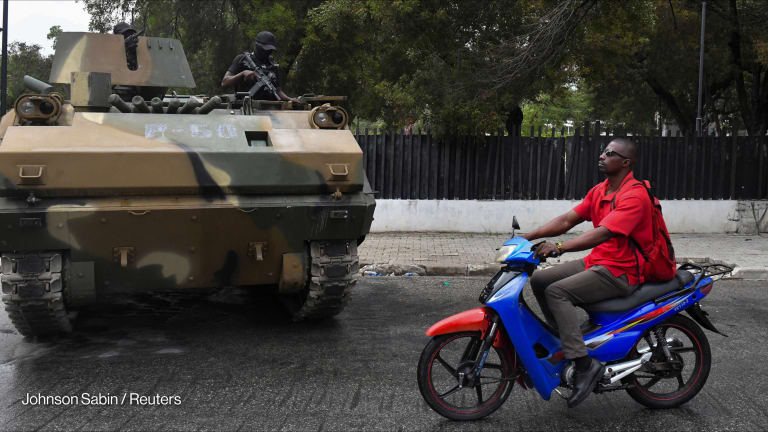



Haiti is spiraling into humanitarian and security collapse. The United States’ top diplomat to the island nation says the U.S. should focus exclusively on the latter before considering the former.
Also in today’s edition: Philanthropic funders say they’re stepping up in this time of dwindling aid. But does the rhetoric line up with the reality, especially for newcomers?
Secure in their thinking
Henry Wooster summed up what the United States wants from Haiti in one word: stability.
“We define that as (A) no collapse of the state and (B) no mass illegal migration onto U.S. shores. Everything we do to implement the president’s Haiti policy is anchored to that singular objective,” the State Department official told lawmakers on Capitol Hill this week.
He admitted Haiti was engulfed in a humanitarian catastrophe — the worst in decades — but said humanitarian aid should not be the priority. Rather, security should be.
Both Wooster and Austin Holmes, CEO of the Caribbean Security Group, pushed lawmakers to invest in a security-first approach with “humanitarian corridor” carve-outs. Holmes also argued that public-private partnerships and faith-based organizations — such as Mission of Hope, which he chairs — should take center stage, my colleague Elissa Miolene writes.
“I believe there’s a model, sir, that’s far more effective than what we’ve currently been using,” said Holmes. “I’m not asking you to create anything that doesn’t exist already. I’m inviting y’all to expand it.”
Holmes also advocated for Christian aid organizations Samaritan’s Purse, Feed My Starving Children, and Food for the Poor to deliver aid via the aforementioned humanitarian corridors.
“I’m representing that coalition here today with a public-private partnership model that frankly can be far more cost-effective in its response and capability because it has a far deeper cultural understanding of Haiti,” he said.
Where that would leave other aid groups is unclear. Moreover, humanitarian corridors have a mixed reputation, providing much-needed shelter and aid on the one hand, but only a narrow slice of it that could be vulnerable to military attack or prevent a more comprehensive ceasefire from taking hold.
But for Wooster, the debate over providing humanitarian assistance doesn’t even matter if you don’t tackle the paramount issue of security.
“Let me be very blunt: If we don’t have security, the other issues that we might be able to talk about today are materially relevant only in the sense that they are academic concerns,” Wooster said. “If we don’t have security, if that’s not established, nothing else can flow in the rest of the country.”
Read: As Haiti collapses, US doubles down on security over aid
Cut off at the knees
49.2%
—That’s the percentage of young people aged 15 to 35 in Zimbabwe not engaged in education, employment, or training. There were green shoots, thanks to a small U.S. government grant that provided vocational support — but the recipients are now paying the price of U.S. foreign assistance cuts.
That includes 19-year-old Tinashe, who used to spend his mornings learning to fuse metal joints under the guidance of an instructor from Teen Rescue Mission, a local organization supporting youth recovering from drug addiction.
But after the Trump administration terminated its funding, the project ended before Tinashe received the promised welding starter kit meant to help him find work.
“Without tools, you can’t start,” he says. “No one will hire you if you don’t even have your own basics.”
The disruption facing Teen Rescue Mission is not unique. Across Zimbabwe, community-based organizations that relied on U.S.-backed grants say sudden funding withdrawals threaten years of progress, writes Linda Mujuru for Devex.
The Girls and Women Empowerment Network Trust is among those organizations. “We had constructed a greenhouse under one of the USAID-funded projects, and the idea was to train 300 women on sustainable agriculture,” says the organization’s founder, Kumbirai Kahiya. “When we had just acquired the first crop, the funding was stopped and the training did not continue.”
Meanwhile, Teen Rescue Mission has turned to small-scale income-generating activities to survive, while seeking alternative funding, but options are limited.
The irony is the several thousand dollars that the U.S. spent on the program was meant to break the cycle of aid.
“When donors support us, we rise,” says Troy Zambara, 29, a trainee of Teen Rescue Mission. “We become empowered economically, socially, and psychologically. But when funding is cut abruptly, without warning, it affects us deeply. We don’t want to be donor-dependent, but projects like this were meant to help us become self-sufficient.”
Read: Zimbabwe’s youth pay the price of US funding drawdown
+ This story is part of The Aid Report, a Gates Foundation-funded, editorially independent initiative to track and document the on-the-ground impacts of the U.S. aid cuts with firsthand reporting and a verified, contributor-based data collection system. For more information and to read the stories, go to https://www.theaidreport.us.
Matchmaker, matchmaker
Someone has to break the ice. That’s where Connective Impact comes in, acting as a sort of relationship broker between funders and potential fundees.
Connective Impact is a membership network working across low- and middle-income countries that in part serves as an intermediary gathering intelligence from hundreds of real-time conversations with both funders and implementers, then translating that intel into access.
The access is key not just because of the straitjacketed world of traditional aid, but because philanthropy can be a tough club to break into. Shelly Helgeson, chief strategy officer of Connective Impact, described a system increasingly defined by closed doors, referral-only pipelines, and a growing gap between the rhetoric of “flexible capital” and the reality faced by organizations on the ground.
“There is sort of this disconnect,” she said during a recent Devex Pro Briefing. “Funders … are telling us, ‘We’re giving out money, we’re giving out the same amount or more than we have in previous years.’ But it’s going to the same actors.”
And although some funders say they are stepping up, Helgeson said philanthropy has not responded with the same surge of emergency support seen during COVID-19.
“[During COVID-19] we were seeing this overwhelming wave of generosity … and we just didn’t see this in 2025,” she said. “Many funders paused to restrategize, and yes, we need to restrategize in this moment. But we also have to start giving at the same time. We can’t pause our giving.”
Read: The challenges facing philanthropy in 2026 (Pro)
+ Stay ahead of the curve in this crucial time for global development by signing up for a Devex Pro membership with a 15-day free trial today and gain unlimited access to all our expert analyses and briefings with industry insiders and funders, exclusive funding data and opportunities from top donors as well as timely career resources and recruiter insights. Check out some of the content exclusive to Pro readers.
The power of unity
Canadian Prime Minister Mark Carney earned plaudits at the World Economic Forum in Davos and beyond for calling out the global “rupture” — without mentioning U.S. President Donald Trump by name — and urging middle powers to unite “because if we’re not at the table, we’re on the menu.”
Those middle powers already seem hungry to influence the trajectory of global development.
“Across the global south and north, from Latin America and Europe to Asia Pacific, Africa, and the Gulf countries, middle powers are no longer peripheral players in development cooperation,” writes Nicole Goldin, head of equitable development at the UNU-Centre for Policy Research, in a Devex opinion piece.
She points out, for example, that middle powers are shaping conversations with calls for reform of the global financial architecture through vehicles such as the Fourth International Conference on Financing for Development — “propelled not only by the poorest countries, but by middle powers pushing for greater voice, fairness, and effectiveness.”
That’s not to say middle powers hold all the power. They face smaller budgets, political instability, debt, inequality, and diverging agendas, among other constraints.
“Coordination is hard. Leadership is costly. And filling gaps left by retreating major donors is not something middle powers can — or should — do alone,” Goldin writes.
But a lack of coordination could lead to a development system that’s “more fragmented, more transactional, and less legitimate.”
“If they act individually, their impact may be limited,” Goldin argues. “If they act collectively and with others, they can stabilize a system under strain and help shape a more inclusive, pragmatic, credible and effective model of global cooperation and finance.”
Opinion: Middle powers are no longer the supporting cast in global development
In other news
A U.S. security firm criticized by the U.N. for guarding Gaza aid distribution sites run by the Gaza Humanitarian Foundation is now in talks with the Trump administration’s Board of Peace about a potential new role in the enclave. [Reuters]
As Bangladesh holds its first parliamentary election since the 2024 uprising, U.N. and women’s groups raise concerns over gender-based violence during the polls. [Times of India]
Mexico is poised to lose its measles-free status as a current outbreak rips through the country, with 2,143 confirmed and nearly 6,000 suspected cases as of Feb. 6. [AP]
Sign up to Newswire for an inside look at the biggest stories in global development.
About the author

Anna Gawel
Anna Gawel is the Managing Editor of Devex. She previously worked as the managing editor of The Washington Diplomat, the flagship publication of D.C.’s diplomatic community. She’s had hundreds of articles published on world affairs, U.S. foreign policy, politics, security, trade, travel and the arts on topics ranging from the impact of State Department budget cuts to Caribbean efforts to fight climate change. She was also a broadcast producer and digital editor at WTOP News and host of the Global 360 podcast. She holds a journalism degree from the University of Maryland in College Park.