
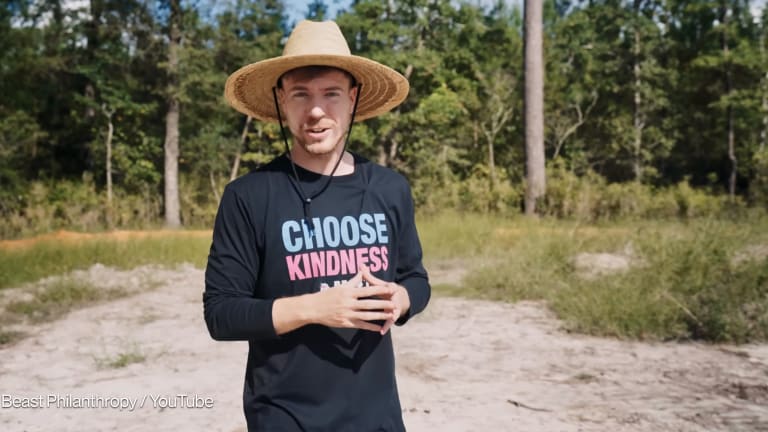
It’s been a quieter week than some in the world of international aid, in part because it’s Thanksgiving in the United States, and there’s therefore been more focus on pardoning turkeys than presidential dramas. However, there are some interesting developments to keep an eye on. Not the least of them is an eye-catching new partnership between The Rockefeller Foundation and … Mr. Beast. For those who don’t have tween kids and might therefore have missed this particular phenomenon, let’s bring you up to speed on Mr Beast. Jimmy Donaldson, aged 27, better known by his YouTube persona Mr. Beast, is the world’s only YouTube billionaire, and the only person to have made a billion before his 30th birthday. (Although there are apparently 15 people who inherited more than $1 billion before the age of 30, which is worth stopping to ponder for a minute.) He’s also given away more than $300 million, according to Fortune, with many public projects focused on people in low- and middle-income countries. Donaldson is a polarizing figure, not least for his habit of forcing other people into unpleasant and difficult circumstances as they compete for cash. His philanthropy has also been controversial, due to his repeatedly filming himself giving money away as a way to generate traffic to his channel, as well as accusations of fostering “white savior” tropes, and because there have been question marks over the effectiveness of his giving. The counterargument, as with so much philanthropy, is that at least he is trying to help, and if he has not always done it perfectly, well, better for him to fall over his feet than sit on his hands. And there’s no doubt that in a time when international aid seems to be facing a communication crisis, Donaldson has tools at his disposal to help make the case for aid. Which leaves the mainstream development sector facing a choice about whether to engage - to Beast or not to Beast, in other words. Last week, The Rockefeller Foundation made its choice: Beast mode. Rajiv Shah, CEO of the foundation, posted a video of himself with Donaldson, ambling around what looks to be a fairly random empty space with a crane in the background, making large but so far fairly vague promises about big things to come. It’s a fascinating picture of what might come next in a fast-changing development landscape. How influential, in the future, might voices like those of Mr. Beast be? Bits and pieces Cross-cutting? The International Committee of the Red Cross has announced plans for major staffing and budget cuts next year, citing declining contributions from donors. The budget will fall by 17% to around $2.25 billion, leading to 2,900 job cuts. “The ICRC remains committed to working on the front lines of conflict, where few others can operate,” said ICRC President Mirjana Spoljaric Egger. “But the financial reality is forcing us to make difficult decisions to ensure we can continue to deliver critical humanitarian assistance to those who need it most.” G19? The fallout continues from last weekend’s G20 summit. The summit itself was widely viewed as a success by development experts, but it was overshadowed by a boycott from the United States. The next summit is due to be held on U.S. soil, and President Donald Trump announced Wednesday that he would not invite South Africa to attend. While Trump cannot formally ban South Africa, he can certainly refuse to issue visas to officials from the delegation. South African President Cyril Ramaphosa called the decision “regrettable.” And yes, we know. After the African Union was admitted, the G20 has 21 members, so the title of this blurb is technically not quite right. The tail of the DOGE. It appears that DOGE, the scourge of USAID, has apparently only outlived its victim by a matter of months and has now also closed its doors, albeit with considerably less fanfare. At least, that’s what Reuters reported, citing comments from Scott Kupor, the director of another U.S. government arm, the Office of Personnel Management. Kupor has since muddied the waters somewhat by saying that DOGE does not have “centralized leadership,” but its principles remain alive. Humanitarian error? Likewise apparently closed, with equally little publicity, is the Gaza Humanitarian Foundation, the controversial initiative set up with U.S. support to feed Palestinians struggling with famine in the wake of war. The GHF did distribute some food aid, but it was heavily criticized after hundreds of Palestinians were killed while waiting for food. Following a ceasefire, more aid is now getting into Gaza, but U.N. officials have warned it is still not sufficient to meet the needs of the population. Berlin cuts. In Germany, there are reports of plans for major cuts at the Foreign Office, including at the division managing humanitarian programs. The German government has made a series of cuts to aid, particularly to humanitarian work, over the last few years, although it remains in a position to become the world’s largest donor in 2026 or 2027 if the U.S. follows through on its cuts. Keeping a CDI on things. Germany remains the second most financially committed of all nations to development, according to a report produced earlier this month by the Center for Global Development. The Commitment to Development Index looked at more than 40 indicators to assess national policies on aid. It found, as those who have been watching this year might expect, that commitment overall was falling around the world. A boost for Sentinel. The MacArthur Foundation has awarded $100 million to the Broad Institute’s Sentinel project, co-led by Pardis Sabeti and Christian Happi, to prevent “pandemics through local empowerment.” Chosen from five finalists in the foundation's third round of 100&Change competition, Sentinel earned high praise from MacArthur Foundation CEO John Palfrey, who said it will “transform infectious disease surveillance and response.” The multiyear award will help Sentinel scale its already proven model, which has trained over 3,000 public health workers across Africa. “With this support, we can build a future where every community has the tools … and stop outbreaks,” Sabeti said. Happi added that the investment “affirms that solutions to global health challenges can be led from Africa.” In memoriam Ambassador David Malone, a Canadian diplomat who served as ambassador to the United Nations, died early last week at the age of 71. Zeid Ra’ad Al Hussein, president of the International Peace Institute — which Malone led when it was called the International Peace Academy — issued a statement paying tribute. “Loved and respected by the UN Think-Tank community, David was ubiquitous throughout Turtle Bay when leading IPA,” Al Hussein said. “Always in the thick of things, tugging at old approaches and suggesting new ways of analyzing multilateralism. He did so brilliantly and — true to his personality, often playfully. He was a most remarkable man and a friend to so many of us. We will miss him sorely.” Moving on After nine years as the director of Wemos, Mariëlle Bemelmans announced plans to step down in March 2026 — “both grateful and sad” to share the news after years of pushing for “structural change for better health” alongside a dedicated team and global partners, she said in a LinkedIn post. After 10 years of service, Rachel Bowen Pittman has stepped down as executive director of the United Nations Association USA — “one of the greatest honors of my life,” she said on her LinkedIn page. She reflects on leading the 80-year-old organization as its first woman and first person of color, and on leaving behind “a community that is more diverse, more dynamic, and more reflective of the world we aspire to build.” Adama Mariko has been appointed executive director for resource mobilization, partnership, and communication at the French Development Agency, after serving as deputy in the department for three years. He replaces the influential Papa Amadou Sarr, who departed the role to become the CEO of Pan-African infrastructure organization the Porteo Group. Philippe Bolopion has been named executive director of Human Rights Watch. Bolopion has worked with the NGO for 13 years and is a former journalist who has extensively advocated on atrocities in conflict zones. Bolopion began his career as a reporter deployed to Kosovo, where he covered the fall of Serbian President Slobodan Milošević and was later chief U.N. correspondent for several French media organizations. Up next The Global Digital Health Forum will take place this week in Nairobi, Kenya, from Dec. 3 to 5. The forum describes itself as a networking and relationship-building opportunity for technology organizations, donors, researchers, government representatives, and implementing organizations working in low- and middle-income countries.




It’s been a quieter week than some in the world of international aid, in part because it’s Thanksgiving in the United States, and there’s therefore been more focus on pardoning turkeys than presidential dramas. However, there are some interesting developments to keep an eye on.
Not the least of them is an eye-catching new partnership between The Rockefeller Foundation and … Mr. Beast.
For those who don’t have tween kids and might therefore have missed this particular phenomenon, let’s bring you up to speed on Mr Beast.
This story is forDevex Promembers
Unlock this story now with a 15-day free trial of Devex Pro.
With a Devex Pro subscription you'll get access to deeper analysis and exclusive insights from our reporters and analysts.
Start my free trialRequest a group subscriptionAlready a user? Sign in
Printing articles to share with others is a breach of our terms and conditions and copyright policy. Please use the sharing options on the left side of the article. Devex Pro members may share up to 10 articles per month using the Pro share tool ( ).
About the author

David Ainsworth@daveainsworth4
David Ainsworth is business editor at Devex, where he writes about finance and funding issues for development institutions. He was previously a senior writer and editor for magazines specializing in nonprofits in the U.K. and worked as a policy and communications specialist in the nonprofit sector for a number of years. His team specializes in understanding reports and data and what it teaches us about how development functions.
Search for articles


Most Read
- 1
- 2
- 3
- 4
- 5