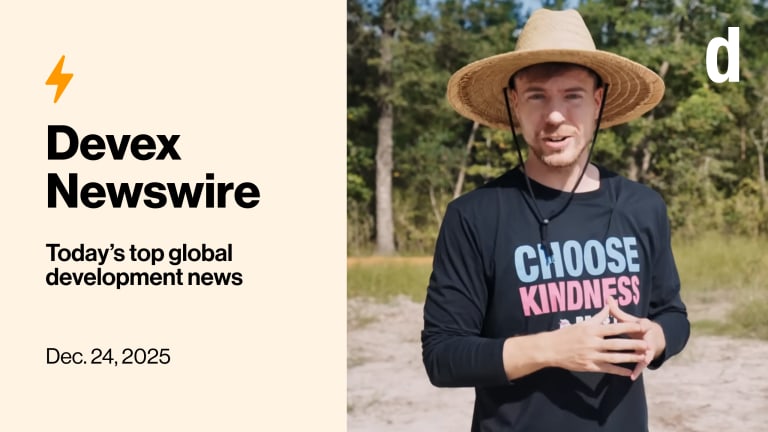
Is MrBeast a force for good in development — or a big problem?
News of the strategic collaboration between MrBeast and The Rockefeller Foundation signals the young YouTuber’s growing influence in modern philanthropy. He has raised hundreds of millions for good causes. But his flashy methods remain controversial, and he risks skewing how a generation perceives aid.
When you think of key players in global development, MrBeast — the world’s richest YouTuber — probably isn’t who comes to mind. But increasingly, he’s become a major philanthropic player in his own right, giving away hundreds of millions of dollars, much of it in the global south, in an incredibly public way. And perhaps more important than that, his vast audience means that he’s influencing how a whole generation views aid. Since starting his own YouTube gaming channel in 2012 at the age of 13, Jimmy Donaldson — or MrBeast as he is better known — has amassed one of the platform’s largest audiences. Across his multiple channels, more than 454 million subscribers follow his elaborate stunts and contests, which include recreating the “Squid Game” television series in real life and, most recently, having “100 pilots fight for a private jet.” In 2017, Donaldson launched the Beast Philanthropy channel, which currently has 28.8 million subscribers. Through on-camera charitable acts, which some have dubbed stunt philanthropy, he has funded numerous health, housing, and climate initiatives. His own YouTube page boasts that he has “helped 1,000 blind people see …helped 1,000 deaf people hear … built wells in Africa,” among other things. Donaldson had always operated independently, leveraging corporate partnerships and views for advertising revenue that he then donates to causes or uses to fund his own philanthropic endeavors. That was until late last month, when The Rockefeller Foundation announced a “strategic partnership” with Beast Philanthropy. The announcement came as a surprise to Rhodri Davies, a Pears research fellow in the Centre for Philanthropy at the University of Kent and founder and director of Why Philanthropy Matters, who has been studying the Beast Philanthropy model for the past couple of years. The mainstream philanthropy sector initially seemed dismissive of Donaldson’s efforts or unaware of the phenomenon, Davies said. It is easy to write it off as nonsense, he added, because “it looks a bit crass and garish.” But, through this partnership, The Rockefeller Foundation is recognizing this approach as something legitimate, as well as a way for them to tap into new audiences, and for Donaldson, who had traditionally pushed a narrative about disrupting traditional models, it is significant to be teaming up with one of the biggest institutions. Davies thinks some good can come from the partnership. The team at The Rockefeller Foundation presumably feels that Donaldson’s intentions are good, and that he has taken onboard some of the criticism of his approach and grown over time, he said. “He’s definitely not doing it perfectly,” he added, but “philanthropy … a lot of it’s problematic for other reasons, it’s just that in the case of MrBeast, [it’s] sort of visceral and obvious because it’s so visual.” The first project between The Rockefeller Foundation and Beast Philanthropy will be a trip to Ghana next year. Genevieve Shaker, professor of philanthropic studies at the Indiana University Lilly Family School of Philanthropy, said the trip will be a good litmus test of how the two organizations work together and adapt to contemporary views of what is appropriate when visiting communities. “I’m witnessing a shift … to a sort of creator-centric aid model.” --— Christian Meyer zu Natrup, managing director, MzN International Are influencers just the new celebrity ambassadors? Influencer collaboration with nonprofits or their involvement in causes is not something entirely new. It echoes U.S. telethons, which were sometimes seen as patronizing or dehumanizing by the groups they were raising money for, Davies said. Where Donaldson’s approach differs is in how it uses the economics of YouTube, the attention economy, and advertising algorithms — the model is less focused on leveraging celebrity and entertainment to request donations and “instead the philanthropy itself is the entertainment,” he explained. This does present challenges, continued Davies, among which is the donor-beneficiary dynamic and an expectation of gratitude. There’s also been concerns, he noted, around how some of MrBeast’s videos depict poverty and people in need, particularly in communities in the global south. “There were pretty unpleasant overtones of white saviorism of a kind that lots of organizations have been trying quite hard to move away from.” Among the videos hosted on the Beast Philanthropy, there are claims of having “adopted an orphanage” in South Africa, “rescuing child slaves in Africa,” and having “rescued kids living in a garbage dump” in India. Christian Meyer zu Natrup, managing director of MzN International, a social consultancy firm that helps nonprofits secure funding, is extremely sceptical of what he sees as algorithm-derived charity or content-driven philanthropy that creates a “sugar rush moment” and risks “commodifying compassion.” He also stressed that an individual influencer or an organization should never be “the hero of the story.” “I feel like I’m witnessing a shift … to a sort of creator-centric aid model,” he said. This model risks demoting the communities that need help to “props in their own survival story” while condensing systematic problems and injustices into 15-minute videos, he said. For Matt Derby, partner of M+R, which supports good causes in their fundraising and engagement efforts, the issue of simplifying complex problems — whether for a 30-second television or social media — isn’t something new. He pointed to malaria campaigns, which over the years have been “very straightforward” and promoted a five-dollar net as a lifesaving solution. Derby believes nonprofits need to “meet people where they are” and communicate things in a way that draws them in — something that Donaldson is skilled at doing. There’s always been concern, said Shaker, when it comes to celebrity involvement with causes and whether they can convey the depth of an issue. As more organizations in the space potentially consider leveraging relationships with influencers, she said it’s up to them to prepare the individual for that involvement and develop appropriate strategies. What’s at risk There’s no denying that influencers can reach new and younger audiences. Shaker believes influencer-led efforts can complement traditional philanthropy and nonprofit organizations, which have, in some cases, been struggling to keep pace with change and communicate with young people. The information ecosystem has evolved, said Derby, and “if non-profits don’t adapt to that, they risk becoming less and less relevant.” Donaldson’s work clearly “authentically speaks to people and … resonates with people,” he said. Reaching a larger audience is a positive thing, said Meyer zu Natrup, especially since the humanitarian and development sector has traditionally been “pretty insular” and ineffective in communicating its worth. However, he likened MrBeast-style content-led philanthropic efforts to a hand grenade — impactful but “not the impact we want to have.” And, in relying on influencers to communicate their work, organizations not only inherit a new audience but also reputational risk, he added. Donaldson has already had his share of negative press, including complaints about working conditions and serious allegations by former staff members. The Rockefeller Foundation will have done its due diligence, said Davies, and must be convinced his efforts are genuine. In his philanthropy efforts at least, Donaldson does seem to have changed his approach lately, he continued, and can be seen in videos suggesting more traditional ways that people can get involved in supporting causes. “What we don’t know at the moment is what is going to be the impact of seemingly a generation of kids and young people whose first introduction to the idea of philanthropy is that this is what philanthropy is — very highly individual, very visual,” Davies said. By allowing viewers to generate money simply by watching a video, “he’s essentially telling people you can do philanthropy without actually having to do anything or give any money.” Is influencer-led philanthropy the future? As other organizations may consider replicating The Rockefeller Foundation’s strategy, Meyer zu Natrup questioned “that [these] attention-seeking moments are not just clutching at straws” while avoiding the bigger issue of a broken business model. In trying to address long-term, systematic problems, you need a long-term funding plan, he said. Davies and Shaker both suggested that influencer-led philanthropy will likely be one element of the philanthropy landscape going forward. In addition to seeing whether more legacy institutions will team up with influencers, Davies is also interested in what these organizations might learn about presenting their work in a way that cuts through the noise. Having watched a lot of MrBeast’s content for research purposes, Davies has come to “more than a grudging admiration for how good he is at what he does,” which involves rigorous A/B testing and content being “relentlessly maximized and optimized.” Organizations are likely going to recognize the large sums that influencers can achieve, Derby said. “The question is what’s going to allow the programs to succeed and make the work on the ground that needs to happen, happen,” he said, “if that’s partnering with influencers, I think for the most part, they’ll probably just have to do it.”
When you think of key players in global development, MrBeast — the world’s richest YouTuber — probably isn’t who comes to mind. But increasingly, he’s become a major philanthropic player in his own right, giving away hundreds of millions of dollars, much of it in the global south, in an incredibly public way. And perhaps more important than that, his vast audience means that he’s influencing how a whole generation views aid.
Since starting his own YouTube gaming channel in 2012 at the age of 13, Jimmy Donaldson — or MrBeast as he is better known — has amassed one of the platform’s largest audiences. Across his multiple channels, more than 454 million subscribers follow his elaborate stunts and contests, which include recreating the “Squid Game” television series in real life and, most recently, having “100 pilots fight for a private jet.”
In 2017, Donaldson launched the Beast Philanthropy channel, which currently has 28.8 million subscribers. Through on-camera charitable acts, which some have dubbed stunt philanthropy, he has funded numerous health, housing, and climate initiatives. His own YouTube page boasts that he has “helped 1,000 blind people see …helped 1,000 deaf people hear … built wells in Africa,” among other things.
This story is forDevex Promembers
Unlock this story now with a 15-day free trial of Devex Pro.
With a Devex Pro subscription you'll get access to deeper analysis and exclusive insights from our reporters and analysts.
Start my free trialRequest a group subscription Printing articles to share with others is a breach of our terms and conditions and copyright policy. Please use the sharing options on the left side of the article. Devex Pro members may share up to 10 articles per month using the Pro share tool ( ).
For four years, Emma Smith covered careers and recruitment, among other topics, for Devex. She now freelances for Devex and has a special interest in mental health, immigration, and sexual and reproductive health. She holds a degree in journalism from Glasgow Caledonian University and a master’s in media and international conflict.