
Exclusive: US and EU aim to kill UN college education subsidy
The Trump administration claims U.N. austerity measures need to cut deeper.
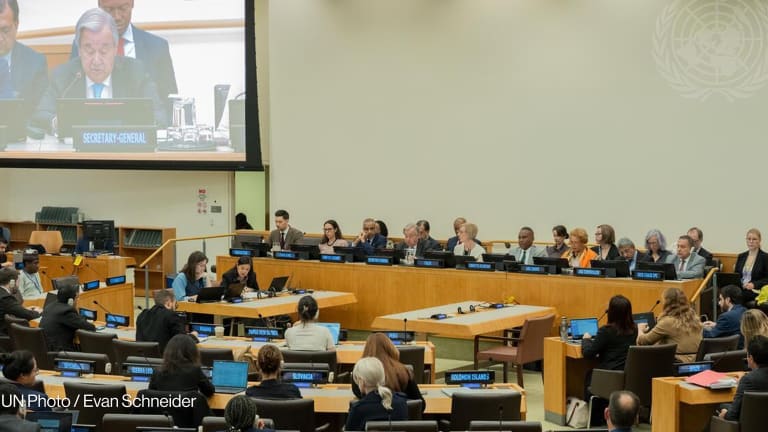
By Colum Lynch // 05 December 2025One of the great perks of working abroad for the United Nations: an education grant of about $30,000 a year for each of your children. Foreign nationals working in U.N. headquarters can receive as much as half of the tuition costs for a private American university. Americans posted in foreign duty stations, but not on U.S. soil, can also claim the benefit. But the Trump administration, with backing from the European Union, is trying to claw back funding for such staff entitlements, arguing that they have become too generous over the years and out of line with benefits awarded to comparable government workers. The U.S., meanwhile, has made it clear that Washington will not be satisfied with proposed U.N. cuts that would reduce overall spending in 2026 by 15% and result in the reduction of some 2,600 posts. U.N. Secretary-General António Guterres said he has been able to insulate U.N. staff from some of the impact of such cuts by offering “voluntary separation” packages and by moving workers whose posts are eliminated to vacant posts. That effort, he said, has been made possible because the percentage of posts slated for elimination — some 18.8% of overall staff — closely matches the share of budgeted posts, around 18%, that remain vacant. The surge in vacant posts is the result of a liquidity crisis, caused primarily by the failure of the U.S. to pay its dues to the U.N. in full and on time, thereby forcing the U.N. not to replace workers when they move on. “The fact is that we have established already programs for voluntary separation that are being quite successful,” Guterres told U.N. member states at a recent address to the U.N.’s budget committee, known as the Fifth Committee. “At the same time, we will have a mechanism allowing for those whose posts that are abolished to have the conditions to compete in a positive way to the posts that are vacant.” “It is my deep belief that, in the end, the number of members of the staff that will be released will be relatively small,” he added. The U.S. and European initiatives on entitlements, meanwhile, would sting, imposing a cost on virtually the entire staff, as they seek a 15% cut in entitlements and allowances. In a recent meeting on U.N. reform, Jeff Bartos, U.S. ambassador for U.N. management and reform, said that the U.N. reform initiative, dubbed UN80, combined with a series of austerity measures, “are a necessary first step for the United Nations to get back to basics.” He said, “We cannot, we must not backtrack in any way from the secretary-general’s revised estimates.” Behind closed doors, the U.S. and the European Union have proposed a series of cuts to rein in staff expenses, which they believe would provide additional savings. They have settled on trying to eliminate the educational grant for college students of U.N. staffers. For months, the Trump administration has been making it clear that it wants to target staff compensation, arguing that other cost-saving measures — such as moving employees to low-cost duty stations — would be minimal. In October, Bartos signaled U.S. concerns about U.N. compensation costs, which he said “comprise 70% of the [U.N.’s] regular budget” and which “must be brought into line with common sense benchmarks. U.N. staff currently out-earn their civil service counterparts in every member state, including the United States, by wide margins on base salary alone. And unlike their civil service counterparts, many U.N. staff also receive generous housing subsidies, tertiary education grants for their children, and significant tax exemptions.” Tertiary education grants refer to four-year university study. The benefits package is renegotiated with the International Civil Service Committee every other year. It is scheduled to take up the matter next year. But the U.S. and Europeans have been pressing governments to take it up now in negotiations in the Fifth Committee. If the cuts are approved, they would apply throughout the U.N. system, impacting staffers from U.N. headquarters to the semiautonomous humanitarian and technical agencies. There is no guarantee the U.S. and Europeans will succeed. They face stiff opposition from the Group of 77, a coalition of more than 130 low- and middle-income countries, and would require broader buy-in from the global south. “The issue of entitlements is decided by the International Civil Service Commission, whose members are elected by the GA [General Assembly] and decisions are approved by the GA,” Stéphane Dujarric, the chief U.N. spokesperson, told Devex by text. The European Union has introduced its own proposal that tracks U.S. aims, but with key differences. While the U.S. plan would end all college subsidies starting January 2027, the European Union favors a phased-in approach that would grandfather in the subsidies for students who began their undergraduate college careers by 2026. The proposals would preserve the existing education subsidy for primary and secondary school. Japan, another major donor to the U.N., has argued in favor of maintaining the subsidy. The European Union and the U.S. both propose a freeze in 2026 on salary increases and propose reducing the gap between the rate of U.N. salaries and those of the U.S. civil service, which serves as the international benchmark. The State Department and the U.S. Mission to the U.N. did not respond to a request for comment.
One of the great perks of working abroad for the United Nations: an education grant of about $30,000 a year for each of your children. Foreign nationals working in U.N. headquarters can receive as much as half of the tuition costs for a private American university. Americans posted in foreign duty stations, but not on U.S. soil, can also claim the benefit.
But the Trump administration, with backing from the European Union, is trying to claw back funding for such staff entitlements, arguing that they have become too generous over the years and out of line with benefits awarded to comparable government workers. The U.S., meanwhile, has made it clear that Washington will not be satisfied with proposed U.N. cuts that would reduce overall spending in 2026 by 15% and result in the reduction of some 2,600 posts.
U.N. Secretary-General António Guterres said he has been able to insulate U.N. staff from some of the impact of such cuts by offering “voluntary separation” packages and by moving workers whose posts are eliminated to vacant posts. That effort, he said, has been made possible because the percentage of posts slated for elimination — some 18.8% of overall staff — closely matches the share of budgeted posts, around 18%, that remain vacant. The surge in vacant posts is the result of a liquidity crisis, caused primarily by the failure of the U.S. to pay its dues to the U.N. in full and on time, thereby forcing the U.N. not to replace workers when they move on.
This article is free to read - just register or sign in
Access news, newsletters, events and more.
Join usSign inPrinting articles to share with others is a breach of our terms and conditions and copyright policy. Please use the sharing options on the left side of the article. Devex Pro members may share up to 10 articles per month using the Pro share tool ( ).
Colum Lynch is an award-winning reporter and Senior Global Reporter for Devex. He covers the intersection of development, diplomacy, and humanitarian relief at the United Nations and beyond. Prior to Devex, Colum reported on foreign policy and national security for Foreign Policy Magazine and the Washington Post. Colum was awarded the 2011 National Magazine Award for digital reporting for his blog Turtle Bay. He has also won an award for groundbreaking reporting on the U.N.’s failure to protect civilians in Darfur.