G20 summit in South Africa adopts declaration without the US
Despite U.S. boycotts and geopolitical strain, South Africa secures a hard-won G20 consensus — though many describe the commitments as “holding the line” as opposed to driving real change.
By Elissa Miolene // 24 November 2025Johannesburg, South Africa — On the first day of the G20 leaders’ summit, delegates adopted a declaration with “overwhelming consensus” on debt reform, climate change, and inequality — even as the United States, which was absent from the gathering, warned countries against doing so. “Most leaders had indicated to the president that they were happy with the declaration, and that they were in full support of having the declaration adopted ahead of the rest of the summit,” Vincent Magwenya, the spokesperson to South African President Cyril Ramaphosa, told reporters on Saturday. “It’s a success for all G20 member countries, it’s a success for the global south, it’s a success for the African continent and the world.” It was far from what most expected — not just on the first day of the G20 leaders’ summit, but throughout the weekend as a whole. For months, South Africa’s presidency of the Group of 20 major economies has struggled to steer the world’s largest economies, as clashes over health, energy, and geopolitics repeatedly threatened to overshadow its agenda. But ultimately, the G20 convened with just one delegation absent: the United States. And on Saturday morning, leaders pressed forward — even as many wondered whether the agreement amounted more to symbolism than it did to change. “There was a willingness, really, to see how [the member nations] could make it work. At a time when you know you have one country that really isn’t interested, that says it’s either my way or the highway, I think this was an important statement.” --— Elizabeth Sidiropoulos, chief executive of the South African Institute of International Affairs “This is a victory for the diplomatic process, but doesn’t really move the needle on policy substance,” said Gilad Isaacs, the executive director of the Institute for Economic Justice, a progressive think tank based in South Africa. “But some might argue that holding the line in this current geopolitical environment is an achievement in itself.” Cracking open the door For Isaacs, South Africa’s G20 presidency — and the resulting leaders’ declaration — did two things. For one, it “cracked the door open” on new areas of engagement. That included the idea of emergency food reserves, Isaacs said, which G20 ministers highlighted as a tool to steady food markets during shocks. Another new area is critical minerals, with South Africa pushing other nations on the continent to prioritize not just the extraction of raw minerals, but their processing and manufacturing — the parts of the value chain where the most money is made. But more than anything, Isaacs continued, South Africa’s presidency shone a spotlight on issues that matter to the African continent. That meant calling for peace in Sudan, the Democratic Republic of Congo, the Palestinian territories, and Ukraine — in that order — and including four pages on the need to invest in disaster response, mitigation and adaptation, and respond to the “urgency and seriousness” of climate change. The declaration also included inequality, rising debt burdens, and Africa’s steep cost of capital, which refers to the interest rates countries face when trying to borrow cash. With the declaration elevating those issues, Isaacs said, G20 member countries now have greater ability to push them forward. “It's an informal forum. So you can take some of these issues, and you can drive them anywhere,” said Elizabeth Sidiropoulos, the chief executive of the South African Institute of International Affairs, a Johannesburg-based think tank. “You can drive them at the [United Nations Climate Change Conference],” she added. “You can drive them in Africa. You can try to build partnerships with countries that think alike. There are things that we can do as Africans, or as developing countries, in terms of addressing some of these challenges.” But still, others pushed — that takes political will. And with the United States taking over the G20 presidency in the days to come, that remains a tall order. Tackling the ‘inequality emergency’ A core outcome of the declaration was the inclusion of inequality, something that South Africa — the most unequal nation in the world — has tried to highlight throughout the year. Earlier this month, a G20 committee released a report on what it called an “inequality emergency,” noting that since 2000, the richest 1% have captured just over 40% of all new wealth. That’s in contrast to the poorest half of humanity, who took home just 1% over the same time period. “The real problem is at the top: it’s the extreme wealth, and therefore, the extreme power, of the very rich. That gives them the ability to influence institutions, laws, rules, regulations, and policies in their favor,” said Jayati Ghosh, one of the six authors of the G20-commissioned report, and a professor of economics at the University of Massachusetts Amherst. “I think leaders are realizing that this is a monster they can’t control anymore.” To tackle that challenge, Ghosh’s committee recommended the G20 create an international inequality panel modeled after the Intergovernmental Panel on Climate Change — a body that would bring together evidence, data, and analysis to inform policymaking. While the panel didn’t make it into the final declaration, the proposal immediately picked up political support. Earlier this week, the leaders of South Africa, Brazil, and Spain backed the idea in a Financial Times opinion piece, pledging to “foster a coalition of governments to champion and deliver it.” “That’s not going to be an overnight event, it’s going to be a process,” South Africa’s Magwenya told Devex on Saturday. “And it’s going to be something we pursue quite strongly.” Debt gains and gaps When it came to debt, the leaders’ declaration stuck to what finance ministers had agreed to back in October. They reiterated their commitment to the Common Framework, the G20’s existing debt restructuring process, and recognized the need for it to be more “predictable, timely, orderly, and coordinated.” Since the framework was launched in 2020, its progress has been slow, and only a handful of countries — Chad, Ethiopia, Ghana, and Zambia — have gone through the process. “The Common Framework, which is a creature of the G20, is really quite problematic — and the declaration sort of glosses over that,” said Isaacs. G20 leaders also failed to take up the core recommendations of a G20-commissioned Africa Expert Panel, which had called for a new debt refinancing plan for low-income countries, a borrowers’ club to strengthen debtors’ voices, and more accountability for credit rating agencies — whose assessments have long been criticized for overstating risk in African economies, and making it more expensive for governments to borrow. “For me, this agreement is significantly weaker than the Seville Commitment,” said Bodo Ellmers, a managing director at the Global Policy Forum Europe. He was referencing the outcome of the U.N.’s fourth financing for development conference this past July, and comparing it to the financial elements of the leaders’ declaration. That comparison is notable: the Sevilla commitment drew support from all U.N. member states and set a higher bar for action on the worsening debt crisis, making the G20’s more limited outcome look especially modest by contrast. “It offers no real added value,” he added. “In fact, it proves that better results for the Global South can be achieved within the framework of the U.N.” Still, the leaders’ declaration did recognize the climbing debt burden facing countries in Africa, and the high cost of capital for nations across the continent. For Eric LeCompte, the executive director of the debt-focused Jubilee USA Network, that mattered — along with the G20’s recent launch of the Africa Engagement Framework, which aims to lock in the G20’s cooperation with Africa, and keep the continent’s most pressing financial issues on the agenda over the next five years. South Africa has committed to supporting the framework until 2030. “There’s a plan for implementation, the goals are solid, and it actually translates some of the other issues that we really are concerned about in terms of economic growth, finance, debt and development,” said LeCompte. “We’ve never had an initiative like this since the G20 began.” ‘Their loss’ While the declaration exposed the limits of what the G20 could agree on, another tension hung over the summit — the glaring absence of the United States, the country that’s slated to take the helm of the G20 next week. Earlier this month, U.S. President Donald Trump announced his nation would be boycotting the G20 Leaders’ Summit, repeating widely discredited claims that South Africa was home to a “genocide” of white Afrikaners. It was just the latest hit against the African nation. Earlier this year, Secretary of State Marco Rubio accused South Africa of “doing very bad things” during its G20 presidency, such as promoting “DEI [diversity, equality, and inclusion initiatives] and climate change.” Days later, Trump cut off all foreign assistance to the country, accusing South Africa of discriminating against Afrikaners. As the summit neared closer, strain between the two countries rose. Ramaphosa said Washington’s absence was “their loss,” and the White House accused Ramaphosa of “running his mouth.” The U.S. eventually offered to send a chargé d’affaires for the presidency handover, but South Africa refused, stating the handover must happen between officials of the same level. Ultimately, the U.S.’ absence at the summit meant several of the country’s red lines — mentions of climate change, for example, or commitments to sustainable development — were crossed. The leaders recognized “the urgency and seriousness of climate change,” which Trump recently called a “con job.” They also reaffirmed the Paris Agreement, which the U.S. has withdrawn from under both Trump administrations. South Africa added a single phrase to the declaration to make clear who was on board: “We, Leaders of the G20, who gathered in Johannesburg.” “There was a willingness, really, to see how [the member nations] could make it work,” said Sidiropoulos. “At a time when you know you have one country that really isn't interested, that says it's either my way or the highway, I think this was an important statement.”
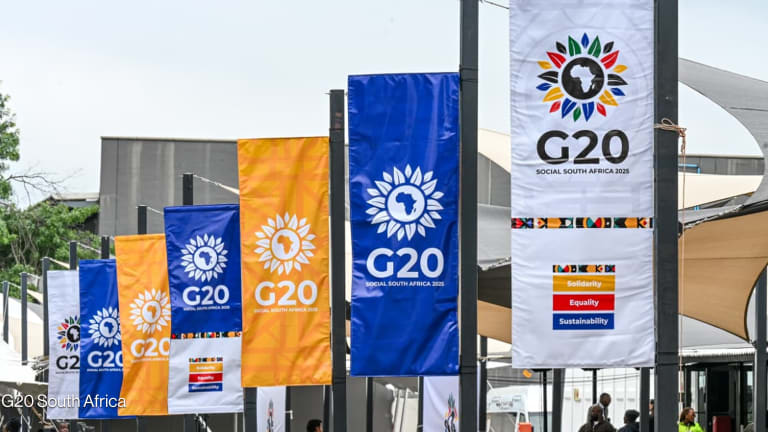
Johannesburg, South Africa — On the first day of the G20 leaders’ summit, delegates adopted a declaration with “overwhelming consensus” on debt reform, climate change, and inequality — even as the United States, which was absent from the gathering, warned countries against doing so.
“Most leaders had indicated to the president that they were happy with the declaration, and that they were in full support of having the declaration adopted ahead of the rest of the summit,” Vincent Magwenya, the spokesperson to South African President Cyril Ramaphosa, told reporters on Saturday. “It’s a success for all G20 member countries, it’s a success for the global south, it’s a success for the African continent and the world.”
It was far from what most expected — not just on the first day of the G20 leaders’ summit, but throughout the weekend as a whole. For months, South Africa’s presidency of the Group of 20 major economies has struggled to steer the world’s largest economies, as clashes over health, energy, and geopolitics repeatedly threatened to overshadow its agenda.
This article is free to read - just register or sign in
Access news, newsletters, events and more.
Join usSign inPrinting articles to share with others is a breach of our terms and conditions and copyright policy. Please use the sharing options on the left side of the article. Devex Pro members may share up to 10 articles per month using the Pro share tool ( ).
Elissa Miolene reports on USAID and the U.S. government at Devex. She previously covered education at The San Jose Mercury News, and has written for outlets like The Wall Street Journal, San Francisco Chronicle, Washingtonian magazine, among others. Before shifting to journalism, Elissa led communications for humanitarian agencies in the United States, East Africa, and South Asia.