South Africa pulled off a G20 diplomatic feat. Will it serve development?
Opinion: The South African G20 presidency secured a full consensus declaration that put Africa center stage despite U.S. opposition. The real task is maintaining this crucial momentum for sustainable development.
Opening the G20 leaders’ summit in Johannesburg last Saturday morning, South African President Cyril Ramaphosa offered the customary opening banalities of welcome required by diplomatic protocol, but then suddenly launched into the substance. The meeting was supposed to have gone into closed session, but someone had failed to flip the switch. A whisper of warning in his ear did not deter Ramaphosa, who dramatically announced that a declaration had been agreed by full consensus of all 18 countries present. Vincent Magwenya, Ramaphosa’s urbane spokesperson, assured me that it was a genuine mistake — but with a twinkle in the eye. At a stroke, the wily Ramaphosa had changed the rules of the G20 game, which by convention require that decisions are made by full consensus. U.S. President Donald Trump had not only announced that he would boycott the Group of 20 major economies, even though the U.S. will take over its presidency next year, but also that he objected to any attempt to secure a full declaration. Ramaphosa applied the old aphorism: If you’re not at the table, then you’re on the menu, gleefully inviting those present to confirm by vote their support for the 30-page document. It was a dazzling diplomatic feat, achieved through the preceding four days and nights by the sherpas who do all of the G20’s heavy lifting. It was also Ramaphosa’s rejoinder to Trump’s attempt to humiliate him in the Oval Office in May. Revenge is a dish best served cold, and Ramaphosa is the political tortoise that often wins the race. And the G20 is a marathon. An unrelenting yearlong plethora of 130 ministerial meetings, countless working groups and task forces, issuing thousands of pages of policy recommendations that funnel into the leaders’ summit and the declaration — one that mentioned Africa over 80 times, reflecting the fact that this was the first G20 to be hosted on the continent. But so what? Like a vast iceberg, the media and public only see the bit that sticks out above the waterline — the leaders’ summit. This is the symbolic part of the G20 — and on this occasion, the symbolism was significant, because it demonstrated that the rest of the world can agree to act without the approval of Washington. It is possible that in years to come, this will be recognized as an important moment in which middle powers from across the regions of the world — some “developed” economies, and some emerging or developing economies — found common cause in confronting the biggest systemic sustainability threats. Which takes us to the big, substantial part that lies below the water. I can only speak to two elements of this labyrinthine multilateral process — the influential G20 Sustainable Finance Working Group, or SFWG, for whom we delivered a customized leadership program in midyear focused on Africa’s context and sustainable finance needs, and the B20, the business segment of the G20. As a “network partner” to the B20, we have had a front-row seat in three of the B20’s eight task forces — whose mandates traverse finance and infrastructure, industrial development and innovation, and the just energy transition — that have produced a set of pragmatic recommendations that could accelerate investment and partnership between the developed and developing economies of the world. By “getting granular and real” these proposals could shape the next decade of transition finance and African green industrialization. Attending the B20 summit last week, I was impressed by the policy recommendations, which won the support of our Africa Corporate Leaders Group. With Trump unlikely to target the B20, its role has assumed greater significance, and I encountered positive indications from the members of the U.S. Chamber of Commerce — next year’s B20 secretariat — who chose to ignore Trump’s boycott by attending the B20. After all, business is business, and they know full well that Africa has huge untapped market potential. As this potential is realized, Africa must carve out a structurally different, sustainable economic development paradigm. So, it must co-curate, for instance, the new global energy system, get full value for its critical minerals, and build resilient, low-carbon infrastructure for its fast-growing cities — all topics covered by the leaders’ declaration. As the chair of the energy task force put it: “Africa must own more of the value chain.” Hence, the task now is to ensure that all this year’s stellar work was not in vain and that in the same way that Ramaphosa managed to secure a full leaders’ declaration, the G20 can continue to make progress next year, despite rather than because of the U.S. The consensus and progress that has been achieved this year face a clear and present danger: how to maintain the momentum created under South Africa in 2025, given that the 2026 U.S. presidency under the Trump administration is likely to be sceptical, even obstructive, toward multilateral processes, climate diplomacy, and development finance commitments. Since the G20 baton will pass to the United Kingdom in 2027, the U.K.’s relationship with South Africa as two legs of the G20’s traditional troika of past, present, and future presidencies will likely be critical in preserving the integrity of the world's most important multilateral process in the face of this threat. Having learned so much about its inner workings, we will continue to play our part in supporting the G20 process and implementing its outcomes. The G20 is a complex but worthwhile game to play.
Opening the G20 leaders’ summit in Johannesburg last Saturday morning, South African President Cyril Ramaphosa offered the customary opening banalities of welcome required by diplomatic protocol, but then suddenly launched into the substance.
The meeting was supposed to have gone into closed session, but someone had failed to flip the switch. A whisper of warning in his ear did not deter Ramaphosa, who dramatically announced that a declaration had been agreed by full consensus of all 18 countries present.
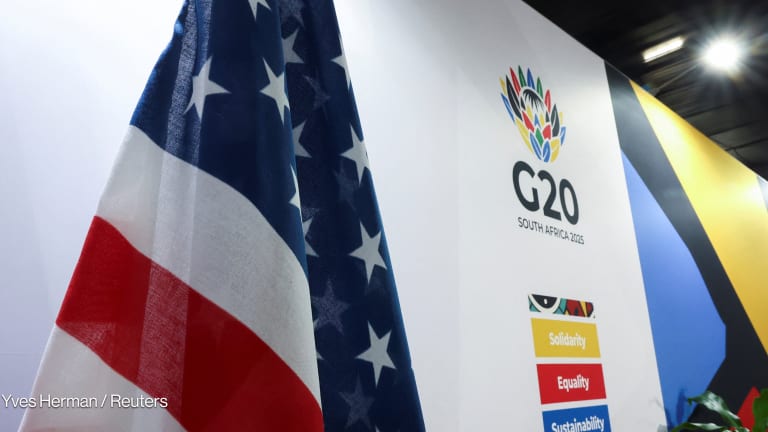
Vincent Magwenya, Ramaphosa’s urbane spokesperson, assured me that it was a genuine mistake — but with a twinkle in the eye. At a stroke, the wily Ramaphosa had changed the rules of the G20 game, which by convention require that decisions are made by full consensus. U.S. President Donald Trump had not only announced that he would boycott the Group of 20 major economies, even though the U.S. will take over its presidency next year, but also that he objected to any attempt to secure a full declaration.
This article is free to read - just register or sign in
Access news, newsletters, events and more.
Join usSign inPrinting articles to share with others is a breach of our terms and conditions and copyright policy. Please use the sharing options on the left side of the article. Devex Pro members may share up to 10 articles per month using the Pro share tool ( ).
The views in this opinion piece do not necessarily reflect Devex's editorial views.
Richard Calland is the director of the Cambridge Institute for Sustainability Leadership, Africa.