
Gaza aid workers say there are 'no aid operations in the field'
"There are no safe areas." Aid workers tell Devex that Israel’s latest airstrikes on Gaza have halted all humanitarian operations, as blocked borders push the region closer to famine.
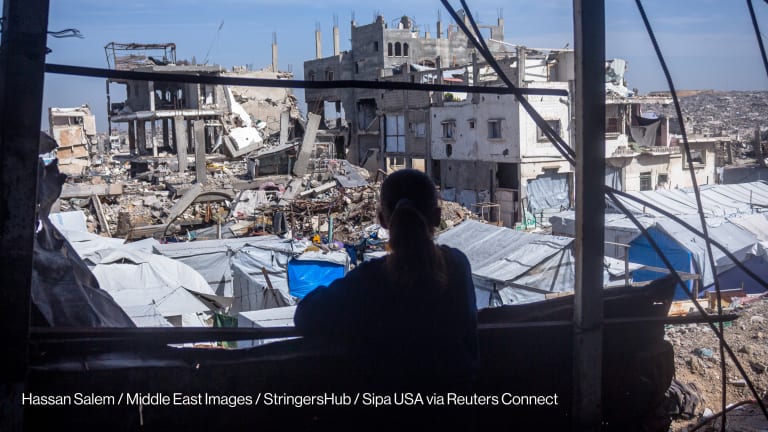
By Jesse Chase-Lubitz // 19 March 2025On Tuesday, the Israeli government launched a missile attack into Gaza, killing more than 400 people — including a United Nations staff member — in the most aggressive breach of a two-month ceasefire that began Jan. 19. Some organizations reported smaller previous violations to the agreement, but none as widely recognized as this. Aid increased during the ceasefire — with more than 4,000 humanitarian trucks allowed to enter the strip per week, along with 600,000 polio vaccinations, and maternity care for 5,000 births. In 2024, prior to the agreement, only about 100 trucks were able to enter per day. Even with the improvements, aid workers on the ground say it still wasn’t nearly enough, and the recent attacks have put an end to even that. Now, employees of Mercy Corps told Devex that there are “no aid operations in the field.” “There are no safe areas,” an aid worker for Mercy Corps who uses the pseudonym Lena for security reasons, told Devex. “For that reason, everyone has stopped working right now and distribution has stopped temporarily.” On Wednesday, a U.N. staff member was killed and five others were injured during a strike on accommodations for the Gaza operation of the United Nations Office for Project Services, or UNOPS, according to Jorge Moreira da Silva, the agency’s executive director, who spoke at a special press briefing today in Brussels. This is the third day the area experienced bombings. UNOPS has been delivering humanitarian relief in Gaza since the start of the war, including distributing fuel. “I want to stress this point. These premises were well known by the Israel Defense Forces and they were deconflicted,” da Silva said. “This means that everyone knew who was working inside the premises. It was U.N. personnel, UNOPS.” On March 2, even before the latest bombings, Israel stopped all aid from entering the Gaza Strip. This means that medical equipment, tents, cooking gas, fuel for hospitals, and water stations are all being blocked. Mercy Corps confirmed that they have not been able to get aid across the border since then. As of March 17, 62% of hospitals in Gaza were partially functional, and none were classified as "fully functional" by the World Health Organization. Those remaining were already reporting a shortage of medical supplies before this new bombardment. Now, they are unable to treat an increase of new injuries coming in, due to the lack of supplies. “Most of the aid coming into Gaza has dramatically decreased, including health-related aid,” said another aid worker for Mercy Corps who uses the pseudonym Osama for security reasons, comparing current aid flows to those prior to the new attack. He and his family are currently living in Khan Younis, a city in the southern part of the Gaza Strip that is serving as a refugee camp for those displaced from Gaza City in northern Gaza. “What’s really devastating is that when the bombardment started, there were a huge number of injuries coming into the hospital and they couldn’t treat them.” In addition to barring all remaining aid from entering, Israel has also stopped medical evacuations, according to Osama, who learned of this through a Jordanian news site that is based on the Rafah border — where medical evacuations have historically taken place. Between Feb. 1 and March 17, 1,702 patients, including 616 children, were medically evacuated from Gaza. WHO said on March 18 that planned medical evacuations via the Rafah crossing had been stopped. Food supplies were able to get in during the ceasefire, but aid workers tell Devex that traders are taking advantage of the closed borders and prices are skyrocketing. “Now that the borders are closed, there is inflation in prices,” said Osama. “Most people will not be able to purchase even basic foods.” The Integrated Food Security Phase Classification has data showing that 344,839 people — or 16% of Gaza’s population — are experiencing phase 5 or “catastrophic” food insecurity. Another 875,573 — or 41% of the population — are experiencing phase 4 food insecurity. Lena said that the risk of famine is increasing. A study published in November by the Security Council Report — a nonprofit that provides analytical reporting on the United Nations Security Council — estimated that by April 2025 there was a “reasonable chance” of famine in the territory. “There are very real concerns about a famine right now in the Gaza Strip,” said Lena. “Especially with the border closure this month.” The Israeli airstrikes hit in the early hours of Tuesday morning, throwing the territory back into an active war zone after the two-month lull. “When I woke in the middle of the night I was terrified. It felt like we had returned back to square one,” said Osama. “I think most people are not afraid of death, they are afraid that they will go through this struggle again and again, myself included,” Osama added. “Because there is no clear solution.” As an aid worker, he said he’s frustrated that he can’t serve his community. “Humanitarian work should be neutral. Governments and international communities should treat us fairly,” he said. “But we are not treated fairly in all aspects of life, including the humanitarian work that we are doing.”
On Tuesday, the Israeli government launched a missile attack into Gaza, killing more than 400 people — including a United Nations staff member — in the most aggressive breach of a two-month ceasefire that began Jan. 19. Some organizations reported smaller previous violations to the agreement, but none as widely recognized as this.
Aid increased during the ceasefire — with more than 4,000 humanitarian trucks allowed to enter the strip per week, along with 600,000 polio vaccinations, and maternity care for 5,000 births. In 2024, prior to the agreement, only about 100 trucks were able to enter per day. Even with the improvements, aid workers on the ground say it still wasn’t nearly enough, and the recent attacks have put an end to even that. Now, employees of Mercy Corps told Devex that there are “no aid operations in the field.”
“There are no safe areas,” an aid worker for Mercy Corps who uses the pseudonym Lena for security reasons, told Devex. “For that reason, everyone has stopped working right now and distribution has stopped temporarily.”
This article is free to read - just register or sign in
Access news, newsletters, events and more.
Join usSign inPrinting articles to share with others is a breach of our terms and conditions and copyright policy. Please use the sharing options on the left side of the article. Devex Pro members may share up to 10 articles per month using the Pro share tool ( ).
Jesse Chase-Lubitz covers climate change and multilateral development banks for Devex. She previously worked at Nature Magazine, where she received a Pulitzer grant for an investigation into land reclamation. She has written for outlets such as Al Jazeera, Bloomberg, the Organized Crime and Corruption Reporting Project, and The Japan Times, among others. Jesse holds a master’s degree in Environmental Policy and Regulation from the London School of Economics.