German development agency head: Cuts 'will haunt us in the future'
GIZ’s Ingrid-Gabriela Hoven says shrinking development budgets could ultimately make the world less secure.
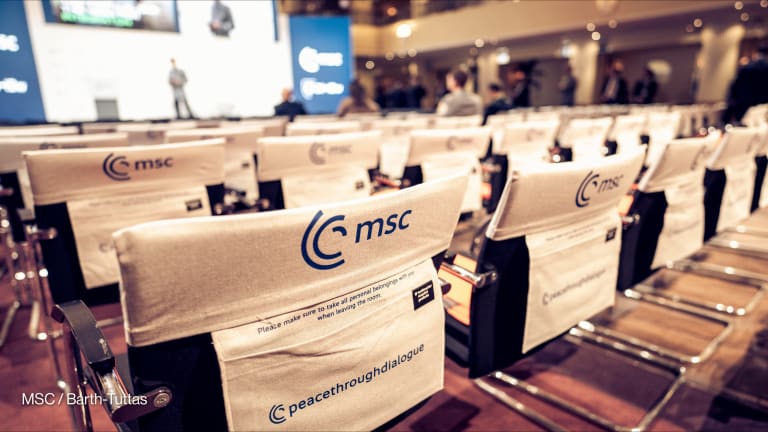
Development leaders are grappling with how to defend international cooperation in an increasingly security-focused world. On the sidelines of the Munich Security Conference, Devex sat down with Ingrid-Gabriela Hoven, managing director of Germany development agency GIZ. She discussed the shifting geopolitical mood, the impact of German budget cuts, and why she believes scaling back development cooperation will ultimately undermine security. This conversation has been lightly edited for length and clarity. You’ve been coming to Munich for years. How does this year’s conference feel different? The theme has changed dramatically over the last couple of years. After Russia’s full-fledged invasion of Ukraine, there was talk of entering a completely new geopolitical decade — a world of multipolarity, new partnerships, and perhaps even new alliances that could preserve a value-based order. There’s still a chance to, through new alliances, preserve a values-based order. But this year’s message that the world order has come to an end signals that many things are going to change fundamentally, and that we have to invest a lot in order to create something new that is sufficiently stable and can provide sufficient security to people. We are going to see more investments into security issues. That’s the tone right now. On the other side will be the huge transformation towards higher competitiveness. But we know that’s easier said than done, and there are actually very conflicting debates ongoing in Europe, not only in Germany, about what the best pathway is and how we strike a balance between competitiveness and social cohesion. Defense budgets are rising, development budgets are shrinking. Where does development fit into this new world order? If you look at the evidence — the root causes of conflict and fragility — you would swiftly come to the conclusion that we need more cooperation and global solidarity. This works for the issue of global health. Who knows when the next pandemic will strike? Or climate change — the IPCC [Intergovernmental Panel on Climate Change] has been very clear about its massive impact not only on human well-being but also on global supply chains and stability. So one could say that, actually, the evidence is there that development and global public goods should be preserved and maintained. If not, people will suffer from hunger and poverty, and this has been increased due to the U.S. cuts in ODA. It’s not only the U.S. cuts, however, but this was the biggest cut. If people suffer from hunger and poverty that provokes unrest and conflict. These may not always make the headlines, but we see them in the more than 120 countries where we operate. In West Africa, for example, worsening conditions for cocoa farmers can deepen poverty and create openings for armed groups to recruit young men. More than ever, development in the DDD [defense-diplomacy-development] nexus should be uplifted in the debate. But it is not. This is my frank perception. “If you look at the evidence — the root causes of conflict and fragility — you would swiftly come to the conclusion that we need more cooperation and global solidarity.” --— Ingrid-Gabriela Hoven, managing director, GIZ What response do you get when you make that argument to defense actors? They don’t say we should do nothing. But there is a notion of saying, has development been sufficiently effective? That is what they say, and whether there is too much bureaucracy, whether we could deliver more with less. Development cooperation is one of the most evaluated policy fields. So, actually, there is proof of the impact and where perhaps we have failed. And then we try to learn lessons out of those failures and make it better next time. Germany’s development budget is shrinking. What is the immediate impact on GIZ? We get our funding and permissions mainly from the German government, and we additionally mobilize cofinance from the European Commission. If German financing decreases, we receive fewer commissions, and our overall business volume declines. About 80% of what we do is advisory services and institution building. That means people and advisors on the ground. So if we lose 20% of our business volume, which is possible over the next three to four years according to medium-term financial planning, we have to review programs and staffing. Could defense funding help compensate for the losses? We already have good cooperation with the defense ministry and implement programs under instruments such as the European Peace Facility. For example, if security sector reform requires institutional capacity building or training, that aligns with our mandate. But the defense ministry will not fill gaps left by cuts in areas such as health. That is not their mandate. Security-related commissions may increase in certain areas, but they will not fully compensate for losses in core development cooperation. Do you think that development spending can come out of defense budgets? No. I firmly believe that cuts in international cooperation will haunt us in the future. That does not mean everything in the system was perfect. I support structural reforms to reduce red tape and increase impact. There is room for improvement, where you could actually get more bang for the buck. So I actually think the move to reform the BMZ is a good one. But still, I very much believe that even if we would, for example, enter a pathway where we try to bring in the private sector, mobilize private sector and capital market resources, that’s fine with me, but in many cases, you still need a bit of public funding to make that happen. And that’s either for de-risking or for building up project pipelines first. There has been criticism that voices from the global south are underrepresented at the Munich Security Conference. Why do you think that is? I think [the organizers] are quite cognizant about this gap. Unfortunately, this year again, the African Union summit is taking place at the same time as the MSC, which is really a pity. Previously, the dates were different and we had hoped for a much higher international presence. My guess is the global south may feel that the conference is dominated by global north perspectives, especially given the focus on Ukraine and transatlantic tensions. Even when leaders from countries such as Bangladesh or Colombia have spoken on the main stage in past years, the room has sometimes been half empty. So why should they come back if they feel their perspectives are not central to the debate? At the moment, Europe is preoccupied with the war in Ukraine, its own defense capabilities, and tensions with the United States. These issues understandably dominate. But they also divert attention from issues of pressing importance to the global south. Together with ministries, we continue to invest in communication, to change the narrative, strengthen it, to show that the trust built through international cooperation remains essential for the shared future we want. But we know it will not be easy.
Development leaders are grappling with how to defend international cooperation in an increasingly security-focused world.
On the sidelines of the Munich Security Conference, Devex sat down with Ingrid-Gabriela Hoven, managing director of Germany development agency GIZ. She discussed the shifting geopolitical mood, the impact of German budget cuts, and why she believes scaling back development cooperation will ultimately undermine security.
This conversation has been lightly edited for length and clarity.
This story is forDevex Promembers
Unlock this story now with a 15-day free trial of Devex Pro.
With a Devex Pro subscription you'll get access to deeper analysis and exclusive insights from our reporters and analysts.
Start my free trialRequest a group subscription Printing articles to share with others is a breach of our terms and conditions and copyright policy. Please use the sharing options on the left side of the article. Devex Pro members may share up to 10 articles per month using the Pro share tool ( ).
Jesse Chase-Lubitz covers climate change and multilateral development banks for Devex. She previously worked at Nature Magazine, where she received a Pulitzer grant for an investigation into land reclamation. She has written for outlets such as Al Jazeera, Bloomberg, the Organized Crime and Corruption Reporting Project, and The Japan Times, among others. Jesse holds a master’s degree in Environmental Policy and Regulation from the London School of Economics.