


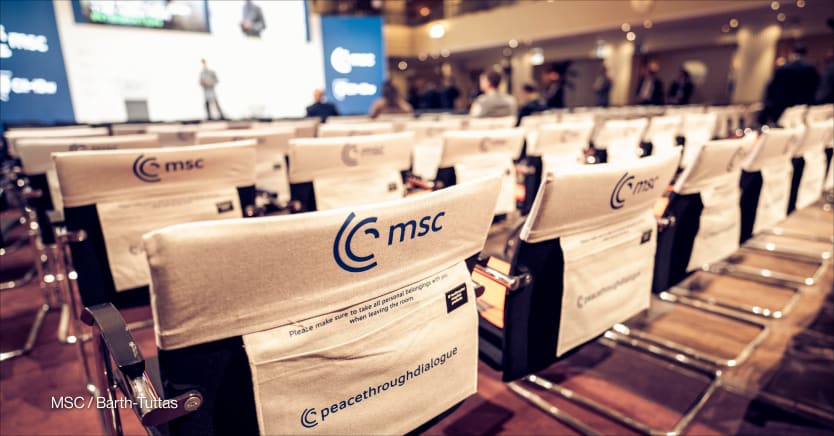
Between the military uniforms, bomb-sniffing dogs, and people pushing — not pausing — by former U.S. Secretary of State Hillary Clinton to rush to their meetings, the development community was at the Munich Security Conference to help determine its place in a new world order.
On Friday afternoon, the first official day of the conference, German Chancellor Friedrich Merz said that the world order as we know it is over. Development professionals were not surprised, having watched their industry combust over the last year. But now, they are hoping that the priorities of global development — which have long been seen by many as fundamental to the defense architecture of the West — will remain priorities. What many found over the course of the conference is that, for now, at least, their sector didn’t feel top of mind.
“Development is the dog tied to the bumper,” a person who asked to remain anonymous told me in the halls of the Rosewood Hotel — the secondary venue connected to the main Hotel Bayerischer Hof. “The irony is that ignoring these issues will ensure that they ultimately undermine the very stability that this conference is about.”
Over the years, MSC organizers have made a greater effort to elevate development’s role in geopolitical conversations. This year, development-related panels were featured each day of the agenda, from climate to water to food security — and dozens of high-level officials from the development world were present, from the U.N. Development Programme’s Alexander De Croo and Gates Foundation’s Mark Suzman to Médecins Sans Frontières’ Tirana Hassan, International Organization for Migration’s Amy Pope, and former U.N. General Assembly president María Fernanda Espinosa.
Justin Vaïsse, director general of the Paris Peace Forum, told me that their presence is “a testimony to the growing success of MSC to create a powerful network effect.”
While the topic of traditional foreign assistance was largely sidelined, “development doesn’t equate to aid,” Alexia Latortue, the former U.S. Treasury assistant secretary for international trade and development, told me. “If you were looking for discussions on aid, they were absent. But there were conversations about trade, debt, how countries collaborate, the future of multilateral development banks, remittances, and curbing illicit financial flows.”
But I heard that in many cases, development conversations existed largely in their own siloes, with climate people talking to climate people and food people speaking to, well, food people. In those cases, audiences were somewhat sparse. In addition, high-level speeches from world powers did not speak to the need for development to underpin security, sparking concern that the soft-power effect of development has been eroded and that the world will face the consequences down the line.
“All problems cannot be solved with the blunt instrument of the American armed forces,” Charlie Dent, a former member of the U.S. Congress, told me. “Even the Department of Defense will tell you that they can’t do the type of work that USAID performs. The American government needs to reconstruct elements of soft power to fulfill its national security objectives — and the U.S. military will be the first ones to tell you that.”
Food security won an impressive 12 sessions over the course of the conference, but even Máximo Torero, the chief economist at the Food and Agriculture Organization, told me he was surprised that there wasn’t more urgency on the issue.
“Pulling out of international cooperation in many countries, this leaves a void,” Ingrid-Gabriela Hoven, managing director at German development ministry GIZ, told me. “I firmly believe that the cuts in international cooperation are going to haunt us in the future,” she said.
ICYMI: At Munich Security Conference, development tries to stay relevant
Opinion: A memo to world leaders — food security is the basis of global stability
Fork in the road
Despite the ramp-up of defense spending across Europe, the military was — and often still is — the first to say that development matters for security.
The Rockefeller Foundation President Rajiv Shah, who previously led USAID through crises from Haiti’s earthquake to West Africa’s Ebola outbreak, told us that Europe’s race to hit 5% defense spending “puts extraordinary pressure on development.” But, he added, “every single military leader we speak to, including those in this room, would tell you over and over again, we need to do more on development, and think of it as the forward defense of our national security.”
Despite gloomy reports about the role of development in the future global order, experts are still piecing together how it fits moving forward. The big question for Shah is whether transactional deals — such as foreign aid being tied to countries’ willingness to accept deported migrants — or coordinated responses to shared threats such as pandemics, climate change, and artificial intelligence, will dominate the path forward.
"We’re living in case ‘A’ right now,” he said, referring to transactional deals.
The undoing of the UN
Many transatlanticists at the conference sighed in relief after U.S. Secretary of State Marco Rubio’s speech took a softer tone toward Europe than last year’s dressing-down by U.S. Vice President JD Vance.
Rubio’s speech was met with a standing ovation, although parts still caused concern, such as comments about how Americans and Europeans were “heirs to the same great and noble civilization” and warnings of “civilizational erasure.”
And it wasn’t exactly a lovefest for multilateralism. The secretary denigrated the United Nations for its failure to end conflicts from Gaza and Iran to Venezuela and Ukraine. Rubio said U.S. leadership “freed captives from barbarians” in Gaza, brought Ukraine and Russia to the negotiating table, and reined in nuclear ambitions in Iran.
“The United Nations still has tremendous potential to be a tool for good in the world. But we cannot ignore that today, on the most pressing matters before us, it has no answers and has played virtually no role,” Rubio said.
But in a sign of the shifting, and often disorienting, geopolitical struggle for influence, Chinese Foreign Minister Wang Yi followed his American counterpart by defending the U.N. and the need for expanding international cooperation.
“The founding of the U.N. was an important outcome of the victory of the World Anti-Fascist War, a historic choice made by previous generations after painful reflection on past agonies, and the peace endeavor that nations have invested their greatest efforts in thus far,” he said. “This edifice was jointly built by the people of the world. We have every responsibility to reinforce and renovate it, and no right to destroy it or tear it down.”
Despite speaking as the representative of a global superpower, he told the crowd, “The monopolization of global power by a small number of countries is unpopular. We live in a multipolar world and need to practice true multilateralism.”
Global south meets global security
Global south representatives were at the core of the call for strong development financing to bolster global security. Senegalese Prime Minister Aminata Touré told me that there's a straight throughline between the debt crisis in Africa and European security.
“Let me remind people that we’re just 14 kilometers from Europe,” she said. “So if you are a good swimmer, you can swim from Africa to Europe. Imagine if African countries can no longer deliver basic social services. It is gonna turn into a security issue. You think Europe is going to be not affected by that?”
The foreign minister of the Maldives, Abdulla Khaleel, said at a high-level lunch that for his country, terrorism is not bombs and armies, but sea-level rise and climate change.
Overall, however, representation from the global south left something to be desired — in no small part because the African Union Summit was once again scheduled to take place at the same time as MSC.
“What is missing is more voices from different parts of the world that need to cooperate on security,” Latortue said. “The transatlantic relationship dominated in a big way, so we need more representation from other parts of the world.”
There is an ongoing push not only to increase the presence of the global south at the conference, but also the number of people listening to it. But for some, there’s still room for growth.
“We are disappointed,” Habib Ur Rehman Mayar, deputy general secretary of the g7+ Secretariat, told me. “We are just treated as a source of challenges and social problems, but we have shown that our problems are not only our problems.”
Watch these interviews:
• Pentagon veteran says development is 'essential' for American security
• Aid leaders resist a zero-sum world as defense budgets climb
Engaging arms
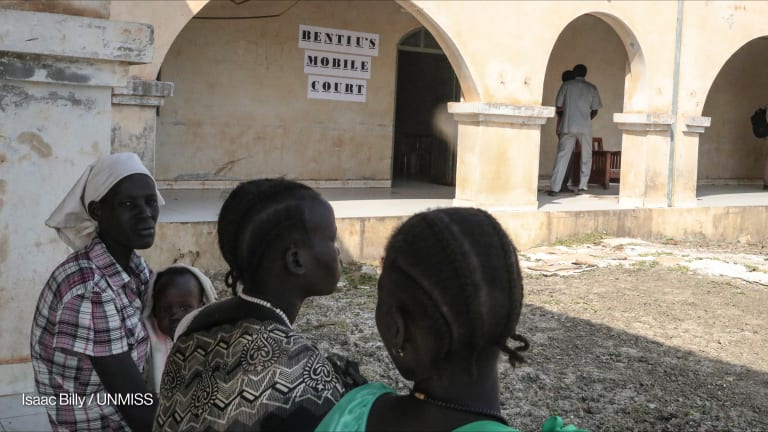
While Munich debated military matters, one security-related number went unmentioned: Over 200 million people now live under armed group control, not government authority.
Geneva Call Director General Alain Délétroz, who runs the only organization working exclusively to change how armed groups treat civilians, told Devex that this pattern is playing out across places such as the Sahel. Armed groups are now pushing toward capitals in Niger, Burkina Faso, and Mali — countries “on the brink of collapse” that could trigger massive refugee flows.
But these groups remain on Western terrorist lists. “No European or American diplomat is allowed to talk to them till the day they arrive in power,” Délétroz said.
He argued that the most effective path is engaging armed groups before they seize power, while the threat of being labeled a war criminal still carries weight. This approach has proven successful; in Syria, for instance, 38 of the 42 groups that toppled Bashar Assad had received training from these organizations based on that very theory.
Read a related op-ed: Security begins with justice
More background reading: Why we need closer links between development and defense (Pro)
+ Not yet a Devex Pro member? Start your 15-day free trial today to access all our expert analyses, insider insights, funding data, events, and more. Check out all the exclusive content available to Pro members.
Spotted
As always, the conference was chock-full of big names. It began with a conveyor belt of powerful people in the coffee lounge, with Bill Browder and Alexander Soros chatting about China, and separate sightings of Elizabeth Cousens, Michael Froman, and Ana Corina Sosa Machado, the daughter of Nobel Peace Prize winner María Corina Machado.
We saw Noubar Afeyan, the cofounder of Moderna, taking a moment to catch his breath at the conference’s central Falk’s Bar while María Fernanda Espinosa and Arancha González Laya laughed together. We happened to share a standing table with Maka Bochorishvili, a member of Parliament for the far-right ruling Georgian Dream party.
Nearby, Ertharin Cousin and Vera Songwe made their way into the main hall for Ursula von der Leyen’s speech.
John-Arne Røttingen from Wellcome and Massad Boulos were spotted near Politico’s pub venue.
And from the U.S., California Gov. Gavin Newsom was making the rounds, Rep. Alexandria Ocasio-Cortez spoke on the rise of populism, and I chatted with Rep. Sara Jacobs after her talk on the Sahel. We caught Sen. Chris Coons after a panel during which he joked about running for president. Stay tuned for coverage of our interview with him.
Rumor has it that the gathering to get into was the Freedom Party hosted by Axel Springer at a burger and lobster restaurant. It was described to Devex as though 200 people were in the room: 100 people, all European parliamentarians and U.S. government delegates, and 100 security staff keeping an eye on them.
Capping off the evening was the annual foosball tournament with roughly 20 tables and readily flowing beer. MSC takes this seriously, with cameras hanging above each table and scoring projected on a wall. Two people were walking around interviewing the teams. There was much anticipation about last year’s dream development team, Stephan Exo-Kreischer of the ONE Campaign and Markus Beck of Gavi, the Vaccine Alliance, who were in the finals. This year, they once again came close but lost their shot in the quarter-final to German politician Wolfgang Schmidt and Der Stern reporter Moritz Gathmann. They eventually won the tournament.
But before anything got started — foosball or otherwise — the ample security team pacing the streets of Munich realized that they forgot to look up. An intrepid Greenpeace protestor had managed to climb a crane in perfect sight of the Hotel Bayerischer Hof. The entire MSC operation shut down for about 10 minutes. We are not entirely sure how security got the protester down, but maybe they’ll be back next year.
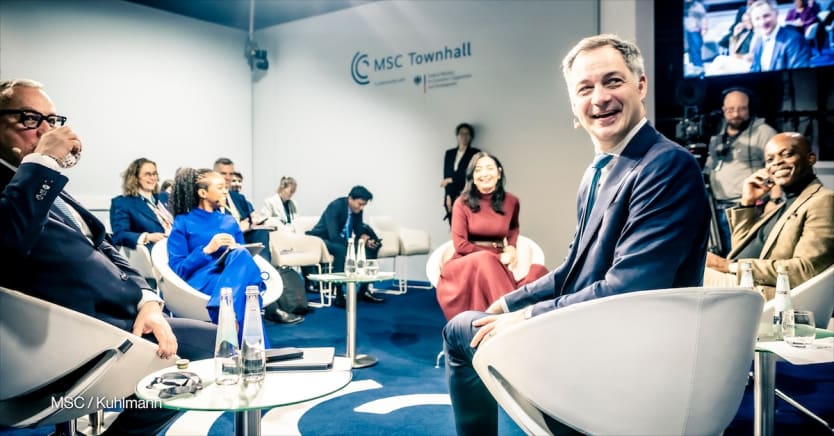
Pic of the day
Sign up to Newswire for an inside look at the biggest stories in global development.
About the author

Jesse Chase-Lubitz
Jesse Chase-Lubitz covers climate change and multilateral development banks for Devex. She previously worked at Nature Magazine, where she received a Pulitzer grant for an investigation into land reclamation. She has written for outlets such as Al Jazeera, Bloomberg, the Organized Crime and Corruption Reporting Project, and The Japan Times, among others. Jesse holds a master’s degree in Environmental Policy and Regulation from the London School of Economics.