• News
    • Latest news
    • News search
    • Health
    • Finance
    • Food
    • Career news
    • Content series
    • Focus areas
    • Try Devex Pro
  • Jobs
    • Job search
    • Post a job
    • Employer search
    • CV Writing
    • Upcoming career events
    • Try Career Account
  • Funding
    • Funding search
    • Funding news
  • Talent
    • Candidate search
    • Devex Talent Solutions
  • Events
    • Upcoming and past events
    • Partner on an event
  • Post a job
  • About
      • About us
      • Membership
      • Newsletters
      • Advertising partnerships
      • Devex Talent Solutions
      • Contact us
Join DevexSign in
Join DevexSign in

News

  • Latest news
  • News search
  • Health
  • Finance
  • Food
  • Career news
  • Content series
  • Focus areas
  • Try Devex Pro

Jobs

  • Job search
  • Post a job
  • Employer search
  • CV Writing
  • Upcoming career events
  • Try Career Account

Funding

  • Funding search
  • Funding news

Talent

  • Candidate search
  • Devex Talent Solutions

Events

  • Upcoming and past events
  • Partner on an event
Post a job

About

  • About us
  • Membership
  • Newsletters
  • Advertising partnerships
  • Devex Talent Solutions
  • Contact us
  • My Devex
  • Update my profile % complete
  • Account & privacy settings
  • My saved jobs
  • Manage newsletters
  • Support
  • Sign out
Latest newsNews searchHealthFinanceFoodCareer newsContent seriesFocus areasTry Devex Pro
    • News
    • Education

    Ghana launches $30M education outcomes fund to get kids into school

    The Ghana Education Outcomes Project — the world’s largest education outcomes fund — is an innovative program that is structured as a results-based financing mechanism. It has finally kicked off in Ghana.

    By Sophie Edwards // 06 March 2023
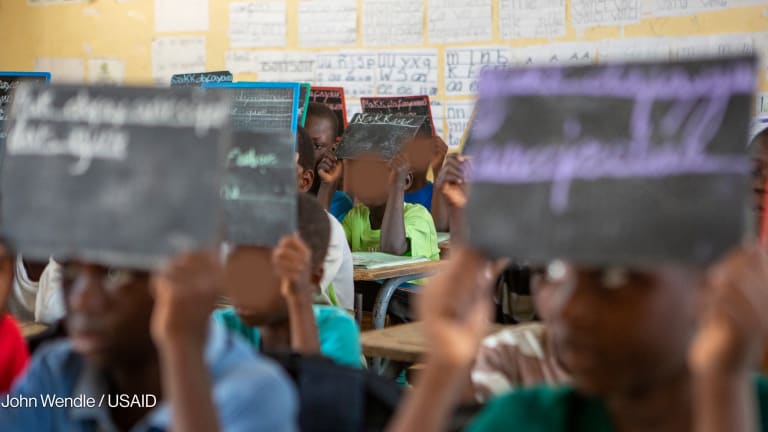
    The world’s largest education outcomes fund — $30 million to get out-of-school children into the classroom and improve learning levels at primary schools — has finally kicked off in Ghana. Over the next four years, the Ghana Education Outcomes Project, or GEOP, aims to get 70,000 out-of-school children back into the classroom and improve learning outcomes for 98,000 children across 600 primary schools. Most of the work is being done in districts in northern Ghana although the project also aims to tackle pockets of out-of-school children living around the cities of Accra and Kumasi. Some five years in development, the innovative program is structured as a results-based financing mechanism, which means that the implementers only get paid if they achieve certain, independently verified results. While a few such programs have been tested in education, this is the biggest to date. However, as with all results-based financing programs, there are risks. The government of Ghana has pledged $4.5 million to the program with the United Kingdom’s Foreign, Commonwealth & Development Office putting up the remaining $25.5 million. First mooted in 2018, the program suffered delays linked to COVID-19 disruption, fundraising stalls, and a complicated design and structuring process, but was officially launched last month in the capital, Accra. Speaking at the launch, Senior Presidential Adviser Yaw Osafo-Maafo said that Ghana was proud to host the world’s largest outcomes-based education project, which he called a “remarkable milestone.” The government was inspired to undertake the project after realizing the country had a “problem” with increasing numbers of out-of-school children and poor learning outcomes, Osafo-Maafo explained. The country’s 2021 census revealed some 1.2 million school-age children in Ghana did not attend school and 940,000 of them had never set foot inside a classroom. Further, World Bank statistics show that those children attending school do not learn much. The project brings together government officials, international donors, social investors, and service providers, Osafo-Maafo said, “with the sole aim of getting our children back into school as well as collectively supporting our schools and teachers to improve learning.” Minister of Education Yaw Osei Adutwum described the launch as a “watershed moment” for the country while also pointing to the benefits of GEOP’s payment-by-results model. “We look forward to seeing the results,” he said during the launch event, adding, “If you don’t succeed, we don’t pay you.” On the implementing side, the government of Ghana has contracted three main service providers to do the work — Street Child UK, Plan International, and Rising Academies, which is partnering with Ghanaian NGO, School for Life. To fund their work until they are paid, most implementers are financially backed by social investors. For GEOP, the investors include Bridges Fund Management and UBS Optimus Foundation via the SDG Outcomes Fund, and the Jacobs Foundation. The UBS Optimus Foundation has played the same role in India and Sierra Leone. If the implementers hit the pre-agreed results targets, as verified by independent evaluator KPMG, then the investors will recoup their initial investment plus a bonus of up to 10%. Payment will come from the Ghanaian government and FCDO. Megan Lees-McCowan, Street Child UK's head of Africa programs, says the results-based model provides implementers with clarity and flexibility. “We appreciate the clarity and laser focus on results, it really speaks to what we are trying to achieve as an organization,” she told Devex. “We can be incredibly adaptive, flexible, and agile because you’re not being held to a work plan or budget, you are deploying money exactly where you think it needs to go in order to get results,” Lees-McCowan added. There are also risks, however. For Lees-McCowan, verification is the biggest concern. Street Child UK’s work on improving learning outcomes in primary schools is measured against a control group of schools in Ghana and this is where some of the risks come in. An unnoticed intervention, for example, could impact the control schools and increase their learning levels making it an unfair comparison, she said. Other issues outside their control, such as the recent decision to bring forward the start of the academic year to January from September could skew the results of the program, she said. “The stakes are high, that’s why you need investors to take the risk,” Lees-McCowan said. Results-based contracts can also create perverse incentives, such as poor-performing kids being kicked out of school to boost exam results and trigger payments. However, GEOP has been designed by the Education Outcomes Fund for Africa and the Middle East, the outfit behind the program, to mitigate these risks. To disincentivize excluding students, for example, EOF has designed the program so that implementers are paid per child, and students must have been on the school register for a month before taking any tests. EOF’s concept is to pool resources from multiple donors to support numerous education outcomes funds. It helped design a similar $18 million outcomes fund in Sierra Leone, which launched last year. EOF’s CEO, Amel Karboul, described the long process of designing GEOP as “painful at times” but ultimately “transformative.” “People outside say this process is slow, but governments have for centuries bought services and goods …[and so] getting a government to buy a series of outcomes instead in two or three years, that’s actually very fast,” she said. “I find it sad that people don’t see the transformative power of [getting] governments around the world to spend their money differently. It’s actually big,” Karboul added. She hopes Ghana, and other governments, could take the model and roll it out into other sectors including skills, employment, and higher education. Update, March 8, 2023: This article has been updated to reflect EOF CEO Armel Karboul’s description of the design process for GEOP.

    Related Stories

    ‘Moonshot’ education finance facility aims to turn $1 into $7 in LMICs
    ‘Moonshot’ education finance facility aims to turn $1 into $7 in LMICs
    What is outcomes-based finance — and where does it go next?
    What is outcomes-based finance — and where does it go next?
    How UK aid cuts are hammering education in Sierra Leone
    How UK aid cuts are hammering education in Sierra Leone
    US aid cuts yank Nepal’s girls out of school and into child marriage
    US aid cuts yank Nepal’s girls out of school and into child marriage

    The world’s largest education outcomes fund — $30 million to get out-of-school children into the classroom and improve learning levels at primary schools — has finally kicked off in Ghana.

    Over the next four years, the Ghana Education Outcomes Project, or GEOP, aims to get 70,000 out-of-school children back into the classroom and improve learning outcomes for 98,000 children across 600 primary schools.

    Most of the work is being done in districts in northern Ghana although the project also aims to tackle pockets of out-of-school children living around the cities of Accra and Kumasi.

    This article is free to read - just register or sign in

    Access news, newsletters, events and more.

    Join usSign in

    Read more:

    ► Education Cannot Wait raises $826M, EU and UK pledges disappoint

    ► Children face an 'epidemic of violence' in schools

    ► Creative financing model aims to reverse staggering education loss

    • Banking & Finance
    • Careers & Education
    • Innovation & ICT
    Printing articles to share with others is a breach of our terms and conditions and copyright policy. Please use the sharing options on the left side of the article. Devex Pro members may share up to 10 articles per month using the Pro share tool ( ).

    About the author

    • Sophie Edwards

      Sophie Edwards

      Sophie Edwards is a Devex Contributing Reporter covering global education, water and sanitation, and innovative financing, along with other topics. She has previously worked for NGOs, and the World Bank, and spent a number of years as a journalist for a regional newspaper in the U.K. She has a master's degree from the Institute of Development Studies and a bachelor's from Cambridge University.


    Search for articles

    Related Stories

    EducationRelated Stories - ‘Moonshot’ education finance facility aims to turn $1 into $7 in LMICs

    ‘Moonshot’ education finance facility aims to turn $1 into $7 in LMICs

    Devex Pro LiveRelated Stories - What is outcomes-based finance — and where does it go next?

    What is outcomes-based finance — and where does it go next?

    UK AidRelated Stories - How UK aid cuts are hammering education in Sierra Leone

    How UK aid cuts are hammering education in Sierra Leone

    EducationRelated Stories - US aid cuts yank Nepal’s girls out of school and into child marriage

    US aid cuts yank Nepal’s girls out of school and into child marriage

    Most Read

    • 1
      Innovation meets impact: Fighting malaria in a warming world
    • 2
      Building hope to bridge the surgical access gap
    • 3
      The silent, growing CKD epidemic signals action is needed today
    • 4
      Turning commitments into action: Financing a healthier future after HLM4
    • 5
      How country-led ecosystems drive sustainable health impact
    • News
    • Jobs
    • Funding
    • Talent
    • Events

    Devex is the media platform for the global development community.

    A social enterprise, we connect and inform over 1.3 million development, health, humanitarian, and sustainability professionals through news, business intelligence, and funding & career opportunities so you can do more good for more people. We invite you to join us.

    • About us
    • Membership
    • Newsletters
    • Advertising partnerships
    • Devex Talent Solutions
    • Post a job
    • Careers at Devex
    • Contact us
    © Copyright 2000 - 2025 Devex|User Agreement|Privacy Statement