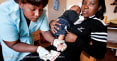
Globaldev careers: The nutritionist
Being a nutritionist means knowing not only your own sector, but understanding how nutrition relates to health, WASH, and livelihoods programs, says Sajia Mahjabeen of Concern Worldwide.
Sajia Mehjabeen didn’t intend to become a nutritionist. She had thought she’d become a teacher until she stumbled into a position with Helen Keller International, and decided the nutrition sector was where she wanted to focus her career. Mahjabeen is now a nutrition adviser at Concern Worldwide, based in Dhaka, Bangladesh, and working with a team at the international level out of Dublin headquarters, which allows staff to do their jobs from anywhere in the world. Previously she was an emergency nutrition manager with Concern, a position which involved much more travel and field-based work. “One of my jobs is to make sure that learnings [are] reflected in the policies and strategies that Concern develops globally and also in the country,” Mahjabeen said of her current role. “You need to make sure that you’re supporting the implementation in the field and supporting the staff.” Mahjabeen spoke with Devex about pursuing a career in nutrition and how she stays inspired. “I think by then I applied for 200 or 300 positions.” --— Sajia Mahjabeen, nutrition adviser, Concern Worldwide This conversation has been edited for length and clarity. What is the job of a nutritionist? The job of the nutritionist is to make sure that the population who are vulnerable to malnutrition, like pregnant and lactating mothers, children under 5, and adolescent girls, are provided with proper services, care, and knowledge so that they know how to take care of themselves and also to provide treatment, in cases where it’s necessary. What does your day-to-day look like? I’m a nutrition advisor at global headquarters so I support some of the countries of concern [Worldwide]. The countries that I support are mainly Bangladesh, Pakistan, Afghanistan, Somalia, South Sudan. Most of the fragile countries. My job is to make sure that the programming we are doing in the fragile contexts is appropriate, of high quality, and serving the people, keeping in mind all the humanitarian principles are actually adhered to. First and foremost is to make sure we reach the people that are in need, the extremely poor people, and to make sure they’re getting all the treatment services where there is a need for treatment or preventative services. I focus on making sure that proposals and strategies that are developed in the country are in line with the context and of high quality. I also make sure that the evaluation and the research we need are also carried out in those countries so that we can make our informed program design. I also make sure that I provide day-to-day support to the countries, like technical support, whenever they have a question related to program advocacy or any other issues that are directly or indirectly related to nutrition. How did you end up in this particular role? Just after completing my master’s I got … a job in Helen Keller International … I was really lucky actually, I just got the job. I don't know how, trust me, it just happened. I really didn’t want to go into this field. Then I got a chance to work with WFP. I worked in an emergency context. There was a big cyclone and they requested Helen Keller to provide some technical support … and I started working with WFP and … I got involved in different emergencies that were happening in the field in Bangladesh. I didn’t want to work only in Bangladesh so I was applying for jobs elsewhere and then this position came up. I think by then I applied for 200 or 300 positions. And then one of my supervisors said “why don’t you apply for this position?” It was an emergency program manager with Concern Worldwide. I thought, “it’s too much, I’m not experienced enough to even apply.” And she told me that “you know what, one of our major problems is we don’t have any confidence in ourselves. Just try it out. Why do you think that you are not a fit for this job? Let them decide.” And boom, it happened … It changed everything in my life and the way I see the humanitarian sector, the way even I see myself, my principles, my values — everything changed after I joined Concern. “... beans and rice for months … You need to be prepared for that if you really, really want to be in this job.” --— What are the biggest challenges of the job and what lessons have you learned that help you overcome these? You need to be very mentally strong. When I first went to the field I was emotionally a little bit weak to see what was really happening around the world, and it affected me a lot. I would say it was a challenge because I was so overwhelmed that it was difficult for me to even cope initially. But then I saw the beauty of it. You need to be passionate. If you’re not passionate, then this is not the field for you because this is not only a job. You need to love what you’re doing. When you see a child in the hospital and he’s 5 years old but when you see him you think he’s 6 months old, you need to have the strength to absorb this. You need to work from morning to night when there is a need. You might need to go to [another] country with two days notice, you need to be mentally prepared for that. There might be an emergency and you might need to live in an area where there is no proper food and you just live on beans and rice for months … You need to be prepared for that if you really, really want to be in this job. What skill sets have you found to be most valuable? Mostly what helps me is my field-level experience. Even if I was trained in everything and I know every nitty-gritty approach or what to do, it’s totally different when you go to the field. Field-level experience, nothing can beat it. So whenever you have a chance to be a volunteer or [do an] internship I would say just go because nothing can beat it. No matter how much theory-based learning you have, even a Ph.D., but field-level experience is the main thing that makes a difference. You have to make sure that although it says nutrition, since nutrition is a multisectoral problem you need to know every sector. You cannot only stay within your sector and know only nutrition specific, you need to know WASH programming, livelihood programming, cash programming, health programming. You need to be an expert on everything to be a good nutritionist because nutrition is not only food, it is affected by so many other factors. “Field-level experience is the main thing that makes a difference.” --— How do you see the impact of your work? Right now I'm an adviser, I don’t go to the field, I don’t stay in the field that long. But when I was an emergency manager, I was in an area supporting an acute emergency setting up a program, and seeing a child coming to a health facility who — you know that the child won’t survive. And day by day that child you see after two months is playing around and you discharge them. What else do you want? Maybe you’re not going to change thousands of lives, but that one life. I still remember South Sudan 2012 or ‘13 I think, and I still remember that child and I still remember the smile. I thought the child was not going to survive … And when we see the program you’re designing … and when you go for internal evaluation and we see that things are happening in the field and people are implementing those [programs] and you see beneficiaries are coming and you see they're receiving those services that you designed … it’s amazing.
Sajia Mehjabeen didn’t intend to become a nutritionist. She had thought she’d become a teacher until she stumbled into a position with Helen Keller International, and decided the nutrition sector was where she wanted to focus her career.
Mahjabeen is now a nutrition adviser at Concern Worldwide, based in Dhaka, Bangladesh, and working with a team at the international level out of Dublin headquarters, which allows staff to do their jobs from anywhere in the world. Previously she was an emergency nutrition manager with Concern, a position which involved much more travel and field-based work.
“One of my jobs is to make sure that learnings [are] reflected in the policies and strategies that Concern develops globally and also in the country,” Mahjabeen said of her current role. “You need to make sure that you’re supporting the implementation in the field and supporting the staff.”
This article is exclusively for Career Account members.
Unlock this article now with a 15-day free trial of a Devex Career Account. With a Career Account subscription you will get:
- Full access to our jobs board, including over 1,000 exclusive jobs
- Your Devex profile highlighted in recruiter search results
- Connections to recruiters and industry experts through online and live Devex events
Start my 15-day free trialAlready a user?
Printing articles to share with others is a breach of our terms and conditions and copyright policy. Please use the sharing options on the left side of the article. Devex Pro members may share up to 10 articles per month using the Pro share tool ( ).
Teresa Welsh is a Senior Reporter at Devex. She has reported from more than 10 countries and is currently based in Washington, D.C. Her coverage focuses on Latin America; U.S. foreign assistance policy; fragile states; food systems and nutrition; and refugees and migration. Prior to joining Devex, Teresa worked at McClatchy's Washington Bureau and covered foreign affairs for U.S. News and World Report. She was a reporter in Colombia, where she previously lived teaching English. Teresa earned bachelor of arts degrees in journalism and Latin American studies from the University of Wisconsin.