
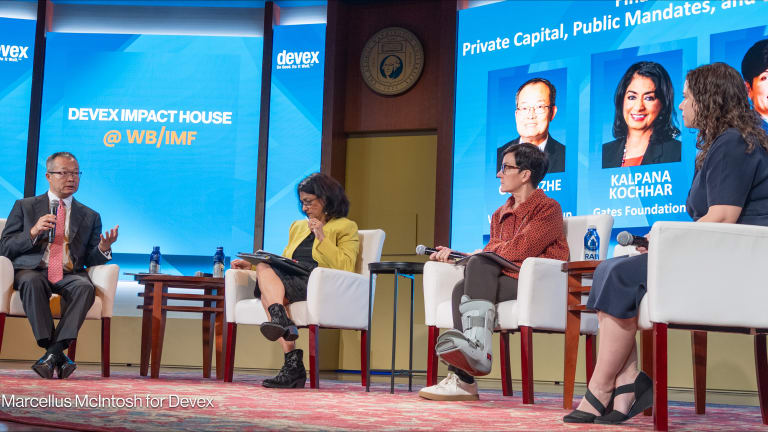
When do private financial institutions want to work with multilateral development banks and development finance institutions? In two specific situations, Faheen Allibhoy, who is head of multilateral development banks and development institutions at J.P. Morgan, told the audience at Devex Impact House held on the sidelines of the World Bank-International Monetary Fund annual meetings in Washington, D.C. First, when those institutions are able to de-risk a deal. And second, when they bring geographic expertise. She said when Axion Telecom, a Madagascan telecoms company, wanted to issue a corporate bond, MDBs were able to step in and act as anchor investors. Similarly, when a port in Morocco wished to expand, the Multilateral Investment Guarantee Agency, the World Bank’s guarantee arm, stepped in and provided support. MDBs and DFIs also have convening power — delivering credibility and advocating for policy reform — said Jake Cusack, cofounder and managing partner at CrossBoundary Group, a firm focused on bringing private capital into underserved markets. MDBs, he said, have unique expertise in emerging markets. And they have access to grants and technical assistance, which can lower transaction costs. Cusack talked about how MIGA had offered his organization a “portfolio-level guarantee” across up to 100 projects across countries and currencies. “It’s not sharing the risk, it’s lowering the risk,” he said. Fabio Fagundes, chief products officer at IDB Invest, said working with an MDB offered both pros and cons for a private finance institution. On the one hand, it brought with it reputational benefits and an AAA credit rating. But on the other hand, it came with compliance issues. “The multilateral development banks are a seal of approval, and many times, that seal of approval comes with lots of strings attached,” he said. He said one of the core jobs of the MDB was “originate to share” — similar to the private finance model of “originate to distribute” — where the bank identified a financial need, did the original groundwork, and then brought in other institutions to invest in its deal. However, there remain challenges around bringing deals to market, Allibhoy said, not least the speed with which deals could be done. She said that MDBs spent a long time on due diligence on projects even when working with a known quantity, whose creditworthiness was well known. They had also, she said, struggled to work in partnership, and they had also tended to make transactions “complicated and bespoke” when they did not need to be. “It’s very hard to replicate bespoke,” she said. Update, Oct. 21, 2025: This article has been updated to reflect Fabio Fagundes’ correct title.


When do private financial institutions want to work with multilateral development banks and development finance institutions?
In two specific situations, Faheen Allibhoy, who is head of multilateral development banks and development institutions at J.P. Morgan, told the audience at Devex Impact House held on the sidelines of the World Bank-International Monetary Fund annual meetings in Washington, D.C.
First, when those institutions are able to de-risk a deal. And second, when they bring geographic expertise.
This story is forDevex Promembers
Unlock this story now with a 15-day free trial of Devex Pro.
With a Devex Pro subscription you'll get access to deeper analysis and exclusive insights from our reporters and analysts.
Start my free trialRequest a group subscriptionAlready a user? Sign in
Printing articles to share with others is a breach of our terms and conditions and copyright policy. Please use the sharing options on the left side of the article. Devex Pro members may share up to 10 articles per month using the Pro share tool ( ).
About the author

David Ainsworth@daveainsworth4
David Ainsworth is business editor at Devex, where he writes about finance and funding issues for development institutions. He was previously a senior writer and editor for magazines specializing in nonprofits in the U.K. and worked as a policy and communications specialist in the nonprofit sector for a number of years. His team specializes in understanding reports and data and what it teaches us about how development functions.
Search for articles



Most Read
- 1
- 2
- 3
- 4
- 5