• News
    • Latest news
    • News search
    • Health
    • Finance
    • Food
    • Career news
    • Content series
    • Focus areas
    • Try Devex Pro
  • Jobs
    • Job search
    • Post a job
    • Employer search
    • CV Writing
    • Upcoming career events
    • Try Career Account
  • Funding
    • Funding search
    • Funding news
  • Talent
    • Candidate search
    • Devex Talent Solutions
  • Events
    • Upcoming and past events
    • Partner on an event
  • Post a job
  • About
      • About us
      • Membership
      • Newsletters
      • Advertising partnerships
      • Devex Talent Solutions
      • Contact us
Join DevexSign in
Join DevexSign in

News

  • Latest news
  • News search
  • Health
  • Finance
  • Food
  • Career news
  • Content series
  • Focus areas
  • Try Devex Pro

Jobs

  • Job search
  • Post a job
  • Employer search
  • CV Writing
  • Upcoming career events
  • Try Career Account

Funding

  • Funding search
  • Funding news

Talent

  • Candidate search
  • Devex Talent Solutions

Events

  • Upcoming and past events
  • Partner on an event
Post a job

About

  • About us
  • Membership
  • Newsletters
  • Advertising partnerships
  • Devex Talent Solutions
  • Contact us
  • My Devex
  • Update my profile % complete
  • Account & privacy settings
  • My saved jobs
  • Manage newsletters
  • Support
  • Sign out
Latest newsNews searchHealthFinanceFoodCareer newsContent seriesFocus areasTry Devex Pro
    • News
    • Sustainable agriculture

    How satellites and insurance are securing livestock in East Africa

    For his work utilizing satellite technology to bring livestock insurance to herders and livestock in East Africa, Andrew Mude was presented with the 2016 Norman Borlaug Award for Field Research. Devex sat down with him to talk about technology, insurance and his passion for helping secure the livelihoods of rural farmers in the region.

    By Jennifer Piette // 21 October 2016
    In many parts of East Africa livestock provide the livelihoods for many herders and pastoralists who, especially with climate change on the rise, are often faced with severe threats from droughts. A particularly bad drought could wipe out most of a herders livestock, leaving them without a source of food or income and with little recourse. It’s a problem that inspired Andrew Mude and his colleagues to launch Index-Based Livestock Insurance, a technology-enabled insurance program to protect herders against the devastating effects of drought. Developed in partnership with International Livestock Research Institute, Cornell University and University of California Davis, IBLI uses data gathered by satellite to create a vegetation index that can be used to track the density of vegetation available to pastoralists. When the available food for livestock falls below an agreed upon threshold, it indicates there is a drought and the IBLI program compensates herders and pastoralists if they suffer a loss. About 15,000 herders have purchased the insurance contracts in Kenya and Ethiopia since its launch in 2010 with about $200,000 paid out on claims thus far. The Kenyan government recently replicated the model and now provides IBLI coverage to about 9,000 households through the Kenya Livestock Insurance Program. Mude was recently presented with the 2016 Norman Borlaug Award for Field Research and Application during the World Food Prize ceremony. He also won the USAID Award for Scientific Excellence from the Board for International Food and Agriculture Development at a separate event in Des Moines, Iowa, in collaboration with his team. But the work is not yet completed. “The research phase continues,” said Mude, during a recent visit to Washington, D.C. The team intends to continue to leverage technology to increase the efficiency of service delivery. Devex sat down with Mude to talk about technology, insurance and his passion for helping secure the livelihoods of rural farmers in East Africa. Here are the highlights of our conversation. How do you explain the concept of insurance and satellites to herders in rural communities? Insurance is a difficult concept across the world. In most places it is mandated — you are forced to have insurance. Explaining what IBLI [is] has been a major challenge. This is a population that hasn't had the experience of insurance much less alone understanding what satellite technology is. But I think we have a ready population here just because they have experienced a lot of loss. Livestock is fundamental to their lifestyle and livelihood. So they were receptive to any idea that would help them reduce the losses that they face. A big part of what we have to do is thinking of innovative ways that we could explain satellite insurance in a way that makes sure that they understand the features. What are some of the other persistent challenges involved in your work? One of the challenges we face is that the satellite tells you the amount of forage on the ground but it doesn’t really tell you how good that green is. Some plants have a lot more nutrients for certain types of livestock. However, the satellite itself doesn’t tell you that. There is a lot of work we are doing [with] crowdsourcing. We are teaching pastoralist themselves to take pictures of the graze land and submit [them]. In the space of about four to five months, they have submitted about 120,000 photos. Working in collaboration with Cornell University’s Institute of Computation Sustainability, we are using big data and other algorithms to develop a filter for the data so that we can get a better sense of how good the green we are seeing is in terms of nutrients. How has the increase in mobile phone penetration in Africa impacted your work? The cost of delivery sales was really high when we started … the point of sales device that an agent required to interact at the point of transaction cost about $12,500. We worked with insurance companies to develop a mobile sales application platform, which is now free. This allows them [to go] from having [less than] 50 agents in an area, to [having] over 350. That increases access for pastoralists. Individuals who are able to interact with mobile phones and are digitally savvy can start using that for other things such as crowdsourcing, disease surveillance, etc. International organizations are scaling up efforts to develop technological solutions for various development challenges. How can African leaders and local NGOs become active partners in the process and encourage more research-based projects on the continent? What we need more of is research or science that is demand-driven. Understand what the key challenges are and key opportunities so that you can orient your research on problems for which once you find the solution you find the ready market. This work is an example of that. We started off by providing livestock life insurance — asset replacement — and we moved on to provide livestock health insurance — asset protection. That came about as a result of closeness with communities. The insurance companies [and] the NGOs that we work with are there on the ground. Partnerships are so central. Not just with clients — whether it is with the farmer or the livestock herder in the case of an agricultural program — but also with the suite of organizations needed to deliver across the value chain. It is really important to engage closely with them and have a strong rigorous research capacity within the team so that when you have understood the key challenges and the key opportunities, you will have a sense of the key cutting edge innovation you can research. What motivates you to keep going? I like to consider myself as passionate about the work that I do and oriented towards finding solutions that would leverage technology. I hope that my colleagues would consider me not just passionate but dependable and excited about the work that we do. There are times that perhaps [the] provision of insurance is not a low hanging fruit. When I started it had great promise but we needed to do the work to show that it could actually be sustainable at a large scale. What drives me is solving some of these challenges. Read more international development news online, and subscribe to The Development Newswire to receive the latest from the world’s leading donors and decision-makers — emailed to you FREE every business day.

    Related Stories

    Devex Invested: The climate insurance lottery low-income countries can’t afford
    Devex Invested: The climate insurance lottery low-income countries can’t afford
    Devex Dish: How AI is guiding India’s farmers through climate change
    Devex Dish: How AI is guiding India’s farmers through climate change
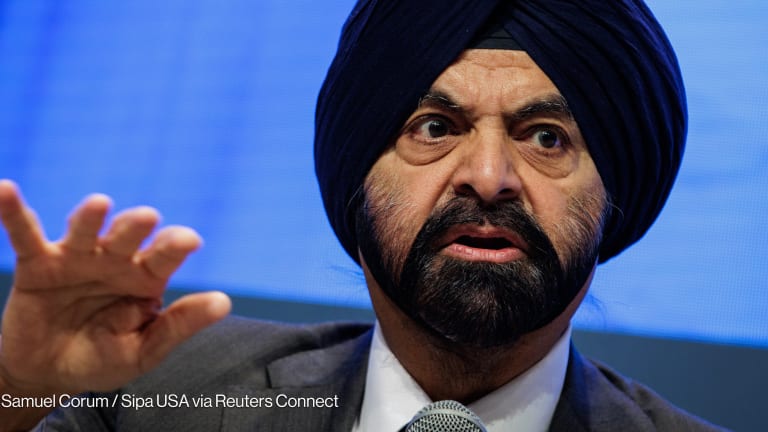
    For World Bank President Ajay Banga, all roads lead to jobs
    For World Bank President Ajay Banga, all roads lead to jobs
    Devex Dish: A chilling problem for Africa’s food supply
    Devex Dish: A chilling problem for Africa’s food supply

    In many parts of East Africa livestock provide the livelihoods for many herders and pastoralists who, especially with climate change on the rise, are often faced with severe threats from droughts.

    A particularly bad drought could wipe out most of a herders livestock, leaving them without a source of food or income and with little recourse. It’s a problem that inspired Andrew Mude and his colleagues to launch Index-Based Livestock Insurance, a technology-enabled insurance program to protect herders against the devastating effects of drought.

    Developed in partnership with International Livestock Research Institute, Cornell University and University of California Davis, IBLI uses data gathered by satellite to create a vegetation index that can be used to track the density of vegetation available to pastoralists. When the available food for livestock falls below an agreed upon threshold, it indicates there is a drought and the IBLI program compensates herders and pastoralists if they suffer a loss.

    This article is free to read - just register or sign in

    Access news, newsletters, events and more.

    Join usSign in
    • Agriculture & Rural Development
    • Innovation & ICT
    • Eastern Africa
    • Washington, D. C., District of Columbia, United States
    Printing articles to share with others is a breach of our terms and conditions and copyright policy. Please use the sharing options on the left side of the article. Devex Pro members may share up to 10 articles per month using the Pro share tool ( ).

    About the author

    • Jennifer Piette

      Jennifer Piettedisgeneration

      Jennifer Ehidiamen is a Nigerian writer who is passionate about communications and journalism. She has worked as a reporter and communications consultant for different organizations in Nigeria and overseas. She has an undergraduate degree in mass communication from the Nigerian Institute of Journalism, Lagos, and M.A. in business and economics from Columbia University Graduate School of Journalism, New York. In 2014, she founded Rural Reporters (www.ruralreporters.com) with the goal of amplifying underreported news and issues affecting rural communities.

    Search for articles

    Related Stories

    Devex InvestedRelated Stories - Devex Invested: The climate insurance lottery low-income countries can’t afford

    Devex Invested: The climate insurance lottery low-income countries can’t afford

    Devex DishRelated Stories - Devex Dish: How AI is guiding India’s farmers through climate change

    Devex Dish: How AI is guiding India’s farmers through climate change

    World Bank annual meetings 2025Related Stories - For World Bank President Ajay Banga, all roads lead to jobs

    For World Bank President Ajay Banga, all roads lead to jobs

    Devex DishRelated Stories - Devex Dish: A chilling problem for Africa’s food supply

    Devex Dish: A chilling problem for Africa’s food supply

    Most Read

    • 1
      When business moves faster than politics
    • 2
      The direction of the Paris Agreement is right. The pace is not
    • 3
      Why NTDs are a prime investment for philanthropy
    • 4
      Devex Power 50
    • 5
      Why a new partnership model is key to future of development finance
    • News
    • Jobs
    • Funding
    • Talent
    • Events

    Devex is the media platform for the global development community.

    A social enterprise, we connect and inform over 1.3 million development, health, humanitarian, and sustainability professionals through news, business intelligence, and funding & career opportunities so you can do more good for more people. We invite you to join us.

    • About us
    • Membership
    • Newsletters
    • Advertising partnerships
    • Devex Talent Solutions
    • Post a job
    • Careers at Devex
    • Contact us
    © Copyright 2000 - 2026 Devex|User Agreement|Privacy Statement