How two global development pros turned layoffs into consulting careers
Two consultants share tips for successfully pivoting to project- and client-based work.
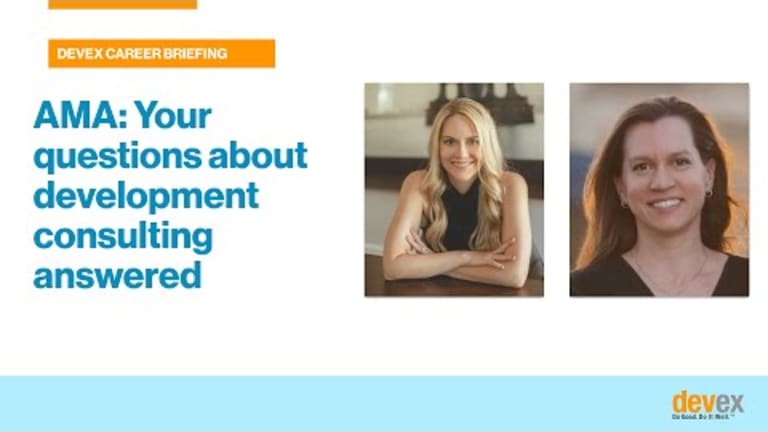
Like thousands of development professionals, Grace Tran, founder of Athena Insight Consulting LLC, and Taylor Williamson, director of Cadence Advisory, lost their jobs last year as a result of the dismantling of the United States Agency for International Development. Both have since transitioned into independent consulting — a shift they discussed during a recent Devex event, reflecting on the challenges of their first year and on navigating the unpredictable nature of project- and client-based work. For Tran, the pivot to consulting was not something she had given much consideration to previously. After being laid off, her gut reaction was to frantically apply to “anything and everything.” But in a saturated job market, where people with decades of experience were applying for relatively junior roles, she struggled to see where she would fit. “Consulting was kind of something that I was essentially forced into,” said Tran. “It became really clear that I was not going to find a full-time job.” Consulting wasn’t an immediate path for Williamson either, but in figuring out his next steps and speaking to others in the sector, he was increasingly drawn to the idea of working with different clients across a range of issues. He also applied for jobs — something he now sees as market research that helped him understand what roles were being hired for and how he could offer the services that organizations were seeking. Invest time in networking One of the biggest challenges for both Tran and Williamson in starting out was securing their first clients. Tran did an “extraordinary amount of networking.” She targeted organizations with diversified funding sources — many of which had also been affected by layoffs and couldn't hire someone full time but still required support to provide services. Talking with a wide range of people helped land contracts for part-time or hourly work, said Tran, though her anchor client came from a conversation with a rowing teammate who works for a conservation organization that was hiring but hadn’t yet advertised the position. The best advice Williamson got was to “tell everyone that you know that you're consulting.” You never know where the next connection will come from and the weak ties are often the ones that land you the most work, he said. In letting your network know about your career pivot, Williamson stressed the importance of a clear value proposition that makes it easy for someone to introduce you or summarize your expertise in a single sentence. “A lot of times, client acquisition happens when you're not in the room,” he explained, so it comes down to someone else describing your work to a potential client and they need to have a clear sense of what you're offering. Stick to your niche Figure out your niche, find your tagline, and stick to it, advised the pair. Williamson's expertise is in providing fractional business development services for small nonprofits and government contractors. If approached about monitoring and evaluation work, for example, he refers prospective clients elsewhere, even though he has some experience in this area. Ideally, he said, those referrals will be reciprocated when an organization needs Williamson’s services. The question shouldn’t be if you can do something, it should be whether the job fits your niche, he said. Similarly, Tran — who provides on-demand project management, business development, and technical writing services — cautioned against straying outside of your lane. She recalled taking on an assignment that didn’t align with her strengths where she struggled to deliver the desired results. The impression you leave on your current contracts is important and you want to win repeat work, she explained. Her advice: Home in on what you can do well and stick to that. Adjust your rates For Tran, it was important to establish a minimum hourly rate that made any job worthwhile, along with varying rates for different types of clients. She charged $50 an hour when working for a small South African health organization, but doubled that rate for a job with a tech-backed academic research organization. “The reality is that you need to have a range of rates that you're willing to work with,” depending on the clientele, she said. Depending on the deliverables, Williamson uses three separate contract templates: a fixed price template, a retainer template, and a monthly or hourly rate template, In trying to set a rate, he advised against working backwards from a previous salary. Instead, he encouraged new consultants to consider the type of organization and what the client is willing to pay for the service you can provide Never stop generating leads Both consultants were familiar with the feast-or-famine nature of consulting work. Tran advised others to budget appropriately in anticipation of those quieter periods. This is also a time to invest in yourself and to do more pipeline development, she suggested. Williamson also stressed the importance of continuous marketing and lead generation. Set aside an hour each week to send out some networking emails or post something on LinkedIn, he suggested. While it can take time for those efforts to bear fruit, he said, “even if you're working 50 hours a week on something, set aside that hour because that will get you through some of the famine.”
Like thousands of development professionals, Grace Tran, founder of Athena Insight Consulting LLC, and Taylor Williamson, director of Cadence Advisory, lost their jobs last year as a result of the dismantling of the United States Agency for International Development. Both have since transitioned into independent consulting — a shift they discussed during a recent Devex event, reflecting on the challenges of their first year and on navigating the unpredictable nature of project- and client-based work.
For Tran, the pivot to consulting was not something she had given much consideration to previously. After being laid off, her gut reaction was to frantically apply to “anything and everything.” But in a saturated job market, where people with decades of experience were applying for relatively junior roles, she struggled to see where she would fit.
“Consulting was kind of something that I was essentially forced into,” said Tran. “It became really clear that I was not going to find a full-time job.”
This article is exclusively for Career Account members.
Unlock this article now with a 15-day free trial of a Devex Career Account. With a Career Account subscription you will get:
- Full access to our jobs board, including over 1,000 exclusive jobs
- Your Devex profile highlighted in recruiter search results
- Connections to recruiters and industry experts through online and live Devex events
Start my 15-day free trialAlready a user?
Printing articles to share with others is a breach of our terms and conditions and copyright policy. Please use the sharing options on the left side of the article. Devex Pro members may share up to 10 articles per month using the Pro share tool ( ).
For four years, Emma Smith covered careers and recruitment, among other topics, for Devex. She now freelances for Devex and has a special interest in mental health, immigration, and sexual and reproductive health. She holds a degree in journalism from Glasgow Caledonian University and a master’s in media and international conflict.