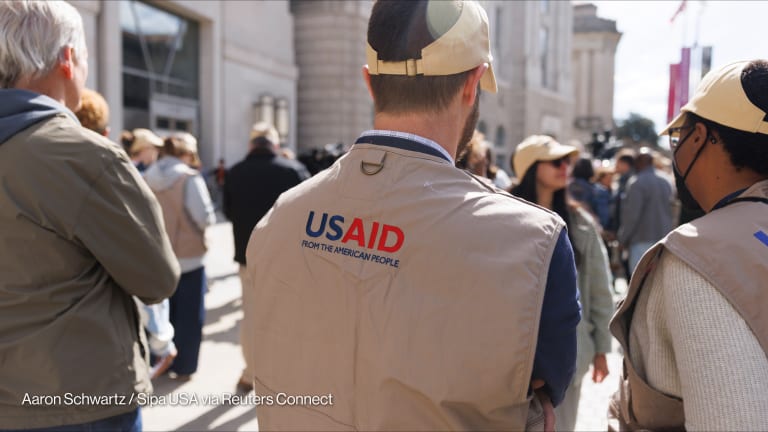
Judge temporarily halts plan to put thousands of USAID staff on leave
The order blocks 2,200 employees from being placed on administrative leave and pauses the recall of USAID employees serving in other countries.
By Adva Saldinger // 08 February 2025A federal court judge said he would block the U.S. Agency for International Development from placing 2,200 employees on administrative leave at 11:59 pm Friday, as had been originally planned. Judge Carl Nichols said he would issue what he called a “very limited” temporary restraining order Friday night. The hearing came just a day after the American Foreign Service Association and the American Federation of Government Employees, two unions representing USAID employees, filed a lawsuit alleging that the Trump administration’s dismantling of USAID was unconstitutional. “There will be zero harm to the state” from pausing the employment-related actions for a short period of time, Nichols said. The order will also require that the rapid recall of USAID employees serving in other countries be halted as the case continues. USAID employees should also have their access to computer systems restored, he said. What was still unclear was whether the 500 or so employees already put on leave would be ordered to be returned to their jobs. Nichols said he would consider that and include it in the order. “The ruling is a crucial first step in halting a reckless assault on USAID and in supporting the dedicated professionals who serve our country,” Tom Yazdgerdi, the president of the American Foreign Service Association, said in a statement. Placing staff members on leave would cut them off from critical systems, including security information for those serving abroad, who are often in unstable or dangerous settings, argued Karla Gilbride, the deputy director of the Public Citizen litigation group. “By locking them out of those systems and placing them on leave, USAID would be “imperiling their safety,” she said. The employees being sent home comes as a result of the closure of offices of overseas stations, which the president cannot unilaterally do, Gilbride said. She argued that these actions violate the Constitution and directly contradict the fiscal year 2024 appropriations act, which prohibits any reduction in force, closure of offices, or reorganization of USAID without congressional consultation, which hasn’t happened, she said. The government argued that the injunction should not be granted, in part because the case was fundamentally an employment claim and that the employees would all be able to seek relief through other mechanisms after they were placed on leave. The government also argued that the employees would not be irreparably harmed. “It is a large number but it is still a personnel action,” Brett Shumate, acting assistant attorney general in the civil division of the Department of Justice, who was representing the government, said. When the judge asked what the reasoning was behind the decision, Shumate responded that the president decided there was widespread corruption in the agency. He did not offer any evidence of the corruption in response to the judge’s query, but argued that the government does not have to justify putting people on leave. There were some questions about what funding had been frozen. Shumate said that Secretary of State Marco Rubio’s funding orders only applied to new obligations. He did not say that Rubio had also issued an explicit stop-work order halting all but a limited number of ongoing programs where funding had already been obligated, even after the judge sought clarity. The judge’s decision does not halt other government actions, including funding cuts. The judge asked detailed questions largely focused on the harm that the particular plaintiffs, in this case USAID employees, would suffer, and not on broader constitutional arguments. He also said he would not be ruling on how the government’s actions might harm the agency or create payment issues for contractors or other organizations. The order will pause the administration’s employee-related actions for a short period of time to allow for additional legal proceedings and information gathering. Nichols, the judge, did not specify how long that would be but said that an expedited schedule for briefings would be included in the order. “There are really fundamentally important questions here,” he said, including those raised with the government, that require more analysis and briefings.
A federal court judge said he would block the U.S. Agency for International Development from placing 2,200 employees on administrative leave at 11:59 pm Friday, as had been originally planned.
Judge Carl Nichols said he would issue what he called a “very limited” temporary restraining order Friday night. The hearing came just a day after the American Foreign Service Association and the American Federation of Government Employees, two unions representing USAID employees, filed a lawsuit alleging that the Trump administration’s dismantling of USAID was unconstitutional.
“There will be zero harm to the state” from pausing the employment-related actions for a short period of time, Nichols said.
This article is free to read - just register or sign in
Access news, newsletters, events and more.
Join usSign inPrinting articles to share with others is a breach of our terms and conditions and copyright policy. Please use the sharing options on the left side of the article. Devex Pro members may share up to 10 articles per month using the Pro share tool ( ).
Adva Saldinger is a Senior Reporter at Devex where she covers development finance, as well as U.S. foreign aid policy. Adva explores the role the private sector and private capital play in development and authors the weekly Devex Invested newsletter bringing the latest news on the role of business and finance in addressing global challenges. A journalist with more than 10 years of experience, she has worked at several newspapers in the U.S. and lived in both Ghana and South Africa.