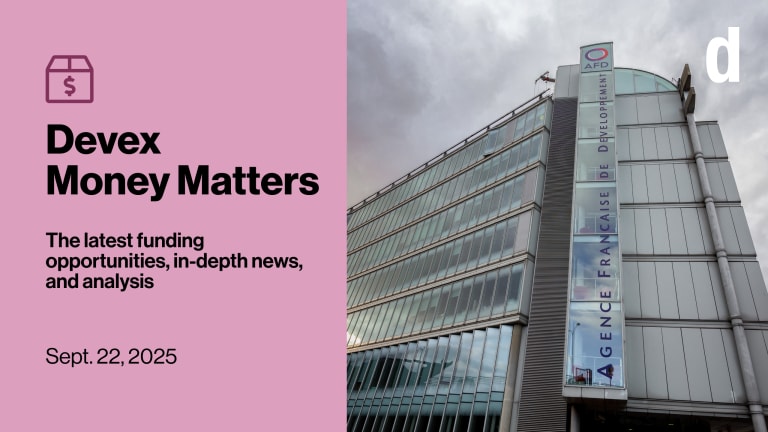


Yesterday, France went to the polls and reelected Emmanuel Macron as president. We look at what that means for the $15.4 billion French development sector.
+ Join us on April 28 at 10 a.m. ET (4 p.m. CET): Following recent concerns about Russian hacking in Ukraine and a major attack on the International Committee of the Red Cross, I will be hosting an in-depth discussion on the risks that NGOs face in times of cyberwarfare. Join me and leading experts as we explore how organizations can build cyber resilience. Save your spot for this Devex Pro Live event on April 28 at 10 a.m. ET (4 p.m. CET).
Liberté, égalité, philanthropie
Emmanuel Macron’s election victory is good news for French aid. Under his presidency, it has been steadily increasing relative to gross national income for several years. The most recent OECD statistics show France as the fifth largest donor in the world.
This is a preview of Devex Money Matters
Sign up to this weekly newsletter and get the latest in development funding in your inbox every Monday.
We regularly cover the French Development Agency, but France has a complex web of different agencies and departments making decisions about aid, which are extremely difficult for outsiders to follow. To start with, we’ve followed on the heels of our primer on German aid with a similar guide to what’s going on in Paris.

French aid: A primer (Pro)
The history: Macron began an overhaul of French aid policy during his first term, which now looks set to continue. For Pro subscribers, last year we summarized the key changes to French aid and heard directly from one of the architects of the reforms, Hervé Berville.
Funding activity
AFD. $4.3M (€4M) to support educational integration in Tunisia.
CABEI. $20M to strengthen key economic sectors in Nicaragua.
EC. $537.2M (€500M) to support EU farmers and consumers affected by the conflict in Ukraine.
USAID. $5.5M to provide cash transfers to refugees in Rwanda.
Know your addendum from your AIDAR?
USAID remains the world’s biggest donor in dollar terms, and it’s trying hard to make itself more accessible to locally led organizations. But there’s a big gap to bridge between the way USAID wants to do business and the way people in other countries are used to working.
As a foreign national used to covering government procurement, I was surprised by the bewildering array of unfamiliar terminology I encountered when I first met USAID. My conversations with others suggest this is a common problem.
As a result, we’ve assembled a glossary of terms commonly used at USAID. If you’re new to the agency, maybe this will help you tell your APS from your RFI.
Understanding USAID: A glossary of common terms in procurement (Pro)
+ With a Pro Funding subscription, track over 600,000 sources of global development funding news. You can use it to find information on key partners, set up custom alerts, and access analysis of funding trends. Start your five-day free trial now.
Back to DAC
Last week, as mentioned above, we brought you details of OECD numbers on total official development assistance. The rules governing ODA are set by the Development Assistance Committee. But does anyone really know how the rules are decided? Do we need more transparency around its activities? My colleague Vince Chadwick caught up with DAC chair Susanna Moorehead and grilled her on the key issues.
Q&A: What if all DAC meetings were public? (Pro)
Are you vulnerable to cyberattack?
Earlier this year, ICRC reported it had been hit by a major cyberattack. Since then, as the war has progressed in Ukraine, there have been reports of NGOs being hacked by the Russian government.
I speak with Olivia Williams, an expert in the field, who says that NGOs were frequently targets of attack, and were unprepared to defend themselves. The whole sector needs a culture change if it is to defend itself, she tells me.
Read: How vulnerable are NGOs to cyberattack? (Pro)
+ Be sure to register for our event: Risks for NGOs in times of cyberwarfare.
On a black horse
The world has already been heavily impacted by two of the four horsemen in recent times, in the form of the pandemic and the war in Ukraine. Now a third is on the way. Food prices are up 37% in a year, largely thanks to COVID-19 and conflict, and the World Bank estimates that hundreds of millions more people are likely to be thrown into food poverty.
My colleague Shabtai Gold has heard the bank is now worried that widespread hunger is on the horizon. The bank is considering an additional $170 billion of emergency funding for the lowest-income nations.
World Bank: Food prices up 37%, middle-income nations in crosshairs
Talent pooling
Are you a senior development worker? Are you open to or actively looking for a career change? Keep reading.
Featured opportunity: Germany grants Namibia $9.2M for urban development
The German government has agreed to a grant of 144.5 million Namibian dollars ($9.2 million) to establish an urban development fund in Namibia. This will come through KfW, and the fund will be accessible to local authorities that need support for infrastructure development. It is expected to come into operation next year, and funds will be available to recipients most likely in the form of grants.
At Devex, we are creating hand-picked talent pools so that the 400-plus globaldev organizations using our platform every day can recruit professionals like you.
We are currently looking to expand our talent pools for these positions: proposal writer, finance officer, monitoring and evaluation expert, business development specialist, and chief of party or team lead.
If you have over seven years of experience in any of these roles and would like to be considered for inclusion in these exclusive talent pools, make sure to update your Devex profile and upload a current CV.
+ Don’t know where to start? Check out our top tips for getting noticed by recruiters on Devex and our guide to a killer online profile.
Sign up to Money Matters for an inside look at the biggest stories in development funding.
About the author

David Ainsworth@daveainsworth4
David Ainsworth is business editor at Devex, where he writes about finance and funding issues for development institutions. He was previously a senior writer and editor for magazines specializing in nonprofits in the U.K. and worked as a policy and communications specialist in the nonprofit sector for a number of years. His team specializes in understanding reports and data and what it teaches us about how development functions.