


Fifty billion U.S. dollars for foreign aid is always a big deal. And in today’s climate, it’s even more so — especially if that money is coming from the United States.
Also in this edition: Inside the United States’ new approach to funding the United Nations, Germany’s latest development strategy, and a look at how the Novo Nordisk Foundation funds aid.
+ Are there topics you want to read more about in Money Matters? We want your feedback.
Halfway there
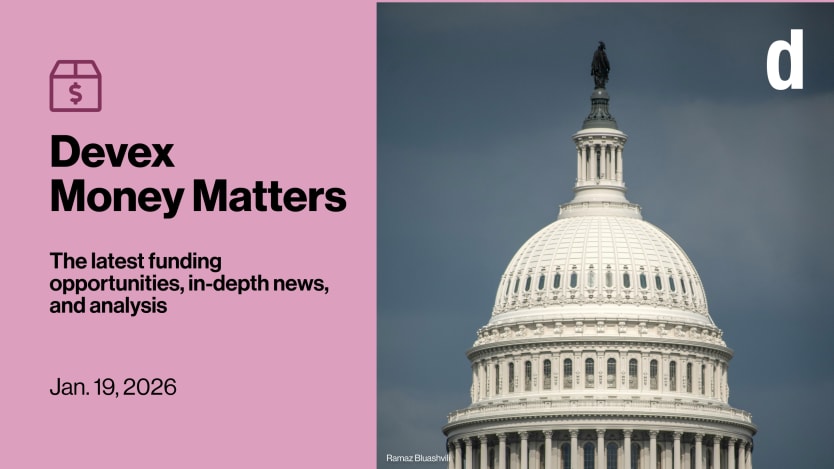
U.S. lawmakers have come to a compromise on foreign aid, with those from the House of Representatives and the Senate releasing a joint foreign assistance appropriations bill last week.
The bill — which has a $50 billion price tag — still needs to clear votes from both chambers before Jan. 30, when an existing funding bill expires. But even so, it’s good news for those pushing for more funding to foreign aid. While the figure is a 16% drop from last year’s spending bill, it’s $20 billion above what President Donald Trump requested earlier in his term.
“[The package] preserves core US global health investments, signaling continued bipartisan backing at a moment of real uncertainty,” says Janeen Madan Keller, the deputy director of the global health policy program and policy fellow at the Center for Global Development.
The bill includes support for Gavi, the Vaccine Alliance and the International Development Association, the World Bank’s fund for the poorest countries. But global health, as Keller suggests, is the biggest winner of the package: The sector gets $9.4 billion of total funding, down from $12.4 billion allocated in fiscal years 2025 and 2024.
“This bill has been long-awaited, but it’s not yet a done deal,” writes Senior Reporter Adva Saldinger. “And even if enacted, a central question remains: Will the Trump administration spend the money as Congress has directed?”
Read: US lawmakers strike $50B foreign assistance deal, surpassing Trump’s plan
Dig deeper: Unexpected global health wins in the US foreign aid bill
+ Join us this Wednesday, Jan. 21, for a Devex Pro Briefing where we’ll analyze what’s in the bill, what it took to get a foreign assistance bill that lawmakers on both sides of the aisle in the U.S. House of Representatives and Senate could agree to, and what will happen if the bill passes. Save your spot now.
Funding activity
We publish tenders, grants, and other funding announcements on our Funding Platform. Here are some of those viewed the most in the past 10 days.
Italian aid funder AICS has launched a €1.2 million ($1.4 million) call for proposals to enhance decent employment and mobility opportunities in Egypt.
The European Union has issued €110.5 million ($128.5 million) of funding to support security, recovery, and reforms in Lebanon.
German aid funder GIZ is seeking consultancy firms to assess the implementation of the Kampala declaration on jobs, livelihoods, and self-reliance for refugees, returnees, and host communities and the Djibouti declaration on refugee education across the Horn of Africa.
The government of Japan has announced $10.5 million of funding to support humanitarian and development efforts in Ethiopia.
The United Nations is inviting proposals for the development of standards and guidelines for climate finance in Bangladesh.
+ From daily funding opportunity alerts to exclusive intelligence on donor trends, Devex Pro Funding gives development professionals the edge they need to navigate today’s complex finance landscape — and win. Sign up with a five-day free trial now.
A $2 billion test
Late last year, the U.S. State Department pledged to give $2 billion to help the United Nations respond to the world’s most pressing humanitarian crises. Now, our Senior Global Reporter Colum Lynch has the details on how exactly that would work — all of which was plotted out in a confidential memorandum of understanding between the State Department’s foreign assistance head, Jeremy Lewin, and the U.N.’s humanitarian chief, Tom Fletcher.
In a nutshell, the funding will be channeled through pooled funds managed by the U.N. Office for the Coordination of Humanitarian Affairs, placing oversight with Fletcher and shifting greater decision-making power to U.N. humanitarian coordinators in the field.
“The new funding plan marked something of a shift in the institutional balance of power,” writes Colum, who broke the exclusive last week. “Over time, the State Department envisions all U.S. funding of U.N. humanitarian work to be channeled through pooled funds managed by Fletcher’s office.”
U.S. officials say the approach is meant to push reforms, cut overhead, and steer more money to frontline lifesaving work. And while the pledge represents only a fraction of the $33 billion the U.N. says it needs for humanitarian work this year — and excludes countries such as Afghanistan and Yemen — some are hoping it could signal Washington’s willingness to fund the institution in new ways.
“It’s a very, very low number relative to what the U.S. would traditionally provide. If this is it, it’s a catastrophe,” Jeremy Konyndyk, the president of Refugees International, tells Colum. “If this is the first down payment of several, then I think it will be intriguing to see how this plays out.”
Exclusive: Inside US-UN plan to remake funding for humanitarian crises
Strong and steady
While the State Department continues its foreign aid shake-up, the U.S. government’s Millennium Challenge Corporation is keeping its contracting dollars steady — but spreading them across far fewer awards, my colleague Miguel Antonio Tamonan reports.
MCC was created in 2004 to boost low-income countries’ economic growth. Last month, it published its latest business forecast, outlining 86 planned contracts worth up to $287.3 million. That’s nearly flat compared to last year’s $292 million forecast, though the number of awards dropped sharply, from 143 awards in fiscal year 2025.
The forecast signals a shift toward fewer, larger procurements rather than a pullback in overall spending. To date, 10 of those 86 contracts have already been approved, while another 16 are expected to be awarded within the first quarter of the year.
Read: How MCC plans to award $287.3 million in contracts in 2026 (Pro)
+ Interested in more funding coverage? Explore our funding insights page. If you aren’t a Devex Pro member yet, start your 15-day free trial now to access all our exclusive reporting, analyses, events, and more.
Germany’s aid reboot
The United States isn’t the only country making funding moves. Last week, Germany unveiled a new vision for its country’s development architecture, with the Federal Ministry for Economic Cooperation and Development, or BMZ, referring to itself as the largest aid agency in the world after the collapse of USAID.
“Experts told Devex that BMZ is moving in a positive direction with its reforms — focusing on least developed countries, or LDCs, offering loans rather than grants depending on the partner countries’ income level, and making a commitment to working with local partners,” my colleague Jesse Chase-Lubitz reports from Berlin.
The aid plan, Jesse writes, has four overarching goals: overcoming poverty and hunger, boosting peace and security, spurring economic growth through the private sector, and strengthening the multilateral system. Africa is now at the top of Germany’s development list, and Ukraine and the Middle East are front and center, too.
Still, the plan leaves some questioning how BMZ will actually implement it, especially when it comes to engaging the German private sector.
Read: Germany charts a new course for global aid
New kid, big shoes
The head of global development at the Novo Nordisk Foundation, a $1.4 billion philanthropy based in Hellerup, Denmark, describes the organization as “still a new kid on the block” when it comes to global development.
For 100 years, Novo Nordisk has prioritized scientific research — but increasingly, it has turned its attention toward noncommunicable diseases, food systems and nutrition, and climate resilience. In part, that’s due to a foundation-wide rethink as bilateral aid budgets tightened and humanitarian needs spiraled.
In the first Devex Pro Funding Briefing of 2026, the foundation’s director of global development, Rikke Johannessen, spoke about Novo Nordisk’s priorities, and how it emphasizes an “ecosystem approach” to its partnerships.
Read: From crisis grants to open calls — Novo Nordisk Foundation’s aid work (Pro)
+ Interested in exclusive conversations with nonprofit and philanthropy funders and policymakers? Check out upcoming events lined up for our professional members.
Sign up to Money Matters for an inside look at the biggest stories in development funding.
About the author

Elissa Miolene
Elissa Miolene covers U.S. foreign assistance from Washington, D.C. She previously covered education at The San Jose Mercury News, and has written for The Wall Street Journal, the San Francisco Chronicle, and other news outlets across the world. Before shifting to journalism, Elissa led communications for aid agencies in the United States, East Africa, and South Asia.
Search for articles

Most Read
- 1
- 2
- 3
- 4
- 5