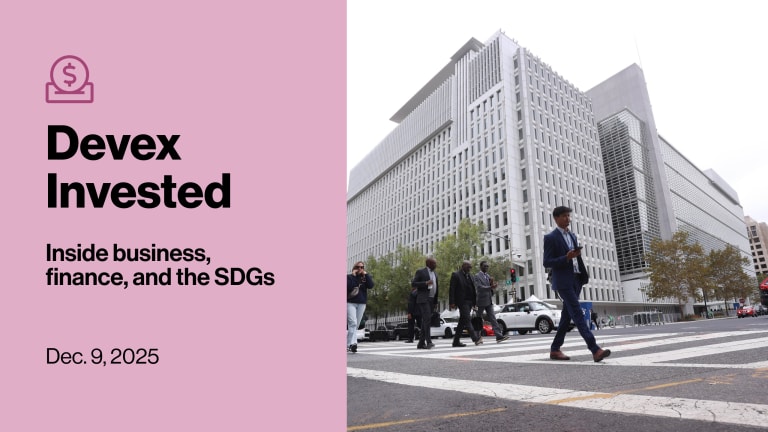
Mounting questions over World Bank’s sweeping consultant purge
Insiders challenge the World Bank's plan to eliminate 22,000 STC roles by 2027, citing operational challenges, U.S. visa politics, and mounting staff anxiety.
The World Bank’s plan to eliminate all short-term consultant positions in just over a year marks a major shift in how it manages its global workload — and it’s raising plenty of questions. Last month, the World Bank announced it will phase out all short-term consultants, or STCs, by January 2027, according to documents obtained by Devex. There are about 22,000 STCs — roughly equivalent to 7,000 full-time positions — making up a quarter of the World Bank Group’s workforce. The bank intends to transition some into extended-term consultant roles, some as full-time staff, and others into independent contractors, while some will leave altogether. Management has framed the move as administrative reform to create a “more strategic and sustainable approach,” boost staff ownership, and reduce dependence on a vast “contingent workforce.” But conversation and rumors are swirling that reducing the number of World Bank staff on G-4 visas in the United States could also be a factor — something sources close to the bank deny. The reliance on STCs is not accidental. Years of shareholder pressure to freeze hiring and cap administrative spending pushed teams to use STCs to meet rising demand. While many insiders agreed the system needed an overhaul, they also voiced concerns about how the transition would affect operations, staff, and workload distribution — especially as the bank is already undergoing a major reorganization and facing pressure to deliver more with existing resources. A retired World Bank manager told Devex that modernization is welcome, but “it’s coming in the midst of all of this change with no certainty that there will be enough resources to get the work done after eliminating STCs.” A system that evolved Broadly, the bank uses STCs for two reasons: highly specialized expertise unavailable internally, or repetitive work that keeps operations running. It’s the latter category that has gotten “overblown and overused,” the retired manager said. Many STCs are early career hires doing routine tasks such as website updates or operational monitoring — work managers increasingly defaulted to outsourcing instead of reallocating internally. Shareholder-imposed hiring limits also made it hard to bring in full-time staff, particularly at the entry level, leading managers to rely even more on STCs, several sources told Devex. “You want to have the staff deliver the bank’s work programs? I think that’s a commendable goal, but then increase the regular budget of the bank if you want that. This doesn’t seem to be the way to do that,” said Eeshani Kandpal, a senior fellow at the Center for Global Development, adding that STCs offered cheaper, more flexible ways to fill staffing gaps. A former senior U.S. government official told Devex that shareholders have been “very short-sighted with the cap on the administrative budget,” even as they demand more from the World Bank and other multilateral development banks. The politics Several sources told Devex there’s speculation that the Trump administration’s stance on immigration and its desire to reduce G-4 visas may be influencing the shift. Independent contractors — one of the categories STCs may move into — are not eligible for G-4 visas and must have local work authorization. “I think it’s known within the organization that now, under this administration, there is real pressure … to curb these visas,” the former manager said. Kandpal agreed that a different approach to G-4 visas under this administration likely plays a role. “I suspect it’s definitely part of the story here,” she said. But sources close to the bank said that the idea that U.S. pressure is driving reforms doesn’t make sense. World Bank President Ajay Banga raised concerns over the reliance on STCs from his first town hall with staff, they noted, and both bank leadership and the staff association have long viewed it as a structural problem. The overhaul of the contingent workforce — including the elimination of STCs — is a global decision and isn’t “being shaped by U.S. immigration policies,” the sources said. They also noted that most consultants are based outside the U.S., not in Washington, D.C. Under current rules, STCs can continue through Dec. 31, 2026, and keep their G-4 visas until then. The bank says it will offer career advisory services, visa guidance, and an online platform to connect STCs with opportunities at peer organizations. The questions A former senior U.S. government official said three questions loom: Will operations improve? Who will be most affected? And can the transition be managed well? “What’s the transition, what’s the plan, what are we doing?” the former U.S. official said. “What is the plan for the work? Is the assumption that combining units will create efficiencies? Where is the data?” Nearly all sources expressed concern about operational impact. Eliminating STCs will force the bank to “completely reconfigure the way that it prepares projects,” a former STC told Devex, warning that teams may struggle to maintain quality if they can’t bring in short-term expertise and don’t have enough staff to pick up the work. Hiring extended-term consultants or independent contractors will also be more expensive, pushing managers to be more strategic and creative with staffing, a former manager said. The bank argues that using vendors for specialized, time-bound skills aligns with global best practice. Several sources expect former STCs to join companies offering their services back to the bank as contractors, though evidence of that is lacking. Illuminate LLC’s recent LinkedIn post recruiting former World Bank consultants could be an early sign. There are also questions about staff diversity, access, and morale. If more roles require local work authorization, the bank risks losing parts of its globally diverse workforce. And contractors typically have more limited access to internal systems, including redress mechanisms, sources said. Above all, insiders say uncertainty is weighing on staff. “There’s this pervasive sense of anxiety right now,” the retired World Bank manager said. “You just walk into the bank — people are anxious.”
The World Bank’s plan to eliminate all short-term consultant positions in just over a year marks a major shift in how it manages its global workload — and it’s raising plenty of questions.
Last month, the World Bank announced it will phase out all short-term consultants, or STCs, by January 2027, according to documents obtained by Devex. There are about 22,000 STCs — roughly equivalent to 7,000 full-time positions — making up a quarter of the World Bank Group’s workforce. The bank intends to transition some into extended-term consultant roles, some as full-time staff, and others into independent contractors, while some will leave altogether.
Management has framed the move as administrative reform to create a “more strategic and sustainable approach,” boost staff ownership, and reduce dependence on a vast “contingent workforce.”
This story is forDevex Promembers
Unlock this story now with a 15-day free trial of Devex Pro.
With a Devex Pro subscription you'll get access to deeper analysis and exclusive insights from our reporters and analysts.
Start my free trialRequest a group subscription Printing articles to share with others is a breach of our terms and conditions and copyright policy. Please use the sharing options on the left side of the article. Devex Pro members may share up to 10 articles per month using the Pro share tool ( ).
Adva Saldinger is a Senior Reporter at Devex where she covers development finance, as well as U.S. foreign aid policy. Adva explores the role the private sector and private capital play in development and authors the weekly Devex Invested newsletter bringing the latest news on the role of business and finance in addressing global challenges. A journalist with more than 10 years of experience, she has worked at several newspapers in the U.S. and lived in both Ghana and South Africa.