
Devex Invested: Anxiety brews at World Bank over workforce overhaul




Presented by the Asian Infrastructure Investment Bank
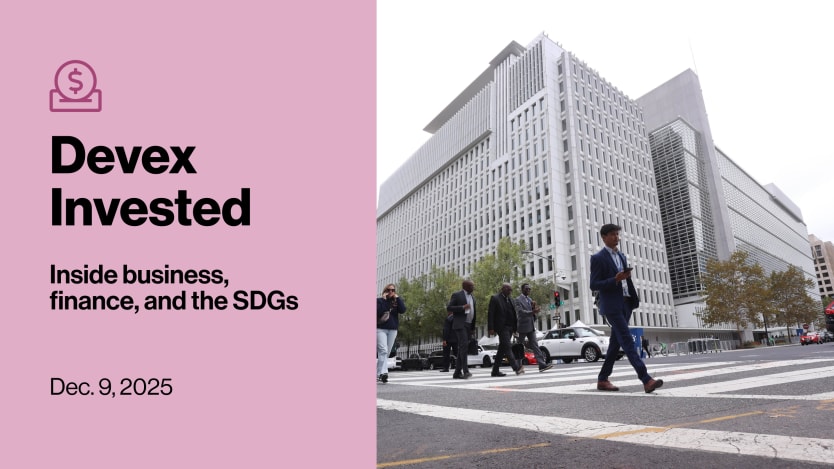
If the mood inside the World Bank’s Washington headquarters feels anxious this week, there is a good reason. The institution is embarking on a massive workforce overhaul and has announced plans to phase out all short-term consultant, or STC, positions by January 2027. That’s roughly 22,000 people.
The bank’s management framed the decision as a “more strategic and sustainable approach.” For years, shareholder pressure to cap administrative spending forced managers to freeze hiring and rely on a vast “contingent workforce” to keep the lights on, my colleague Adva Saldinger writes. These consultants, who now make up a quarter of the bank's staff — equivalent to 7,000 full-time roles — handle everything from routine website updates to specialized economic analysis.
Now, the bank intends to transition this workload to extended-term consultants, full-time staff, or independent contractors.
The implications for the bank are steep. A former manager warns that the shift creates “no certainty that there will be enough resources to get the work done after eliminating STCs.” There are financial questions, too: Hiring extended-term consultants or independent contractors will be more expensive, forcing managers to be more “creative” with staffing.
“What’s the transition, what’s the plan, what are we doing?” a former U.S. official tells Adva. “What is the plan for the work? Is the assumption that combining units will create efficiencies? Where is the data?”
In the hallways of 1818 H Street NW in Washington, D.C., speculation is swirling that a different factor is driving the timeline: U.S. immigration politics.
With the Trump administration expected to scrutinize immigration and international visas, sources tell Adva that there is a belief that the shift is a preemptive move to reduce the number of staff on G-4 visas — which are nonimmigrant visas for employees of designated international organizations. But the institution’s leadership denies this, noting that World Bank President Ajay Banga has criticized the overreliance on STCs since his first town hall.
Read: Mounting questions over World Bank’s sweeping consultant purge (Pro)
Background: World Bank staff alarmed by plan to phase out short-term consultants
+ Not yet a Pro member? Start your 15-day free trial today to access all our expert analyses, insider reporting, funding data, exclusive events and briefings with sector leaders, policymakers and influencers, and more. Check out some of the content exclusive to Pro readers.
Even trade
In a move that could signal a strategic evolution for U.S. development finance, Kenya and the U.S. International Development Finance Corporation, or DFC, have agreed to a $1 billion debt-for-food swap.
The arrangement, announced by Kenyan President William Ruto last week after meeting with DFC CEO Ben Black, allows Nairobi to restructure a portion of its external liabilities. By swapping costly existing debt for lower-cost financing, Kenya aims to redirect the savings into food security programs — which offers a financial lifeline to a heavily indebted African economy.
The deal comes as Kenya faces acute fiscal pressure. As of August, the country carried $41.8 billion in external debt, with one of the highest interest-to-revenue ratios in the world — and roughly one-third of government revenue now goes solely to servicing interest.
Observers of DFC say the deal suggests the agency is broadening its scope. While the Trump administration has previously focused its development finance strategy on critical minerals and supply chains — such as the Lobito corridor — this move could hint at a change in DFC’s role.
“Until now, the Trump administration has basically been focusing in a singular manner on critical minerals, and so, broadening that aperture to other sectors could signal an evolution on how they see the DFC’s role,” Carnegie Endowment for International Peace scholar Afreen Akhter tells my colleague Ayenat Mersie.
The critical minerals push is remaining strong, however. DFC also issued a letter of interest detailing an investment into a joint venture that is made up of a commodities group and a state-owned enterprise in the Democratic Republic of Congo to help them commercialize their minerals. A second letter shows interest in assisting the rehabilitation of a railway line in the DRC to connect it with the Lobito Atlantic Railway in Angola.
Read: Kenya lands $1B debt-for-food swap with US DFC
One big number
$741 billion
—That’s how much more money low- and middle-income countries paid out in principal and interest on their external debt than they received in new financing between 2022 and 2024 — the largest gap in at least 50 years, according to the World Bank’s latest International Debt Report.
Related opinion: Time for a rally in global debt reform
A climate change debt trap
Your next job?
Lead/Principal Investment Officer, Loan Syndication
Asian Infrastructure Investment Bank
Worldwide (based in Beijing, China)
As the world focuses on the more tangible risks of climate change, a financial storm is brewing. Low- and middle-income countries are currently paying billions more to service debt than they receive in climate financing. This imbalance creates a vicious cycle of “climate inflation,” where environmental shocks disrupt supply chains and drive up local prices, compelling central banks to raise interest rates — which only makes future borrowing for infrastructure recovery unsustainable.
In an opinion piece for Devex, Eman Peri, a lawyer and researcher specializing in sustainability, development policy, and climate finance, explores why the current model of high-interest borrowing to fund recovery is creating a solvency trap for nations such as Belize, Sri Lanka, and Pakistan.
While the IMF and World Bank have introduced resilience programs, Peri says these are insufficient without a fundamental framework shift. She argues that international creditors must move beyond rigid repayment structures, while local governments in the global south must urgently overhaul fragmented governance to build the institutional capacity required for a green future.
Opinion: How debt is undermining countries’ fight against climate change
What we’re reading
Qatar’s quiet rise as a development powerhouse. [Devex Pro]
How nine multilateral development banks are incorporating nature and biodiversity considerations into their processes. [World Resources Institute]
The Lao people’s debt-disclosure republic. [Financial Times]
About the author

Jesse Chase-Lubitz
Jesse Chase-Lubitz covers climate change and multilateral development banks for Devex. She previously worked at Nature Magazine, where she received a Pulitzer grant for an investigation into land reclamation. She has written for outlets such as Al Jazeera, Bloomberg, the Organized Crime and Corruption Reporting Project, and The Japan Times, among others. Jesse holds a master’s degree in Environmental Policy and Regulation from the London School of Economics.
Search for articles


Most Read
- 1
- 2
- 3
- 4
- 5