• News
    • Latest news
    • News search
    • Health
    • Finance
    • Food
    • Career news
    • Content series
    • Focus areas
    • Try Devex Pro
  • Jobs
    • Job search
    • Post a job
    • Employer search
    • CV Writing
    • Upcoming career events
    • Try Career Account
  • Funding
    • Funding search
    • Funding news
  • Talent
    • Candidate search
    • Devex Talent Solutions
  • Events
    • Upcoming and past events
    • Partner on an event
  • Post a job
  • About
      • About us
      • Membership
      • Newsletters
      • Advertising partnerships
      • Devex Talent Solutions
      • Contact us
Join DevexSign in
Join DevexSign in

News

  • Latest news
  • News search
  • Health
  • Finance
  • Food
  • Career news
  • Content series
  • Focus areas
  • Try Devex Pro

Jobs

  • Job search
  • Post a job
  • Employer search
  • CV Writing
  • Upcoming career events
  • Try Career Account

Funding

  • Funding search
  • Funding news

Talent

  • Candidate search
  • Devex Talent Solutions

Events

  • Upcoming and past events
  • Partner on an event
Post a job

About

  • About us
  • Membership
  • Newsletters
  • Advertising partnerships
  • Devex Talent Solutions
  • Contact us
  • My Devex
  • Update my profile % complete
  • Account & privacy settings
  • My saved jobs
  • Manage newsletters
  • Support
  • Sign out
Latest newsNews searchHealthFinanceFoodCareer newsContent seriesFocus areasTry Devex Pro
    • News
    • Munich Security Conference 2025

    Munich diary: The latest from the jam-packed security conference

    Heavy hitters and heavy rhetoric take over the Munich Security Conference.

    By Hayley Mundeva, Anna Gawel // 15 February 2025
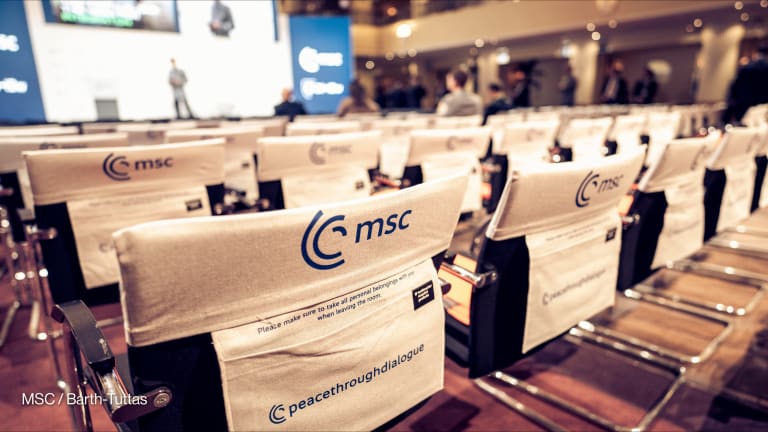
    Valentine’s Day coincides with the opening of the Munich Security Conference. Despite this, the vibe in Germany is anything but romantic. The mood remains somber, overshadowed by a tragic incident where a man drove his car into a crowd just a few blocks away yesterday, injuring dozens. Apart from one striking red suit that stood out and a few heart decorations at the Politico Pub, the general sentiment is decidedly gloomy. The mood shifted to stunned silence following U.S. Vice President JD Vance's packed, fiery speech, a broadside against Europe criticizing its “out-of-control” migration and alleged political censorship, which he claimed threatens democratic values. “The Cold War positioned defenders of democracy against much more tyrannical forces on this continent. Consider the side in that fight that censored dissidents, that closed churches, that canceled elections — were they the good guys? Certainly not, and thank God they lost,” Vance said. “Unfortunately, when I look at Europe today, it’s sometimes not so clear what happened to some of the Cold War’s winners.” Away from the global spotlights trained on Vance’s controversial comments, Ghana’s President John Dramani Mahama warned the United States in his speech at the opening session: Expect to lose influence abroad to other major powers because of your massive aid cuts. “There are many other partners. The U.S. are not our only partner. We will continue to cooperate with other countries and that’s why we have a multipolar world,” he said, without mentioning the widely predicted main beneficiary, which is China. “As bridges are burning, new bridges are being formed. We need to look for those new bridges and link the world with those new bridges,” Mahama added. From the war of words to the geopolitical tensions to the lighter moments, we’re featuring highlights from the Munich Security Conference to keep you updated throughout the weekend. Climate warnings served up in Munich A dinner menu as a wake-up call? That's exactly what Sam Kass, a former White House under the Obama administration, served up at Munich's “Dinner of Extinction” — where every ingredient told a story about climate change's looming impact on our food systems. Speaking with attendees at the Council on Foreign Relations and MSC-hosted event, the message was clear, those wine, chocolate, and coffee lovers among us might want to pay attention: These everyday luxuries could become increasingly scarce and expensive if climate action stays on the back burner. The dinner drew heavy hitters from across the policy and business spectrum, including World Food Programme head Cindy McCain and economist Vera Songwe, with CFR President Michael Froman, former head of the U.S. International Development Finance Corporation Scott Nathan, and Bayer's Matthias Berninger. But the evening's focus on food security landed at a particularly fraught moment. With a suspected terrorist incident unfolding nearby in Munich, and Germany's upcoming national elections pointing to a potential surge for the far right — polling suggests 20% support — the dinner's themes of climate and food security felt increasingly entangled with broader political currents. Against the backdrop of Trump's recent withdrawal of the U.S. from the Paris Climate Agreement, one wonders if this creative approach to climate messaging will prove more digestible than traditional warnings — or if it's just another well-plated reality check destined for the policy compost bin. Munich breakfast reveals aid reality Development leaders traded hard truths over breakfast at the MSC on Friday, revealing an aid system at a breaking point — and potentially ready for transformation. The surprising insight? As traditional funding faces cuts, small, flexible funding through trusted local networks is proving remarkably effective. Examples abound: local partners mobilizing hundreds of civil engineers for urgent post-earthquake safety checks with just $2,000 — while major funding remained tied up in bureaucracy. A peacebuilding network preventing violence in Syria through rapid response, demonstrating how agile operations can deliver outsized impact. Yet the discussion revealed deeper challenges. Western compliance requirements make promising projects unviable in Africa, while artificial divisions between humanitarian aid, development, and security undermine effectiveness. One example? An entrepreneur working to electrify vehicles can’t access development financing because they don't fit traditional funding categories. The path forward requires fundamental shifts: simplifying compliance to unlock private sector engagement, better leveraging the hundreds of billions of dollars flow annually through remittances, and moving from rigid funding silos to flexible, trust-based models. The stakes go beyond aid effectiveness — as one participant noted, the very future of multilateral cooperation hangs in the balance. Tech's development dilemma: Protection vs. progress At MSC on Friday morning, Tanzanian member of Parliament Neema Lugangira spoke with Devex about a central challenge in development: how to leverage digital technology while protecting against exploitation. As founder and chair of the African Parliamentary Network on Internet Governance, Lugangira explained how African countries must develop infrastructure and skills while ensuring “global north tech companies don't take advantage of our lack of robust legislation” around artificial intelligence and data monetization. The path forward? Lugangira sees a dual-track approach: accelerating digital transformation through infrastructure development and skills training, while simultaneously building robust legislation around AI and data. With global development aid shrinking, she argues these safeguards are critical for ensuring Africa's digital transformation benefits its own people. This balance extends beyond tech to other sectors. Africa's food systems, for instance, represent another massive market opportunity that requires similar protective frameworks. “Africa can trade amongst itself, but also export,” Lugangira noted. MSC has now launched its first food systems task force — a growing recognition that in today's development landscape, growth and guardrails must advance together. When political violence goes digital “I was shot at. I was involved in accidents because my vehicle was tampered with, had a broken leg,” Nigerian Senator Natasha Akpoti Uduaghan told Devex at the MSC, describing her path to office. The chair of Nigeria's committee on diaspora and NGOs shared her firsthand experience with the evolving nature of political violence. The repercussions of the online attacks against her in October 2022, which falsely accused her of terrorism, even affected her baby: “In two days, my breast milk dried because I was too afraid.” Her experience points to a growing challenge in strengthening democratic institutions. While international aid often focuses on expanding political access and participation, coordinated disinformation campaigns can quickly undermine these investments. “No one should have to go through this amount of torture just because she wants to be given a space to serve,” she said. Making her MSC debut, Akpoti Uduaghan called for stronger international frameworks to combat political violence. Her story reveals an emerging reality: In today's political arena, digital protection is as crucial as physical security. Can raw material partnerships break the race to the bottom? With critical mineral demand soaring and defense spending putting additional pressure on the sector, traditional resource extraction models are getting a hard look at the Munich Security Conference — and the pressure for change is coming from resource-rich countries themselves. Speaking with Devex at MSC, Ingrid-Gabriela Hoven, managing director of the German development agency GIZ, emphasized how partner countries are pushing back against the old approach. "They don't want to call it a traditional export model, where we simply deliver the raw materials," Hoven explained. "We need jobs for our young generation. We want to have an income, and we want to conduct the business in a sustainable way." The solution? Partnerships that go beyond extraction. In Chile, GIZ is working to improve environmental and social standards in lithium production while working to bring in foreign investors across different sectors. In Africa, they're advising governments on contracts with mining industries to ensure fair prices. But time might be running out. "The investments that I see in building up those partnerships, in supporting regional institutions … is not commensurate with the challenges that we are going to face," the managing director warned, emphasizing the need for stronger institutional networks. As demands for critical minerals increase, the race isn't just about securing resources — it's about ensuring gains are "distributed in a fair manner." Experts sound the alarm on gaps in global health security On the second day of the Munich Security Conference, experts warned that silos in public health, security, and foreign aid are leaving the world vulnerable to the next pandemic. Discussions highlighted urgent gaps in global disease surveillance — limited data sharing between countries, funding challenges in low- and middle-income nations, and the geopolitical complexities of pandemic response as the aid industry continues to be massively disrupted. Speakers debated the role of the military in public health crises, with some advocating for deeper collaboration, while others cautioned against misaligned priorities. Concerns were also raised about the declining effectiveness of global health information-sharing mechanisms, shifting U.S. foreign aid priorities, and whether regional public health bodies could complement or replace a weakened World Health Organization. Food security has risen in prominence on the global security agenda at MSC — could health security be next? With the aid industry in turmoil and health threats increasingly going global, the public health community faces a pressing challenge: adapt to new security realities or risk being sidelined in future crises. Can public-private-philanthropy partnerships bridge the energy gap? New models of collaboration between public, private, and philanthropic sectors are essential for energy security, according to leaders at the Munich Security Conference. A panel brought together Ndidi Okonkwo Nwuneli of the ONE Campaign, Laurence Tubiana of the European Climate Foundation, and John Studzinski of PIMCO. "Real public-private partnerships are win-wins,” Studzinski said, adding that these partnerships thrive when stakeholders recognize that "no two partners look at the same project through the same lens.” The recently launched Mission 300 is a key example, bringing together the World Bank, African Development Bank, and Rockefeller Foundation to address energy access in Africa. The initiative has secured commitments from "30 African governments to sign a compact to say, ‘This is our part. We'll create the policy environment. We'll commit to supporting the infrastructure,’" Nwuneli said. The challenge of risk perception in African investment also emerged as an important theme. "There continues to be a risk premium placed on investment in Africa, which is unacceptable. It's tied to bias," affecting how partnerships develop and succeed,” Nwuneli said. Success requires long-term thinking: "Real partnerships require you lock arms ... it's a three- to five-year commitment of people and money,” Studzinski said. In fact, "it’s not about debt. It's about taking a long-term equity interest." Building on COP29's multilateral momentum The path from the U.N. Climate Change Conference in Azerbaijan, or COP29, to COP30 in Brazil is paved with proof that international cooperation can still deliver results, according to leaders at the Munich Security Conference. A panel brought together COP29 President and Minister of Ecology of Azerbaijan Mukhtar Babayev; Deputy Minister of the Azerbaijan Ministry of Foreign Affairs Yalchin Rafiyev; State Secretary and Special Envoy for International Climate Action Jennifer Morgan; E3G Founding Director and co-CEO Nick Mabey; and Brazil's Secretary of Multilateral Political Affairs Carlos Márcio Bicalho Cozendey. "COP29 proved that multilateralism can still work. It showed that countries can still come together, find solutions, and deliver results," Babayev said, noting that two major breakthroughs emerged from the Azerbaijan conference: carbon market negotiations and a historic climate finance goal. After a decade since first being proposed in the Paris climate agreement, the carbon markets framework is finally taking shape, Babayev said. Even more significant was "the historic Baku finance goal to mobilize at least $300 billion a year for developing countries by 2035" — triple the previous target, he added. Looking ahead to Brazil's COP30 in Belém, where nations will present their next round of emissions-cutting commitments through 2035, Babayev’s message was emphatic: “The truth is that working together is our only hope to address the full scale of the climate crisis.” As aid budgets crumble, Norway won't budge Development budgets may be shrinking across Europe, but Norway isn't backing down from its $5 billion annual development aid commitment — about "one percentage of our national income." Speaking with Devex's President and Editor-in-Chief Raj Kumar, Åsmund Grøver Aukrust, the minister of international development, emphasized that while Norway provides aid partly because "in our hearts, you want to support people that are living in war and conflict," the more pressing reason is national security. "War and conflicts in other countries have a big effect, also back home in Norway and in every other country," he explained. The conversation comes at a critical moment, with USAID — "our most important partner" — facing unprecedented challenges. Many Norwegian NGOs rely on U.S. funding, and as Aukrust warned, "no country in the world can take the role that Americans have." Looking ahead, Aukrust believes "we should do more investments" and wants "more private capital, more private funding into development agenda." But with multiple humanitarian crises unfolding — from Ukraine to Sudan to the Middle East — he maintains that "development aid would still be necessary." For now, Norway's Labor Party, with its "100 years tradition of international solidarity," is maintaining its commitment even as other European donors scale back. Whether this continues may depend on September's elections — as Aukrust noted, "in the end, it's up to…voters." Join the club At every turn of the Munich Security Conference, there is a famous face to pique people’s interest or a speech tackling some of the world’s gravest challenges. Ideas flow freely during the day, just as the wine flows freely at night. More and more representatives from the global south are in attendance, a reflection of MSC’s increasing recognition of the nexus between development and defense. But is the whole experience just a bit too swish — or stodgy, depending on your perspective? Do the speeches and panels say anything new — delivered by new voices? It’s iffy, according to one U.S. senator, Brian Schatz, a Democrat from Hawaii. “This is only my second MSC, and it's a club. Everybody knows each other. There are cocktail parties, there are old and dear friends,” Schatz told a conference side meeting. “It really is time for a new generation of thinkers to reform our systems in such a way that we can have more peace, more stability, more justice going forward.” Schatz went on to say the conference “is in desperate need of some new ideas,” adding: “And that is not just the same people with new ideas that they've read in the Atlantic, but actually new people.” Whether the rebuke earns the senator a return invitation to MSC 2026, only time will tell.

    Related Stories

    8 things we learned at the UK Labour Party conference
    8 things we learned at the UK Labour Party conference
    Devex Newswire: Is Trump's latest UN demand proactive or pointless?
    Devex Newswire: Is Trump's latest UN demand proactive or pointless?
    UNGA80 reporters' notebook: Day 4
    UNGA80 reporters' notebook: Day 4
    Pension funds and investors quietly back climate investing
    Pension funds and investors quietly back climate investing

    Valentine’s Day coincides with the opening of the Munich Security Conference. Despite this, the vibe in Germany is anything but romantic. The mood remains somber, overshadowed by a tragic incident where a man drove his car into a crowd just a few blocks away yesterday, injuring dozens. Apart from one striking red suit that stood out and a few heart decorations at the Politico Pub, the general sentiment is decidedly gloomy.

    The mood shifted to stunned silence following U.S. Vice President JD Vance's packed, fiery speech, a broadside against Europe criticizing its “out-of-control” migration and alleged political censorship, which he claimed threatens democratic values.

    “The Cold War positioned defenders of democracy against much more tyrannical forces on this continent. Consider the side in that fight that censored dissidents, that closed churches, that canceled elections — were they the good guys? Certainly not, and thank God they lost,” Vance said. “Unfortunately, when I look at Europe today, it’s sometimes not so clear what happened to some of the Cold War’s winners.”

    This article is free to read - just register or sign in

    Access news, newsletters, events and more.

    Join usSign in

    Read more:

    ► Ghana on US aid cuts: ‘As bridges are burning, new bridges are formed’

    ► Scoop: EU halts funding as OACPS woes ‘more serious than expected’

    ► Belgium just cut its foreign aid by 25%. Does anybody care? (Pro)

    • Democracy, Human Rights & Governance
    • Trade & Policy
    • Environment & Natural Resources
    • Economic Development
    • Munich Security Conference (MSC)
    • Munich, Germany
    Printing articles to share with others is a breach of our terms and conditions and copyright policy. Please use the sharing options on the left side of the article. Devex Pro members may share up to 10 articles per month using the Pro share tool ( ).

    About the authors

    • Hayley Mundeva

      Hayley Mundeva

      Hayley Mundeva is the Communications Lead at Devex, where she handles executive communications, podcast production, and other signature content. Born in Nepal and based in Rwanda, she brings communications consulting experience spanning private businesses, nonprofits, and international organizations in East Africa, Southeast Asia, and North America. She holds a master's degree in global health.
    • Anna Gawel

      Anna Gawel

      Anna Gawel is the Managing Editor of Devex. She previously worked as the managing editor of The Washington Diplomat, the flagship publication of D.C.’s diplomatic community. She’s had hundreds of articles published on world affairs, U.S. foreign policy, politics, security, trade, travel and the arts on topics ranging from the impact of State Department budget cuts to Caribbean efforts to fight climate change. She was also a broadcast producer and digital editor at WTOP News and host of the Global 360 podcast. She holds a journalism degree from the University of Maryland in College Park.

    Search for articles

    Related Stories

    UK AidRelated Stories - 8 things we learned at the UK Labour Party conference

    8 things we learned at the UK Labour Party conference

    Devex NewswireRelated Stories - Devex Newswire: Is Trump's latest UN demand proactive or pointless?

    Devex Newswire: Is Trump's latest UN demand proactive or pointless?

    UNGA 2025Related Stories - UNGA80 reporters' notebook: Day 4

    UNGA80 reporters' notebook: Day 4

    Climate FinanceRelated Stories - Pension funds and investors quietly back climate investing

    Pension funds and investors quietly back climate investing

    Most Read

    • 1
      Why NTDs are a prime investment for philanthropy
    • 2
      The silent, growing CKD epidemic signals action is needed today
    • 3
      Trump withdraws, defunds dozens of international orgs and treaties
    • 4
      Why capital without knowledge-sharing won't solve the NCD crisis
    • 5
      Why are 3.4 billion people still offline?
    • News
    • Jobs
    • Funding
    • Talent
    • Events

    Devex is the media platform for the global development community.

    A social enterprise, we connect and inform over 1.3 million development, health, humanitarian, and sustainability professionals through news, business intelligence, and funding & career opportunities so you can do more good for more people. We invite you to join us.

    • About us
    • Membership
    • Newsletters
    • Advertising partnerships
    • Devex Talent Solutions
    • Post a job
    • Careers at Devex
    • Contact us
    © Copyright 2000 - 2026 Devex|User Agreement|Privacy Statement