




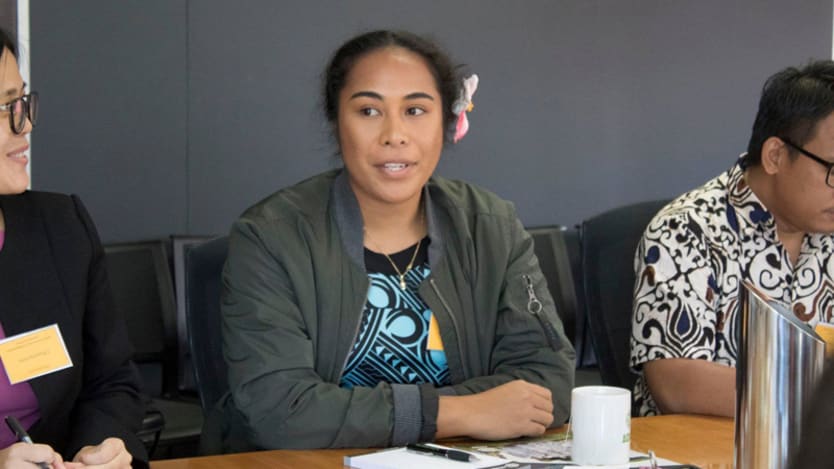
CANBERRA — Amy Maslen-Miller is a new kind of researcher focused on indigenous agriculture. Young and passionate about what science can bring to food security, she is also keen to understand traditional approaches to agriculture — and bring the two together.
“We need to be looking outside the lab more to be able to support farming.”
— Amy Maslen-Miller, Samoan scientistMaslen-Miller’s pathway was established thanks to programs at the University of Auckland building support for Māori and Pasifika students — along with lecturers bringing indigenous practices into the courses.
Today, she is with the Scientific Research Organisation of Samoa researching taro, a root vegetable that has a strong link with traditional farming. Problems with fungus have impacted production and economic opportunities for farmers. Through scientific research, Maslen-Miller is hoping to support Samoans to continue farming the vegetable.
Beyond this, New Zealand-born Maslen-Miller is hoping to find new ways of connecting with her Samoan ancestry and bring traditional methods of Pacific agriculture to contemporary science.
Other Māori and Pasifika students supported by the University of Auckland have followed paths into fisheries research and other areas of agriculture and food production, with strong connections between their research and links to indigenous cultures.
While in Australia, as part of the John Dillon Memorial Fellowship, supported by the Australian Centre for International Agricultural Research, Maslen-Miller spoke to Devex about her research to promote indigenous culture — and her unique journey to this career path.
A new career choice
“I was brought up the Kiwi way and had no understanding of Samoan culture,” Maslen-Miller said. “It was only during university that I wanted to learn more about the Samoan culture.”
Before university, science wasn’t even on the agenda — music was her passion. But through following the interests of friends, she fell into a biology degree.
“My first love was music — I play the violin,” Maslen-Miller said. “Initially it was a shock — it was a challenge. I wasn’t good at science ... It was in my first year that I was introduced to a program at the University of Auckland for Māori and Pasifika students to [get] support with their academic work in the form of workshops, support groups, and they helped me get through university ... When I got over the first year, I was fine — I could understand the link between science and my culture, and that was partly because of the program.”
The University of Auckland’s support is not only important in introducing the association between indigenous culture and science — including in the use of plants, which Maslen-Miller described as a “lightbulb moment” — but also in ensuring Māori and Pasifika students are supported to pursue a career in their chosen field of study.
By ensuring indigenous culture and practices were part of university courses, students could make connections between heritage and science.
“I can now clearly see how the work of agriculture can impact places like Samoa in food security,” she said. “That shows the importance of the work we are doing.”
The importance of giving back
Despite her Samoan heritage, Maslen-Miller had never been to Samoa, nor did she speak the language. Immersing herself in the culture allowed her to understand more about indigenous and traditional practices related to agriculture, and identify the need for greater links to science.
“That’s one of the main reasons I am in science — because I am able to give back to Samoa and indigenous communities,” she said.
But it is still a learning curve as she discovers more about Samoan culture and the approaches her colleagues are taking — including a project within the Scientific Research Organisation of Samoa that highlights the value of medicinal plants.
“Within Samoa, there are traditional healers and they use plants in a variety of ways. They use the leaves, the seeds, and more to treat sores and sickness,” she said.
The research aims to look at the health benefits of traditional healing. And for Maslen-Miller it highlights how indigenous knowledge can be combined with Samoan science.
"We need to be looking outside the lab more to be able to support farming,” she said.
There is resistance to combining indigenous practices with science — not just from scientists but from indigenous elders who are concerned their knowledge may be misused for commercial or other gains. But this is not stopping Maslen-Miller from trying to communicate the way that they can complement and benefit each other.
Sharing knowledge, science, and culture
Under the moniker of “Samoan scientists,” Maslen-Miller is encouraging young Pasifika women such as herself to pursue a career in science, as well as to educate scientists and government on the value of considering indigenous approaches in research and policymaking.
She’s reaching out to a diverse audience through Facebook, Twitter, Instagram, and YouTube.
“It is a snapshot into my journey as a scientist to get the community to know about science beyond lab coats,” she said. “And it gives my perspective as a Samoan woman. It is my way of engaging the community, and opportunities have arisen through that channel. It is how I can support the sharing of knowledge and inspire others.”
With agriculture and food security critical to the world’s future, especially in the Pacific which is feeling the effect of changes in climate and environment, the more Pasifika women inspired to solve these challenges, the better.
About the author

Lisa Cornishlisa_cornish
Lisa Cornish is a former Devex Senior Reporter based in Canberra, where she focuses on the Australian aid community. Lisa has worked with News Corp Australia as a data journalist and has been published throughout Australia in the Daily Telegraph in Melbourne, Herald Sun in Melbourne, Courier-Mail in Brisbane, and online through news.com.au. Lisa additionally consults with Australian government providing data analytics, reporting and visualization services.