• News
    • Latest news
    • News search
    • Health
    • Finance
    • Food
    • Career news
    • Content series
    • Focus areas
    • Try Devex Pro
  • Jobs
    • Job search
    • Post a job
    • Employer search
    • CV Writing
    • Upcoming career events
    • Try Career Account
  • Funding
    • Funding search
    • Funding news
  • Talent
    • Candidate search
    • Devex Talent Solutions
  • Events
    • Upcoming and past events
    • Partner on an event
  • Post a job
  • About
      • About us
      • Membership
      • Newsletters
      • Advertising partnerships
      • Devex Talent Solutions
      • Contact us
Join DevexSign in
Join DevexSign in

News

  • Latest news
  • News search
  • Health
  • Finance
  • Food
  • Career news
  • Content series
  • Focus areas
  • Try Devex Pro

Jobs

  • Job search
  • Post a job
  • Employer search
  • CV Writing
  • Upcoming career events
  • Try Career Account

Funding

  • Funding search
  • Funding news

Talent

  • Candidate search
  • Devex Talent Solutions

Events

  • Upcoming and past events
  • Partner on an event
Post a job

About

  • About us
  • Membership
  • Newsletters
  • Advertising partnerships
  • Devex Talent Solutions
  • Contact us
  • My Devex
  • Update my profile % complete
  • Account & privacy settings
  • My saved jobs
  • Manage newsletters
  • Support
  • Sign out
Latest newsNews searchHealthFinanceFoodCareer newsContent seriesFocus areasTry Devex Pro
    • Opinion
    • Global Health

    Opinion: How the world funds global health is starting to look outdated

    The global health financing gap is widening, and the replenishments model is no longer sufficient to meet these growing needs.

    By Bright Simons // 17 October 2024
    For me, there wasn't a dull moment at the 79th United Nations General Assembly, but one moment in particular stood out because it touched on a highly consequential issue — and allowed me to share my controversial position on that issue. The ONE Campaign staged a debate to examine whether the golden age of global health replenishments is over, and I was firmly on the “it’s over” side. Even though my sparring partner from the ONE Campaign, Jenny Ottenhoff, did her best to maintain the nuance and rich factual texture of the question at hand, I went straight for the jugular as to why the current approach to funding the likes of the Global Fund to Fight AIDS, Tuberculosis and Malaria and Gavi, the Vaccine Alliance is doomed in the coming years. ONE is a strong supporter of the replenishments campaign, so it is testament to their open-mindedness that they wanted a debate on the issue at all. I reckon that most people in the global health community are gung-ho about the prevailing health replenishments model, which is why it is important to share some counterpoints to this broad consensus. A rich-government affair The global health replenishment model, which fuels initiatives like the Global Fund and Gavi, relies heavily on donations from a handful of wealthy governments. For instance, 94% of the Global Fund’s contributions come from governments, and this trend is consistent across other major global health partnerships. Yet, donor fatigue is setting in, as evidenced by several high-income countries like Austria, Finland, and Poland discontinuing contributions. Even prominent donors, including the United States and the United Kingdom, have fallen short on their pledges. Beyond these blips on the rich government radar, there are more critical issues. Private sector participation is long overdue One of the most pressing issues with the replenishment model is the low participation of the private sector. Private and nongovernmental contributors to the Global Fund account for the remaining 6% of all contributions — with nearly 80% of that from just the Gates Foundation. In contrast, private capital often plays a significant role in global development financing across many sectors, not just health. We see this particularly with multilateral development banks like the World Bank, which taps into private markets using government-backed guarantees. However, in the 77 years since the World Bank has been raising private money, it has never actually had to call on its rich government shareholders to make good those guarantees. Global health institutions have not fully explored this private capital financing path. If global health funds are serious about closing the financing gap — estimated at over $66 billion for Africa alone — they must find innovative ways to engage private investors. This would involve borrowing from private markets and paying back through well-designed treasury operations, similar to how development banks operate. The ‘solidarity’ model is looking passé One of the central tenets of the current model is solidarity, where countries — regardless of wealth — contribute what they can and receive funding according to need. However, this model is increasingly strained. Some middle-income countries, like India and Malaysia, remain eligible for Global Fund resources despite having the capacity to address health challenges themselves. Vietnam and Indonesia, which only recently transitioned out of Gavi funding, could and should have exited much earlier. For example, in 2014, Vietnam’s immunization budget was less than $80 million. Total health care expenditure over the period was over $14 billion. Effectively, vaccination spending accounted for just about 0.5% of total public health funding. The idea, therefore, that without Gavi’s intervention with free money in a place like Vietnam the government couldn’t pay is taking the solidarity logic too far. In addition, the $18 billion target set for the seventh Global Fund replenishment cycle (2023 – 2025) is starting to look overambitious — especially without pandemic solidarity to bank on. Nearly two-thirds of the way in, just a little over $5.2 billion of the $14.4 billion in pledges from the public sector have been redeemed. Funds targeting specific disease burdens is an outdated approach Another reason I believe the replenishment models are becoming something of the past is that they tend to focus on specific health challenges — such as vaccines or HIV/AIDS — often at the expense of broader health systems. Is it smart to limit the lowest-income countries to small amounts of money for vaccines and a few health interventions when these countries are thinking big — for example, by borrowing money from the likes of China to build water systems to provide clean water to their citizens? As the social determinants of health become more apparent — the conditions in which people live, including factors like socioeconomic status, education, access to health care, etc. that affect overall health — it's increasingly clear that narrow disease-targeted approaches may not be enough. Countries need more comprehensive financing to address the broader factors influencing health outcomes, such as water, sanitation, and health care infrastructure. While grants have been helpful in targeting specific issues, they are not enough to address systemic health challenges. Instead, concessional loans — which are long term and low interest — could unlock much-needed capital to fund integrated health interventions. Contrary to fears of debt crises in low-income countries, health is an investment that could boost productivity and, with good governance, generate returns that keep debt sustainable. The global health financing gap is widening, and the replenishments model is no longer sufficient to meet these growing needs. Governments are showing signs of fatigue, private-sector engagement is minimal, and the focus on grants is limiting our ability to tackle systemic health challenges. It’s time to rethink the approach, embracing innovative financing solutions that harness the power of private capital and concessional loans. The Global Fund and Gavi have together saved about 67 million lives to date. This is wonderful, but so much more could be done for so many more. It is time to expand their “resource imagination” so that they can be even more transformative. By embracing new methods, we can ensure that the global health community has the resources it needs to meet future challenges.

    Related Stories

    Germany commits €1B to Global Fund as aid cuts shape World Health Summit
    Germany commits €1B to Global Fund as aid cuts shape World Health Summit
    To end TB, time for us to own our disease response and financing for health
    To end TB, time for us to own our disease response and financing for health
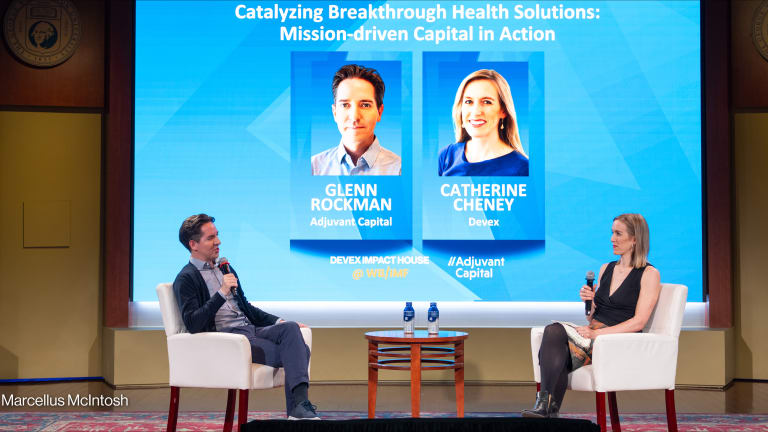
    Catalyzing breakthrough health solutions: Mission-driven capital in action
    Catalyzing breakthrough health solutions: Mission-driven capital in action
    Where does the private sector fit in the Accra Reset?
    Where does the private sector fit in the Accra Reset?

    For me, there wasn't a dull moment at the 79th United Nations General Assembly, but one moment in particular stood out because it touched on a highly consequential issue — and allowed me to share my controversial position on that issue.

    The ONE Campaign staged a debate to examine whether the golden age of global health replenishments is over, and I was firmly on the “it’s over” side.

    Even though my sparring partner from the ONE Campaign, Jenny Ottenhoff, did her best to maintain the nuance and rich factual texture of the question at hand, I went straight for the jugular as to why the current approach to funding the likes of the Global Fund to Fight AIDS, Tuberculosis and Malaria and Gavi, the Vaccine Alliance is doomed in the coming years.

    This article is free to read - just register or sign in

    Access news, newsletters, events and more.

    Join usSign in

    More reading:

    ► Gavi launches $9B replenishment target

    ► The 4 most important calls for global health funds in 2024

    ► WHO raises nearly $700M, but global health funding worries persist

    • Funding
    • Global Health
    • Institutional Development
    • Private Sector
    • Trade & Policy
    • Gavi, the Vaccine Alliance
    • The Global Fund to Fight AIDS, Tuberculosis and Malaria (GFATM)
    Printing articles to share with others is a breach of our terms and conditions and copyright policy. Please use the sharing options on the left side of the article. Devex Pro members may share up to 10 articles per month using the Pro share tool ( ).
    The views in this opinion piece do not necessarily reflect Devex's editorial views.

    About the author

    • Bright Simons

      Bright Simons

      Bright Simons is a social innovator, multipatent-holding technology inventor, and policy activist. Through his work at mPedigree and with think tanks like IMANI, he contributes to the breaking of silos and crossing of boundaries necessary to finding lasting solutions to society's ever more complex problems. As a senior adviser to international NGOs, global multinationals, leading universities, and social movements around the world, his impact has been recognized with awards and prizes by multiple prominent institutions.

    Search for articles

    Related Stories

    World Health Summit 2025Related Stories - Germany commits €1B to Global Fund as aid cuts shape World Health Summit

    Germany commits €1B to Global Fund as aid cuts shape World Health Summit

    Opinion: Global healthRelated Stories - To end TB, time for us to own our disease response and financing for health

    To end TB, time for us to own our disease response and financing for health

    Sponsored by Adjuvant CapitalRelated Stories - Catalyzing breakthrough health solutions: Mission-driven capital in action

    Catalyzing breakthrough health solutions: Mission-driven capital in action

    The future of global healthRelated Stories - Where does the private sector fit in the Accra Reset?

    Where does the private sector fit in the Accra Reset?

    Most Read

    • 1
      Innovation meets impact: Fighting malaria in a warming world
    • 2
      The silent, growing CKD epidemic signals action is needed today
    • 3
      Building hope to bridge the surgical access gap
    • 4
      Why capital without knowledge-sharing won't solve the NCD crisis
    • 5
      3 ways AI can support drug innovation and global research equity
    • News
    • Jobs
    • Funding
    • Talent
    • Events

    Devex is the media platform for the global development community.

    A social enterprise, we connect and inform over 1.3 million development, health, humanitarian, and sustainability professionals through news, business intelligence, and funding & career opportunities so you can do more good for more people. We invite you to join us.

    • About us
    • Membership
    • Newsletters
    • Advertising partnerships
    • Devex Talent Solutions
    • Post a job
    • Careers at Devex
    • Contact us
    © Copyright 2000 - 2026 Devex|User Agreement|Privacy Statement