Opinion: What my Masai community thinks about carbon credits
My community in Tanzania benefits greatly from carbon credits, which protect our land and fund education. This is our story.
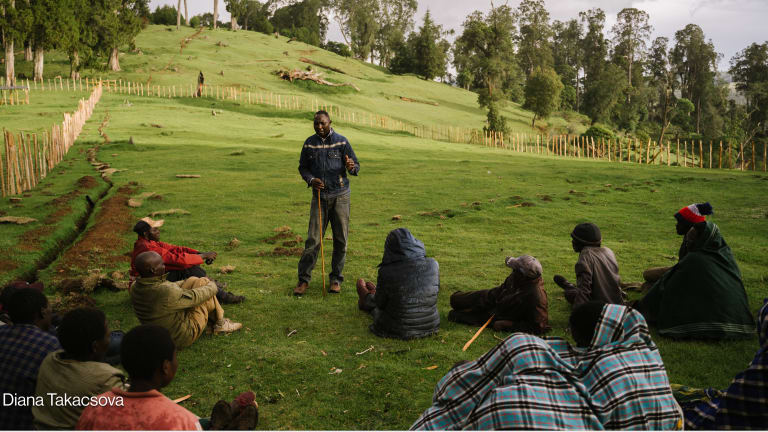
By Kisaro Thomas Lombutwa // 20 February 2025The media is full of stories about how carbon-crediting projects ignore the voices of local people. I’ve read countless articles proclaiming that people in the global north swan in, sell carbon that’s been captured by trees in the global south and do not share their profits with people like me. To be honest, these types of articles have always left me feeling sad and confused. How can others have experienced the carbon markets so differently from me? My name is Kisaro Thomas Lombutwa and I always say that I am a “typical Masai.” By this I mean that my grandparents were Masai, my parents are Masai and I grew up in Makame in northern Tanzania. My parents raise livestock and for them, as for nearly everyone in my village, land is life. Without our lands, we cannot survive. And, it may surprise you to read this, but this land is one of the reasons so many of us value our local carbon credit project. How do I know this? Well, last year I worked with a social science research team to see how carbon revenue impacts my Masai community. This is what I discovered. I live in one of five villages set inside the Makame Wildlife Management Area, or WMA, where, since 2016, we have partnered with a company called Carbon Tanzania to run a carbon credit project. The project works with the WMA to protect the lands from the two main challenges we face: encroachment and poaching. Land, as I have said, is of utmost importance to us Masai. However, this is increasingly challenging — over the last decade, many people have moved to the Makame WMA in the hope of finding new land to farm. While I understand their reasons, this puts pressure on our communities. New arrivals often see forests as unused land and clear trees to make way for agriculture. Before Carbon Tanzania began its work, Makame had a deforestation rate nine times higher than the national average. Deforestation is hugely problematic for us. It threatens the habitats of native wildlife; it disrupts migratory species and it can cause conflict between the new and the long-established communities. So how can we alleviate this pressure? Fundamentally, it’s all about conserving forests that would otherwise have been destroyed. When Makame’s forests are successfully conserved, Carbon Tanzania is issued carbon credits by an independent standard. You can understand this process as the standard saying: “We have reviewed your work, found it meets our quality criteria and now we can confidently say, based on historical records and current trends in similar forests, less carbon has entered the atmosphere thanks to your work.” Each carbon credit represents one metric ton of carbon dioxide (or an equivalent volume of another greenhouse gas) that has been removed or prevented from entering the atmosphere. Carbon Tanzania sells these credits to companies (predominantly in the global north) and shares 61% of the sales revenue with the people living in the WMA. The WMA employs village game scouts to spot signs of encroachment and poaching. Carbon Tanzania pays people from the villages to work as carbon champions. They make sure people understand the importance of forests for fighting climate change, how carbon credits work, and what revenue sharing means for them. It’s in everyone’s interest to stop deforestation. Globally, it’s a necessary part of mitigating climate change. Locally, more standing trees also mean more credits — and more credit sales mean more revenue to spend on our village projects such as building classrooms and school dormitories. In 2024, the five villages in the WMA earned more than $1.3 million of carbon revenue and, naturally, Carbon Tanzania wanted to know how people felt about their earnings. This is why I worked with social scientists — we ran focus groups and conducted surveys to find out if people had experienced changes in their lives, how important any changes had been to them, and whether they associated these with carbon revenue. For this study, the carbon champions visited every boma (homestead) in the WMA with an iPad — this caused quite a lot of excitement if any children were home! However, once any kids had had a good look at the tablet, an adult would complete the survey on behalf of the household. Our survey revealed that, across the five villages, people generally shared the same strong values which likely made the process of deciding how to spend carbon revenue much easier. Most people agreed that securing land and educating their children were their greatest priorities. Across Makame, 94% of people said they value their children’s education highly. Undoubtedly, this is why the communities decided to build classrooms and dormitories as well as fund stipends for students to attend higher education institutions with the carbon revenue they earned from Carbon Tanzania. Now these projects are complete, children who live far away from school can more easily (and safely) attend classes and teenagers can go on to complete specialist training. Both of these are likely reasons why 84% of respondents said that their children are attending school because of carbon revenue. Perhaps unsurprisingly, the study also revealed how much people value the additional protections the project places upon their land. Villagers can report signs of suspicious activity to the game scouts, who regularly patrol the WMA to guard against encroachment. With their lands more secure, many people in my Masai community reported better grazing for their livestock and, as a consequence, their financial stresses have reduced. This may not be everyone’s carbon credit experience, but it is certainly true for us. Carbon revenue helps to secure our land and fund our children’s education. For us Masai, the land is the foundation of life. When it is secure, we are free to invest in our children’s education, equipping the next generation with knowledge and opportunity.
The media is full of stories about how carbon-crediting projects ignore the voices of local people. I’ve read countless articles proclaiming that people in the global north swan in, sell carbon that’s been captured by trees in the global south and do not share their profits with people like me. To be honest, these types of articles have always left me feeling sad and confused. How can others have experienced the carbon markets so differently from me?
My name is Kisaro Thomas Lombutwa and I always say that I am a “typical Masai.” By this I mean that my grandparents were Masai, my parents are Masai and I grew up in Makame in northern Tanzania. My parents raise livestock and for them, as for nearly everyone in my village, land is life.
Without our lands, we cannot survive. And, it may surprise you to read this, but this land is one of the reasons so many of us value our local carbon credit project. How do I know this? Well, last year I worked with a social science research team to see how carbon revenue impacts my Masai community. This is what I discovered.
This article is free to read - just register or sign in
Access news, newsletters, events and more.
Join usSign inPrinting articles to share with others is a breach of our terms and conditions and copyright policy. Please use the sharing options on the left side of the article. Devex Pro members may share up to 10 articles per month using the Pro share tool ( ).
The views in this opinion piece do not necessarily reflect Devex's editorial views.
Kisaro Thomas Lombutwa was born and raised in the heart of Makame Wildlife Management Area. While part of the WMA management team he gained invaluable experience in natural resource governance, community engagement, and sustainable land use practices. Kisaro is now the Makame Savannah project manager where he works closely with local leaders, stakeholders, and conservation partners to ensure that the voices of his community are heard and that they receive equitable compensation from conservation efforts.