
Scoop: Trump admin opposes UN commitment to broaden women's peace role
U.S. negotiators also seek to remove references to disinformation, gender, and international law in the U.N. peacekeeping agreement.
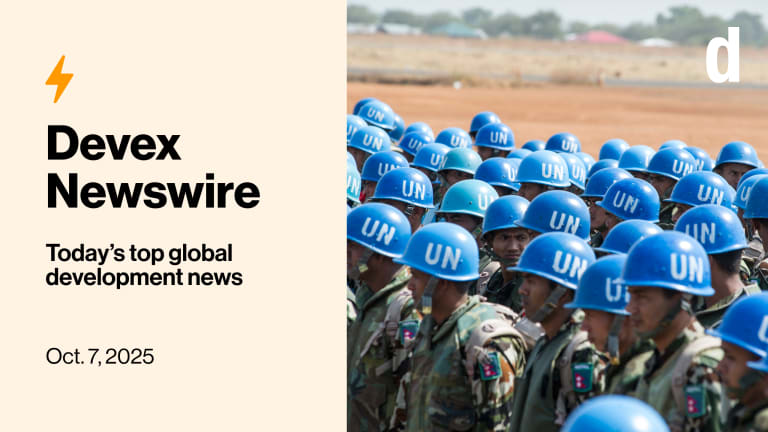
By Colum Lynch // 25 February 2025The Trump administration has proposed scaling back the United Nations’ commitments to expanding the role of women in peacekeeping operations and strengthening the world body’s ability to counter disinformation against U.N. blue helmets, several diplomatic sources told Devex. The United States floated the proposals last week in closed-door negotiations with a special committee of troop-contributing countries — known as the C34 countries — over an annual report detailing the U.N.’s peacekeeping priorities for the year. It also proposed removing some references to the words gender and inclusion and replacing references to “international law” and “international humanitarian law” with “relevant legal obligations,” signaling a sharp break from the U.S.’s historical role as the guarantor of the rules-based international system. It remains unclear how successful the U.S. will be in securing the changes during talks, which will play out over the coming weeks. However, the effort reflected the new administration’s efforts to rewrite the terms of international agreements hammered out over decades of intergovernmental negotiations and to impose its more conservative cultural values on the international system. The U.S. recommended dropping previously agreed language welcoming efforts “to significantly increase the number of women in all categories of personnel and at all levels of United Nations peacekeeping operations.” It also proposed removing a separate provision that underscores the significance of a landmark 2000 U.N. Security Council measure — Resolution 1325 — that encourages “increased representation of women at all decision-making levels in national, regional and international institutions and mechanisms for the prevention, management, and resolution of conflict.” The participation of women in U.N. peacekeeping operations has steadily risen over the past three decades, with women accounting for only 1% of all uniformed personnel in peacekeeping operations in 1993. In 2023, women made up nearly 7% of military personnel and 16% of police units in a force of some 72,000 U.N. peacekeepers worldwide, according to the Better World Campaign. By December 2024, just over 10% of the more than 61,000 blue helmets in uniform were women, according to U.N. figures. “Today, the UN is actively working to bring more women into peacekeeping efforts around the world,” according to the Better World Campaign. “The 2028 target for women in military contingents is 15%, with a goal of 25% for military observers and staff officers, and one in five in police units.” The U.S. proposals appear to be part of a broader effort by the Trump administration to counter efforts to promote diversity, equity, and inclusion, or DEI — a phrase that administration officials have derided as code language for left-wing “woke” policies that are threatening professional advancement based on merit. U.S. diplomats also want to scrub out references in the peacekeeping report to gender, a word the Republican administration has come to view as a political dog whistle signaling the recognition of transgender people. “U.S. funds will not be used to promote gender ideology, and all references to and work to that end should cease immediately,” the Trump administration insisted in a statement at an executive board meeting of the World Food Programme, the U.N.’s premier food agency. “Just as the United States has ended radical and wasteful diversity, equity, and inclusion (DEI) programs, so should WFP and all other UN agencies end any programs, initiatives, or funding that promote these harmful ideologies; instead they should focus on merit.” The U.S. made a similar argument in seeking changes to work programs run by UNICEF. “As Secretary [of State Marco] Rubio made clear, we must eliminate our focus on political and cultural causes that are divisive at home and deeply unpopular abroad,” Jonathan Shrier, a U.S. diplomat recently told delegates. “In addition, it is U.S. policy to recognize two sexes, male and female, and not to promote gender ideology. It is particularly disturbing that this language is being used in UNICEF programming documents; children should be protected from this dangerous ideology and its possible results,” he said. The U.S. is also targeting provisions that seek to strengthen the ability of U.N. peacekeeping missions to counter misinformation, a move that aligns U.S. policy more closely with that of Russia. In the past, the U.N. troop contributors voiced concern that misinformation, disinformation, and hate speech are fueling ethnic violence, discrimination, and ethnic cleansing, according to the 2024 report. The special committee “requests the Secretariat and peacekeeping missions, in cooperation with host States, to prevent, detect and combat disinformation, misinformation and hate speech against civilians,” the document states. The Trump administration wants to strip out all references to misinformation and disinformation during the current round of negotiations. The Trump administration has equated attacks on misinformation and disinformation —or call for fact-checking — to attacks on free speech. “It’s a red line for the Americans,” said one source familiar with the negotiations. A U.S. Department of State official declined to comment on the specifics of the U.S. negotiating position, telling Devex: “We do not comment on ongoing negotiations.” In his address at the Munich Security Conference earlier this month, U.S. Vice President JD Vance derided European leaders for “hiding behind ugly Soviet-era words like misinformation and disinformation” to prevent a critical public from expressing a different point of view or voting for a populist political party. Vance said that some of the “loudest voices for censorship” have come from the U.S., “where the prior administration threatened and bullied social media companies to censor so-called misinformation. … The Trump administration will do precisely the opposite.” At the U.N., the U.S. faces fierce opposition from members of the Group of 77, a coalition of some 134 lower- and middle-income member states, including countries with large peacekeeping contingents. They have become increasingly alarmed by the power of online disinformation campaigns in tarnishing the reputation of U.N. blue helmets and exposing them to violence. Ironically, the U.S. recently recognized the challenges faced by Russian-backed online campaigns in Africa — though they don’t use the term disinformation. “Kremlin-backed actors are … undermining the stability of the Central African Republic and the self-determination of its people through these actors’ spreading insidious propaganda,” John Kelly, a U.S. diplomat told the council in a Feb. 20 session devoted to the U.N. Mission in the Central African Republic, known as MINUSCA. “I will say what we have said before: it is unacceptable a member of this Council continues to disseminate information diminishing the credibility and effectiveness of MINUSCA. Such manipulation harms the civic space and impedes democratic development.”
The Trump administration has proposed scaling back the United Nations’ commitments to expanding the role of women in peacekeeping operations and strengthening the world body’s ability to counter disinformation against U.N. blue helmets, several diplomatic sources told Devex.
The United States floated the proposals last week in closed-door negotiations with a special committee of troop-contributing countries — known as the C34 countries — over an annual report detailing the U.N.’s peacekeeping priorities for the year. It also proposed removing some references to the words gender and inclusion and replacing references to “international law” and “international humanitarian law” with “relevant legal obligations,” signaling a sharp break from the U.S.’s historical role as the guarantor of the rules-based international system.
It remains unclear how successful the U.S. will be in securing the changes during talks, which will play out over the coming weeks. However, the effort reflected the new administration’s efforts to rewrite the terms of international agreements hammered out over decades of intergovernmental negotiations and to impose its more conservative cultural values on the international system.
This article is free to read - just register or sign in
Access news, newsletters, events and more.
Join usSign inPrinting articles to share with others is a breach of our terms and conditions and copyright policy. Please use the sharing options on the left side of the article. Devex Pro members may share up to 10 articles per month using the Pro share tool ( ).
Colum Lynch is an award-winning reporter and Senior Global Reporter for Devex. He covers the intersection of development, diplomacy, and humanitarian relief at the United Nations and beyond. Prior to Devex, Colum reported on foreign policy and national security for Foreign Policy Magazine and the Washington Post. Colum was awarded the 2011 National Magazine Award for digital reporting for his blog Turtle Bay. He has also won an award for groundbreaking reporting on the U.N.’s failure to protect civilians in Darfur.