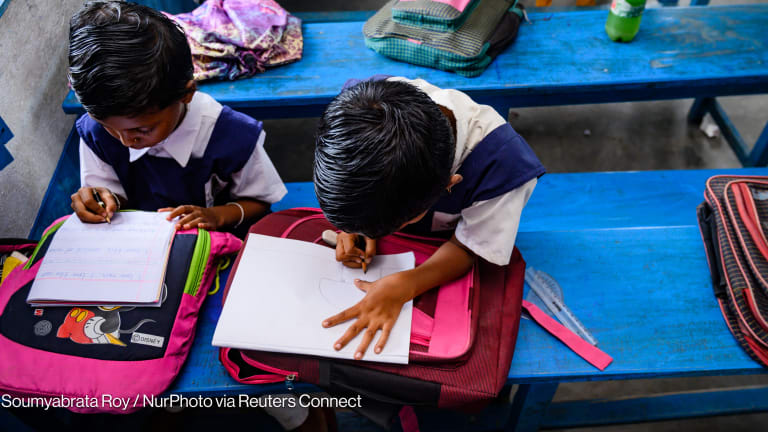





A global pandemic, it would seem, rips the curtain back on society, revealing its weaknesses and an urgent need for solidarity. COVID-19 has unmasked and exacerbated the gaps and inequalities in our existing educational systems, threatening to widen them even further in the absence of alternative solutions.
We are on the precipice of an unparalleled learning crisis, and what António Guterres, secretary-general of the United Nations, has called the largest disruption to education in history. More than 1 billion students in almost every country have been impacted by school closures, which is continuing to take its toll on parents, caregivers, teachers, and young people worldwide.
While many children are back in school, rolling lockdowns mean that the COVID-19 risks to education are not over by far.
Progress in health and education slows in Africa while social protections deteriorate
According to the 2020 Ibrahim index of African governance, overall gains made in health and education are slowing on the African continent, and progress on social protection is deteriorating.
Those who were already living on the margins, and most at risk of being left behind, are at an even greater risk now. While some have pointed out that the pandemic has stimulated innovation, making education more inclusive through remote and online learning, this shift remains inaccessible for those without connectivity in a world still marked by a digital divide.
We shouldn’t be surprised that formal education is cracking under pressure of the pandemic. Overcrowded classrooms, outdated and rigid curriculums, underappreciation for providing a holistic approach to education — these are just some of the ways it was already failing to give students opportunities to develop important life skills and become lifelong learners.
The solution to fixing education is not just about reopening schools and giving students access to digital tools, it is also about offering them more flexible educational opportunities that are community-based and focused on local realities.
This is where nonformal education can shine and complement formal education systems.
Youth organizations, sports clubs, community groups, and increasingly, online communities, can all offer spaces for young people to connect with each other, learn by doing, and develop the skills necessary to engage meaningfully in society.
Education has the possibility to be the great equalizer in overcoming a once-in-a-generation health crisis and securing our common future.
—For more than a century the global Scout movement — which is made up of more than 54 million scouts connected together through a membership network of 171 national scout organizations — has offered educational programs and activities to equip young people and adult volunteers with the leadership knowledge, skills, and attitudes to contribute positively to society, care for our communities, and become global active citizens.
Through mass mobilization efforts such as Scouts for Sustainable Development Goals, and initiatives like Earth Tribe and Messengers of Peace, Scouts are not only building the kinds of competencies valued in today’s modern world, they are also contributing billions of hours of community service toward the sustainability of our planet.
Other prominent youth movements and organizations such as the World Alliance of Young Men’s Christian Associations, World Young Women’s Christian Association, International Federation of Red Cross and Red Crescent Societies, World Association of Girl Guides and Girl Scouts, and The Duke of Edinburgh’s International Award Foundation are also at the forefront of nonformal education, offering leadership training, community-based programming, experiential learning, mentorship, and volunteer opportunities to support the growth and development of more than 250 million young people worldwide.
The longevity of these movements and organizations remind us that nonformal education, while not new, has lasting power and is ideally suited to evolve with the times. At the World Non-Formal Education Forum held in Brazil last year, more than 400 participants from 70 international organizations, youth organizations, and U.N. entities signed on to the Rio Declaration calling for more recognition, innovation, partnerships, and investment in nonformal education an essential element of the educational experience.
Among the calls to action were the need to promote evidence-based approaches to nonformal education, to increase investment in technological and digital solutions, and to strengthen partnerships between formal, informal, and nonformal education in the creation of policies and practices. Further research into the impact of nonformal education together with academic institutions and youth organizations also emerged as key priorities.
At a time when society is undergoing rapid change, communities can leverage the power of nonformal education by asking their leaders and governments to increase investment in educational opportunities that go beyond the formal education system.
Parents can involve their children in local youth and community groups and activities that promote experiential learning, and volunteer their time towards these causes. And young people themselves can demand more access to nonformal education and learning opportunities that will support them to develop the skills necessary to reach their full potential.
Education has the possibility to be the great equalizer in overcoming a once-in-a-generation health crisis and securing our common future.
By strengthening the links between formal and nonformal education, and making a greater investment in the latter, we can provide more opportunities for young people to access quality education in all its forms. This includes building and nurturing the soft skills, resilience, and critical thinking necessary for young leaders to cope and thrive even in these times of great uncertainty.
Learn more about the transformative power of nonformal education by reading the Rio Declaration on Non-formal Education and Joint Position Paper on Non-Formal Education.
About the author
Hany Abdulmonem
Hany Abdulmonem is the global director for scouting development with the World Organization of the Scout Movement, the world’s leading educational movement for young people. Abdulmonem has more than 20 years of experience working in the areas of non-formal education and youth development. His passion is to develop learning opportunities for young people to become active global citizens in their communities.