
Financing Asia’s transformation: How to plug the trillion-dollar gap




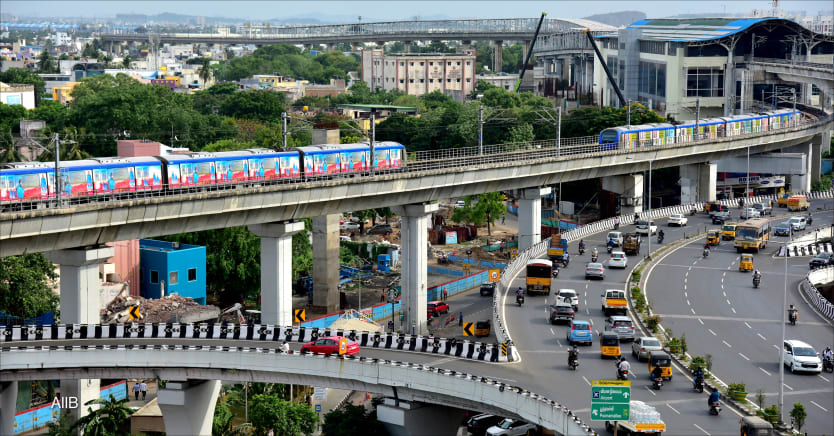
The world is evolving in unpredictable and formidable ways — from COVID-19 disruptions to the urgency for climate action, from the rapid pace of technological change to intensified calls for reform across multilateral institutions. All the while, infrastructure needs remain high. Asia alone will need an estimated $1.7-$1.8 trillion a year up to 2030 to address infrastructure requirements.
In the nearly 10 years since our founding, the Asian Infrastructure Investment Bank, or AIIB, has evolved from a fledgling institution to a driving force in global infrastructure finance. The bank’s projects, spanning clean energy in Uzbekistan, airport modernization in China, broadband expansion in Indonesia, and post-flood recovery in Brazil, have demonstrated a commitment to achieving sustainable growth to meet the infrastructure needs of Asia and beyond.
Today, AIIB supports over 350 projects across 39 economies, giving millions of people access to climate-friendly energy, jobs, and healthier living conditions. AIIB’s renewable energy investments have significantly cut carbon dioxide emissions, reduced fossil-fuel reliance, and created long-term employment.
Supporting this rapid growth are AIIB’s investment-operations departments, which bring together client engagement, sector expertise, and delivery. I gathered the thoughts of three senior colleagues leading these departments about the bank’s achievements, priorities for our second decade, and the innovations that can drive future impact.
Connecting strategy with action
Ajay Bhushan Pandey, vice president, Investment Solutions, leads public-sector client support initiatives, with a focus on forging long-term partnerships that align national development priorities with tangible implementation.
“Our mission,” he said, “is to connect high-level policy direction with real-world projects, de-risking and amplifying their impact through market enablers.”
Pandey is pioneering an integrated stakeholder engagement model that bridges strategic vision with on-the-ground impact. The approach ensures top-level policy alignment, operationalized through sector-specific groups and executed via vertical networks that link national priorities to local implementation. This end-to-end approach is aimed at creating a repeatable blueprint for sustainable, high-impact projects.
This method reflects AIIB’s “finance-plus” approach, which blends capital with technical advisory and de-risking tools to transform project concepts into bankable, actionable investments. For instance, in the renewable energy sector, AIIB employs partial credit guarantees and cofinancing structures to attract private capital into large-scale projects.
“The Maharashtra solar pumps project in India is a masterclass in integrated problem-solving. It elegantly weaves together the threads of fiscal responsibility, agricultural resilience, and climate action into a single, powerful solution. By replacing nighttime thermal power with daytime solar energy for irrigation, Maharashtra is not just greening its grid. More broadly, it is unshackling its farmers from unpredictable power schedules, alleviating a crippling financial burden on its utility, and powering the economic engine of India with clean, reliable, and sustainable energy.”
Delivering impact where it matters
Kim-See Lim, as a chief investment officer, Public Sector (Region 1) & Financial Institutions and Funds (Global) Clients, oversees AIIB’s public-sector investments in South Asia — except Afghanistan and Pakistan — South East Asia, the Pacific islands, and sub-Saharan Africa, aligning investment operations with the bank’s corporate strategy and strengthening client engagement to deliver sustainable infrastructure.
“We want to ensure that our projects are not just approved on paper but actually delivered in a way that meets people’s daily needs,” she said.
This has been achieved in projects such as the Mumbai Urban Transport Project – Phase III, or MUTP, which is expanding the suburban railway network by doubling the capacity of an existing 64-kilometer corridor and constructing a new 28-kilometer corridor to connect peripheral areas with central Mumbai. The project also enhances safety at 36 mid-section crossings of existing lines and ultimately will benefit the more than eight million daily local commuters who rely on Mumbai’s suburban railway network.
AIIB’s first satellite investment, the Indonesia Multifunctional Satellite PPP Project, will provide broadband internet to 45 million people, including 23 million women in remote regions, and connect schools, hospitals, and local government offices that previously had limited digital access.
To deliver these impactful projects, AIIB’s teams worked closely with local counterparts to prepare project design and implementation plans. The goal is not just delivering infrastructure but ensuring that it is sustainable, inclusive, and responsive to local communities.
Scaling impact across regions
Konstantin Limitovskiy, chief investment officer, Public Sector (Region 2) & Project and Corporate Finance (Global) Clients, oversees AIIB’s public-sector investments across Europe, the Middle East and North Africa, Latin America, Pakistan, Afghanistan, and Central, East, and West Asia, as well as handling private infrastructure and corporate finance for operations in all AIIB members.
“Since joining AIIB in 2018, I have witnessed the bank’s growth from 34 cumulative approved projects in late that year to over 350 today, with a total financing amount of $68.41 billion across 39 members,” Limitovskiy said. “Our goal is to ensure that infrastructure needs translate into tangible, bankable projects that generate both economic and social impact.”
AIIB is fundamentally a project-focused development bank. Limitovskiy highlighted our growth path, which involves strengthening sovereign-backed financing, growing the nonsovereign business by enriching investment toolkits to meet clients’ needs, introducing local-currency options, and deepening partnerships with other multilateral development banks.
Current and upcoming projects reflect this diversity. Across them all, we will continue to maintain a focus on sustainable and socially inclusive delivery. Investments in urban water systems, implemented through participatory planning, have improved access to safe drinking water for over eight million people, including women and vulnerable populations, while a single rural infrastructure project reached over 360,000 people, more than half of them women. Renewable energy investments continue to reduce emissions and fossil-fuel dependency, while green credit lines have helped small and medium-sized enterprises adopt energy- and water-saving technologies.
“We put strong emphasis on rigorous project design, stakeholder engagement, and transparency to ensure infrastructure is not only economically sound but socially and environmentally sustainable,” Limitovskiy said. “Our client-oriented approach ensures that we support our members in helping translate their infrastructure ambitions into real-world outcomes.”
Looking ahead: The next decade of impact
AIIB will step into its second decade on Jan. 16, 2026. This date will also mark the start of the five-year term of our new president, Zou Jiayi, who will succeed the founding president, Jin Liqun.
This leadership transition, together with AIIB’s updated 2025 corporate strategy, sets the stage for the bank’s next decade. We aim to double annual financing to $17 billion by 2030, balancing support for sovereign and private clients while unlocking more private capital. Over 50% of our financing will target climate-related investments annually, totaling $50 billion, while 25%-30% will support cross-border connectivity projects.
Guided by this vision, AIIB’s leadership envisions a future in which the bank helps members finance “Infrastructure for Tomorrow” that is greener, more inclusive, and resilient. We enter our next decade with a sharper focus on partnerships, innovation, and measurable impact, determined to leave a lasting legacy that transforms communities and strengthens economies in Asia and beyond.
To discover how AIIB is shaping the future of infrastructure, visit the AIIB@10: A Decade of Impact microsite.
About the author

Jeffrey Hiday
Jeffrey Hiday is director general of the communications department at the Asian Infrastructure Investment Bank. He provides public relations counsel to AIIB’s senior management; acts as the senior media contact; and serves as the official spokesperson. Before joining AIIB, he was the director of the Office of Media Relations at the RAND Corporation and director general of the Department of External Relations at the Asian Development Bank. He also worked at the European Bank for Reconstruction and Development as adviser to the president, speechwriter, and head of media relations.
Search for articles


Most Read
- 1
- 2
- 3
- 4
- 5