




Instead of competing for a limited number of projects, public development banks, or PDBs, should be developing bankable projects together and better collaborating to support more sustainable development gains, said Jin Liqun, immediate past president and chair of the board of directors at the Asian Infrastructure Investment Bank, or AIIB.
Historically, PDBs — which include multilateral, bilateral, and national development banks — have operated independently. But that is changing.
“Broadly, particularly over recent years, there's an enhanced awareness of how all these PDBs need to work together and how they should use their resources most effectively,” said Jin. The AIIB, established in 2015, focuses on achieving economic and social development through investment in infrastructure.
Founded in 2020 as a one-off event, the Finance in Common initiative, or FiCS, has evolved into a global network of over 540 PDBs that meet on an annual basis to convene around the Sustainable Development Goals and the Paris Agreement. Its objective is strengthening partnerships among PDBs to promote shared standards and best practices, support banks’ commitments to shift toward sustainability, and give PDBs more visibility in global fora discussing international policy issues such as the U.N. Climate Change Conference of the Parties, the United Nations, or the Group of 20 largest economies, among others.
Its five-year report, released in December 2025, documents how these PDBs have progressively aligned around a shared ambition: making sustainability the new norm of finance. The report captures a shift away from fragmented commitments and toward structured cooperation, peer learning, and collective action on climate, biodiversity, and development priorities. It highlights how PDBs are positioning themselves not as peripheral players, but as central pillars of a reoriented global financial architecture.
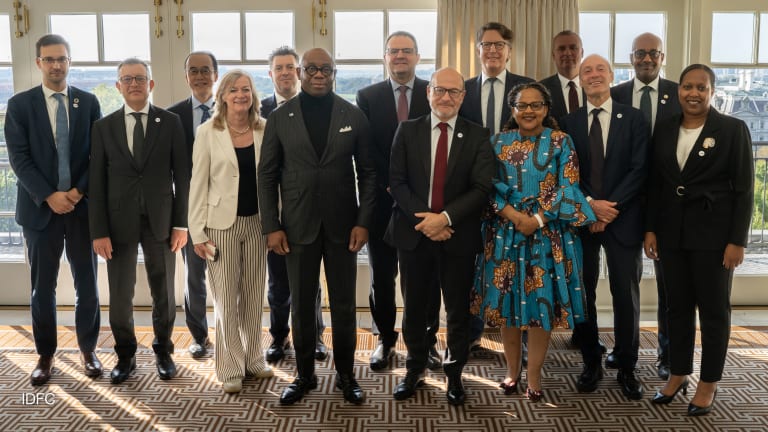
Jin observed that FiCS’ annual summit “is a very good platform for all of those PDBs to sit down and exchange ideas and to look for room for improvement in their coordination and cooperation.” At the most recent edition, cohosted by AIIB in Cape Town, South Africa, he felt there was a consensus among PDBs about the need to better “work together as a system, as a team.”
Speaking to Devex shortly before his term concluded, Jin shared what it will take to make that consensus a reality, the value FiCS has played in convening PDBs, and what the system of development banks can be doing to better meet goals around climate and sustainability.
This conversation has been edited for length and clarity.
What is the value for AIIB of being a part of FiCS?
The AIIB’s mandate is to promote broad-based economic and social development through investment in infrastructure and other productive sectors. But as you know, there are some other development banks that have concessional funding, which allocates resources for poverty reduction projects.
Ours is a new development bank which does not have concessional funding. It was actually intentional: Ten years ago when the bank was set up, we thought there would be limited resources for concessional financing, and [AIIB] was not supposed to compete for limited concessional financing with other institutions. So instead of focusing on poverty reduction in a narrow sense of the word, we focus on infrastructure development, which we believe can pave the path for sustained and resilient economic development.
FiCS has a large number of PDBs, a large number of institutions and partners, and by working with them, we can maximize the impact of development.
How did convening as a group in Cape Town last year help to enhance the development financial system?
The meeting in Cape Town highlighted the importance of the multilateral development banks and PDBs working together, focusing on some of the major challenges. For instance, financing for climate change [has] never been so highlighted, in my view, in the FiCS meetings.
Secondly, we focused on resilient growth through the effective use of resources. We [will] work together to develop bankable projects, which [will] have long-term benefits to the people.
Also, I feel strongly that these development bank partners [took] seriously the need to empower women, particularly in remote areas where women have not benefited from the growth in the outside world.
All this indicates that we share the same values, views, and objectives. I believe out of the Cape Town meeting there will be some new creative ideas by which we can achieve great results moving forward.
How do you see the role of Asian PDBs and development finance institutions within FiCS?
First of all, everybody knows that Asia is a very vibrant, fast-growing region. On the other hand, this fast growth and fast economic development does not mean that all of the economies are doing well. There are some very poor countries in the region, and [they face] huge challenges to deal with poverty [and] the consequences of climate change.
We believe that Asia needs to work with the rest of the world. By working with other regions, Asia’s economic resilience would be further enhanced. Attracting investment in infrastructure and other productive sectors in Asia would help a lot.
Only by working together could we achieve greater success — and in this regard, FiCS is really doing a wonderful job because its view is broad, global, and it’s very open and inclusive.
You said that it’s very important to work with countries outside of Asia. Do you have examples of projects that are doing this successfully?
We financed a rural road in Côte d’Ivoire that fills the missing link in the transportation network in Côte d'Ivoire so that remote areas would be connected with the outside world. Ever since this road was built, it [has been] easier for farm products, such as cashews and coffee beans, to be shipped out. Vietnam is the biggest cashew processor in the world. Now, this rural road can help these farmers bring their products to [the] Abidjan port and ship to Vietnam, thereby greatly improving the living standard of the people.
What can the system of development banks — national, regional, multilateral, and local — do to better meet goals around climate and sustainability?
Certainly, better communication and better coordination among themselves is important. It’s not simply coming together to mobilize resources; it’s more important for us to think about the creative and innovative approaches to make all these institutions work better.
Also I believe that coordination does not mean that we work on the same project. Coordination could be interpreted very broadly … It is to develop projects that can supplement and complement each other. If one PDB is building renewable energy, maybe another should think about developing a project for transmission or distribution so that, if they can really coordinate, all these projects can produce tangible results.
Explore FiCS’ five years of impact and its recently released activity report at https://financeincommon.org/five-years-of-fics.
This content is sponsored by Finance in Common as part of Financing the Future — a series exploring how the global development finance system is evolving to unlock capital, reform institutions, and build investable markets for sustainable growth. Click here to learn more.
About the author

Devex Partnerships
Thanks for reading and for your interest in Devex. In collaboration with our partners, Devex’s partnerships editorial team produces content to promote a partner’s work or perspectives on a particular issue. It gives actors across the global development sector — including nongovernmental organizations, private sector stakeholders, aid agencies and government institutions — the opportunity to go beyond traditional advertising and tell their stories in an impactful way. If you’d like to learn more about how you can shine a spotlight on a particular issue with Devex, please email partnerships@devex.com. We look forward to hearing from you.
Search for articles


Most Read
- 1
- 2
- 3
- 4
- 5