
Why a new partnership model is key to future of development finance




A turbulent year in global development finance may be ending with greater clarity on how to move beyond the sector’s traditional paradigm, which is no longer fit for purpose.
“We’re seeing a coming to terms with the reality of the world we’re now in,” Qahir Dhanani, managing director and partner at Boston Consulting Group, told Devex. “There is a realization right now that we’re in a multipolar world, which means the rest of the world has grown.”
With rising geopolitical fragmentation and tightening public budgets, Dhanani pointed to emerging economies in Africa and elsewhere as potential catalysts for more targeted, multiplayer coalitions that combine public, private, and philanthropic strengths.
“I think these pressures will force positive action in many areas, not only in terms of economic growth and development, but also in building self-reliance and resilience,” he said.
Speaking to Devex, Dhanani reflected on the lessons of the past year, where he sees momentum building, and what the evolution of cross-sector partnerships will mean for development finance as the world looks toward 2026.
This conversation has been edited for length and clarity.
It’s been an especially eventful year in global development finance — from the fourth Financing for Development Conference, or FfD4, and the first G20 hosted in Africa to the fallout from the unprecedented U.S. foreign aid funding cuts. When you look back, what stands out to you the most?
It has been a very turbulent year for international development and the world, and it started with the challenges created by the pullback of foreign development assistance channeled through USAID. While this followed a trend that was going on for the last few years, it was the largest amount of money ever taken out of development assistance. So, the year started off with a reckoning that the development paradigm will have to change, to establish other sources of finance for development, and that set the tone for the whole year, and I think, the tone for the future.
At the Spring Meetings of the World Bank Group and the [International Monetary Fund] in April, there was much discussion about the need to stop just talking about private capital mobilization and make it a reality, and I do think that the leadership at the World Bank Group and other multilaterals has really zeroed in on the issue.
In Seville at FfD4’s International Business Forum, that’s where the most interesting conversations were happening. Some centered around how to optimize capital allocation — thinking about where we put the money and how to scale these with proven risk-sharing mechanisms that avoid overindexing on grants while still mobilizing private investment. There were also discussions around how to create space for innovation within the mandates of existing organizations and how to leverage technology like AI to make transactions faster and more efficient, as well as the need to adjust our models for collaboration across different organizations in the public and private sectors.
Given the turbulence you referenced, some may feel disheartened by a sense of uneven ambition and fractured consensus on development. Do you see reasons for optimism emerging from the changing development paradigm?
We’re now in a multipolar world, with multiple centers of gravity. So, we’re experiencing a shifting dynamic where growth in South Africa, India, China, and Brazil are making a mark. The Gulf countries are playing a much larger role than they did, at least in financial markets and in technology, where they have very forward-leaning investments in digital and AI. And of course, China continues to play a major role in emerging markets.
From the vantage point of Africa, for instance, the conversation has shifted to “how do we become self-sustaining on the continent?” National objectives are on growth and quality of life for their people, and that means they have to optimize their partnerships, and we’re seeing a lot of that happen. One of the core topics of discussion among CEOs and the political class in Africa has been around resilience. They were not ready for this shock. But it came, they’re dealing with it, and they know they need to make sure that they’re not in a position for such shocks to impact them again. I think this is a positive sign for the future.
You mentioned the importance of collaboration and the need to optimize these efforts. Can you speak to this further and share an example of an ideal coalition model in action?
I think what we’re seeing now is the importance and the ability of coalitions to play a larger and more essential role, and one of the key themes at the Paris Peace Forum this year was new coalitions. I think this idea of “coalitions of the willing” for every topic, for every issue, is really, really critical, and will define how the world moves forward, and frankly how diplomacy will get done.
Part of what makes this important for the future is an element that’s missing in multilateralism today, which is this notion of multistakeholders and multi-actors. The old paradigm has been driven by nation-states, but I think that the paradigm for the future has to be multi-actor. It's got to be nation states working with philanthropy, with the private sector, with civil society, and with nontraditional entities, and I think we're seeing more of these coalitions coming together.
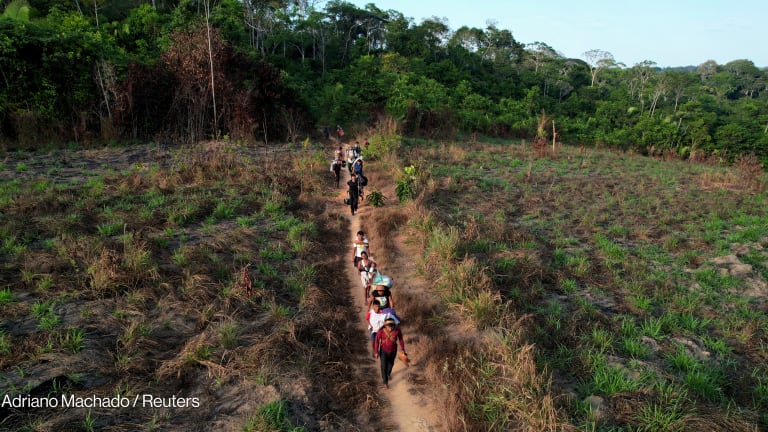
One example is the LEAF Coalition, or the Lowering Emissions by Accelerating Forest Finance Coalition, which started up in the Amazon. For this, you have a handful of companies, a few countries with large forests, some donor countries, and some civil society organizations. These actors came together, and they created this coalition. And rather than creating a long convention at the U.N. or negotiating something at the COP [conference of parties on climate change], they just started with several billion dollars on the table to get things going. So I think we’re going to see many more coalitions like this that drive things forward.
From your perspective, what distinguishes coalitions that deliver real execution, trust, and accountability from those that remain symbolic?
A lot of the events over the course of the year are essentially talk shops. You have panels and discussions, but much of the work happens in the hallways, with groups of people agreeing to do something together, and momentum builds from there. I think that’s how these coalitions get built. They get built around a central idea that is appealing to everybody, and as long as it’s on a tangible issue that will have an impact on people’s lives, they tend to get traction. If they’re centered around esoteric issues, it’s a challenge.
I also think trust is really important. I think that we have a through line over the last five-plus years of eroding trust in institutions, and that’s resulted in challenges across all parts of the economy, as well as in political and economic life. Trust in corporations, trust in politicians, trust in regulation, and trust in multilateral institutions are all declining, except in some of the developing countries. So over the next year in particular, there is an opportunity for action, and for coalitions to work together and rebuild trust, and to rebuild resilience, in international institutions and in the agenda for development.
As we look toward 2026, are you confident that the next iteration of cross-sector partnership — and development finance more broadly — can deliver at the scale the moment demands?
My hope for 2026 is that we will have gone through the process of adjusting and understanding the consequences of the world that we’re living in. I don’t see major geopolitical shifts happening in the next year, but I do see the need and the importance of countries, civil society, and philanthropy having clarity on the world we’re in, and moving toward taking the actions needed that start to build the future that we want, given the context that we’re in.
So, I’m optimistic because I feel like we’re over the big hump, and now we’re in the tail-end of the adjustment period. The conversations I had at the G20 in Johannesburg last month weren’t the same sort of conversations happening at FfD4 in Seville, or the spring and annual meetings in Washington. Fast forward from April, when there was a sense of shock and panic, all the way to November, where the conversation was about confidence in the future.
We know that we’re living in a world that requires adjustments. We’ve adjusted, and we’re still adjusting and building resilience. From here, it’s a matter of activating that so that we can build for the future. I think that that’s the direction we’re seeing, and that’s what gives me a lot of hope.
About the author

Devex Partnerships
Thanks for reading and for your interest in Devex. In collaboration with our partners, Devex’s partnerships editorial team produces content to promote a partner’s work or perspectives on a particular issue. It gives actors across the global development sector — including nongovernmental organizations, private sector stakeholders, aid agencies and government institutions — the opportunity to go beyond traditional advertising and tell their stories in an impactful way. If you’d like to learn more about how you can shine a spotlight on a particular issue with Devex, please email partnerships@devex.com. We look forward to hearing from you.
Search for articles


Most Read
- 1
- 2
- 3
- 4
- 5