



The global health landscape is at a crossroads. While infectious diseases have dominated headlines and funding priorities for decades, noncommunicable diseases, or NCDs, are continuing to devastate low- and middle-income countries, or LMICs.
NCDs such as diabetes, cancer, and cardiovascular disease account for 74% of global deaths, with 77% occurring in LMICs. Yet these diseases receive only 1%-2% of global health financing. This isn't just a health crisis — it's an economic one. In LMICs, families are pushed into poverty by out-of-pocket costs, health system resources are stretched to their limits, and entire communities are impacted by loss of productivity.
Today, this mismatch is even more dangerous. With development assistance contracting worldwide, traditional donor-dependent models have proven insufficient to address the global challenges we are facing. Short-term projects and fragmented aid cannot deliver the sustainable, scalable solutions needed to tackle NCDs effectively.
The innovation imperative: Blended finance as a game changer
To overcome these challenges, we need blended finance strategies that combine public, private, and philanthropic capital to catalyze investments in health infrastructure. These models aren't theoretical — they're practical approaches we can implement today.
Impact funding for NCD health care is critical for long-term success in overcoming the NCD challenge in LMICs. It isn't just philanthropy — it's a catalyst for systemic change. By channeling capital to local entrepreneurs, we are helping to unlock solutions that are deeply rooted in community needs and designed for long-term sustainability, identifying innovative models — from blended finance to social enterprises — that deliver scalable solutions.
When local innovators have access to purpose-driven capital, they don't just build businesses — they are helping to build ecosystems that create jobs, reduce health inequalities, and accelerate progress toward global sustainability goals. Empowering entrepreneurs at the grassroots level is not optional; it's essential.
This strategy can help mitigate the infrastructure weaknesses that leave health systems vulnerable and communities underserved. But here’s a critical insight: Access to capital alone is not enough. Investing in local entrepreneurs must be paired with mentorship to provide a necessarily holistic approach to support growth and scalability. This commitment of human capital — knowledge sharing — fosters the kind of local ownership that supports progress after investors move on.
A model for dual support
I have seen the impact of this approach through our Global Health Unit’s Impact Investment Fund. We’ve embraced this principle, supporting health care startups in underserved regions — not just with capital, but with knowledge sharing. Our employees throughout Sanofi help entrepreneurs build more efficient and scalable delivery models by improving supply chain operations, sales and marketing processes, and go-to-market strategies. This is where mentorship becomes transformative: The dual approach supports local innovators’ ability to transform promising ideas into sustainable businesses, ideally creating a multiplier effect as mentored entrepreneurs become mentors themselves.
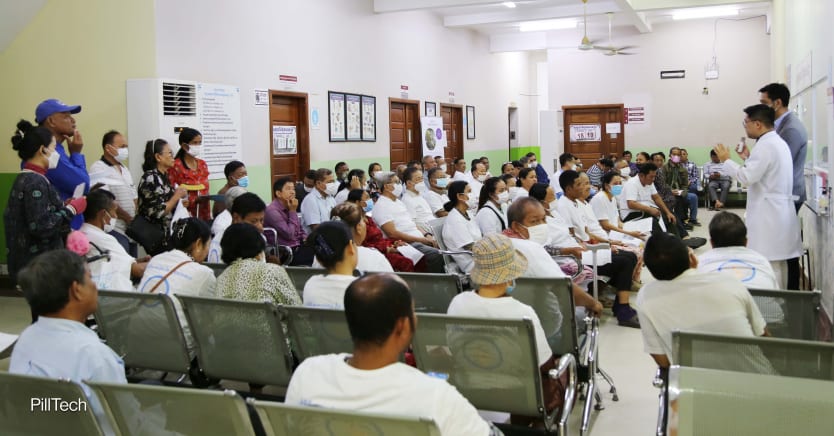
Consider our investment in PillTech, a health-tech startup in Cambodia. PillTech is digitizing medicine distribution for thousands of pharmacies and is often the first point of care, improving access to essential treatments for chronic conditions. Through our Impact Fund investment and mentorship, PillTech is scaling its platform and has expanded to three new provinces, doubling the number of facilities served. This has been possible because of improved client segmentation and targeting and more robust procurement and supply chain processes. They also reinforced their PillTech Academy to train pharmacists through a public/private partnership our Global Health Unit facilitated, strengthening both supply chains and local health care capacity. This is impact funding in action: combining financial resources with knowledge transfer to create lasting change.
A call for true partnership
Beyond the financing gap for NCDs, we face a different challenge: an opportunity gap. Local innovators have the ideas and cultural insight to deliver last-mile solutions. What they lack is access — to capital, networks, and knowledge sharing. By closing these gaps through partnerships, we are helping to create health systems that are not only stronger but locally owned and sustainable.
The future of NCD global health financing lies in fostering true partnerships that empower local communities and leverage diverse resources. Models like our mentorship-driven investments show what's possible when we combine financial and human capital.
It's time for all stakeholders — governments, the private sector, civil society, and international organizations — to commit to this vision. The NCD crisis demands more than financing; it requires strategic partnerships that transform how we think about global health investment.
Only through this approach can we close the gap between NCD burden and funding, turning the tide on one of our generation's greatest health challenges. Entrepreneurs in vulnerable communities with high, unmet needs are ready. Local solutions are ready to scale. We're only missing the collective commitment required to make this transformation a reality.
For more information about Sanofi's Global Health Unit, visit impact.sanofi.
About the author

Jon Fairest
Jon Fairest leads Sanofi’s Global Health Unit, the not-for-profit, sustainable social business model that expands access to 30 Sanofi medicines, largely focused on NCDs, in 40 countries with the highest unmet medical needs. Jon joined Sanofi in 2002 and has held positions of increasing responsibility since, including general manager roles in Bulgaria, Finland, Portugal, and Canada, before taking the position of head of the Africa region. In 2019, Jon became head of external affairs for Eurasia, the Middle East, and Africa and served as head of trade and revenue management.
Search for articles


Most Read
- 1
- 2
- 3
- 4
- 5