The future of the UN? Fuzzy
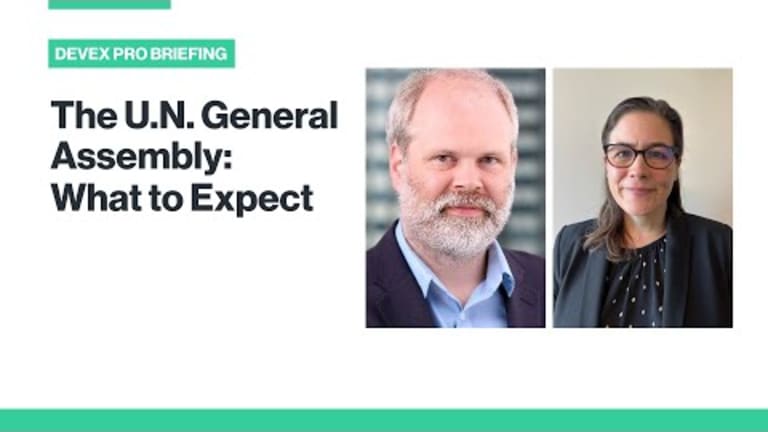
Three U.N. experts tackle U.N. reform, the secretary-general race, and the prospects of the world body's survival under an unpredictable superpower.
The past year has been one of reform at the United Nations, principally the UN80 initiative, which has resulted in some 20% cuts in the administrative budget. But a panel of experts interviewed by Devex in a Pro Briefing voiced concern that they are not necessarily the reforms needed to make the U.N. more relevant in the year ahead. For sure, the U.N. belt-tightening has helped Turtle Bay convince American policymakers that it is willing to heed their demands to rein in spending in an organization that even its staunchest defenders contend is plagued by a certain level of bloat and duplication. It certainly doesn't help that Washington has largely failed to pay its bills on time and in full, fueling a major cash crisis that threatens an “imminent financial collapse” of the U.N., according to its secretary-general, António Guterres. The larger question is whether the changes are tailored to help the world body do its job better, or to simply make it smaller. “I don’t think the ambition was how to better prepare the U.N. to confront challenges of the future,” Heba Aly, the director of the Article 109 coalition, which is focused on amending the U.N. Charter, said in reference to the UN80 initiative. “It was really a cost-cutting exercise, and because of the lack of vision as part of the process I think the risk is … that you end up with a U.N. that’s 20% smaller and still trying to do the same thing.” The result, she added, is a U.N. that is “less effective, and therefore continues to lose relevance.” Guterres’ blueprint for modernizing the U.N., the 2024 Pact for the Future, has largely been short-circuited by Washington’s dismantling of the rules-based world order and its deep skepticism of global governance. "The pact for the future was a really ambitious idea to start talking about the future of global governance,” Aly said. “The challenge is that its commitments are not binding, and it results in a kind of menu of ideas that unfortunately don't have much energy anymore,” she said. “We’ve heard a number of world leaders, from Canadian Prime Minister Mark Carney to German Chancellor Friedrich Merz, essentially saying the old order is dead and actually wasn’t all that fair to begin with,” she added. The ongoing election campaign for a new secretary-general to replace Guterres, who steps down at the end of the year, “is a major opportunity to reset” the U.N.’s priorities, said Jane Kinninmont, chief executive officer at the United Nations Association-UK. So far, only four candidates have formally entered the campaign: former Chilean President Michelle Bachelet; Argentine head of the International Atomic Energy Agency, Rafael Grossi; Costa Rican economist and secretary-general of the United Nations Trade and Development agency, Rebeca Grynspan; and former Senegalese President Macky Sall. Guterres’ focus on global crises such as humanitarian relief, climate change, as well as his work on 21st century challenges laid out in his Pact for the Future, including digital equality and AI governance, “is interesting and important” said Kinninmont. But he “has to a large extent shied away from peace and security, especially in those areas that are most affected by great power competition.” “One of the big risks that faces the U.N. is the risk of being consigned into irrelevance, where it isn’t having as much of an impact on the ground in terms of delivering aid or development,” she said. Kinninmont noted that political polarization in the U.N. Security Council — which is dominated by its five permanent members: China, France, Russia, the United Kingdom, and the United States – has impeded an international response to a range of major conflicts. But she also pointed out that the U.N. Secretariat has been passive. “So we haven't seen the U.N. sending envoys to Tehran and the Gulf states, which could have been a possibility, given that this war, what we’re in now, was widely predicted for a long time,” she added. “The U.N. seems to be facing a fundamental crisis of purpose and vision.” “There may still be things that a future secretary-general can do, using their good offices, using their ability to appoint mediators intelligently and getting key countries to back those mediators,” Kinninmont said. But such an opportunity could be squandered by picking a new U.N. leader who is excessively compliant. “If there is a secretary-general who is seen simply as someone who will do the bidding of the U.S., they will be less relevant, and they will be less able to get things done, including things that the U.S. might want them to do,” she said. “The selection of the next SG is far more than just what the member states think about the individual, but very much what type of multilateral cooperation and U.N. they want to see over the next five to 10 years,” added Daniel Forti, the head of U.N. affairs at the International Crisis Group. There is a risk, Forti said, that candidates will see the easiest path to winning the election rests on promising to deliver “a U.N. that is palatable to capitals.” “That’s an easy sell that any candidate who really wants to win this race can pitch. We would push back on that and say candidates need to have a clear vision of what role the U.N. needs to be playing in the world,” he said. In the end, one of the central challenges facing the U.N. will hinge on how it manages the relationship with the U.S., including how it addresses Washington’s efforts to exert leverage over the world body through its oversized financial contributions. There are “tons of contradictions” in the way the U.S. has approached its financial obligations to the U.N., including by “holding it in a financial vice grip,” Forti said. The “approach we’ve seen from Washington over the past seven, eight months of U.N. funding a la carte,” where the U.S. attempts to earmark funds for specific missions while withholding them from others. He warned, “If the UN gives in to this approach, why wouldn’t other powerful member states try and adopt the same practice of withholding funding unless they're getting their way?”
The past year has been one of reform at the United Nations, principally the UN80 initiative, which has resulted in some 20% cuts in the administrative budget. But a panel of experts interviewed by Devex in a Pro Briefing voiced concern that they are not necessarily the reforms needed to make the U.N. more relevant in the year ahead.
For sure, the U.N. belt-tightening has helped Turtle Bay convince American policymakers that it is willing to heed their demands to rein in spending in an organization that even its staunchest defenders contend is plagued by a certain level of bloat and duplication.
It certainly doesn't help that Washington has largely failed to pay its bills on time and in full, fueling a major cash crisis that threatens an “imminent financial collapse” of the U.N., according to its secretary-general, António Guterres.
This story is forDevex Promembers
Unlock this story now with a 15-day free trial of Devex Pro.
With a Devex Pro subscription you'll get access to deeper analysis and exclusive insights from our reporters and analysts.
Start my free trialRequest a group subscription Printing articles to share with others is a breach of our terms and conditions and copyright policy. Please use the sharing options on the left side of the article. Devex Pro members may share up to 10 articles per month using the Pro share tool ( ).
Colum Lynch is an award-winning reporter and Senior Global Reporter for Devex. He covers the intersection of development, diplomacy, and humanitarian relief at the United Nations and beyond. Prior to Devex, Colum reported on foreign policy and national security for Foreign Policy Magazine and the Washington Post. Colum was awarded the 2011 National Magazine Award for digital reporting for his blog Turtle Bay. He has also won an award for groundbreaking reporting on the U.N.’s failure to protect civilians in Darfur.