The problem with ‘zombie funds’
Nearly a year after its launch, the Cali Fund has raised just $1,000 — highlighting how underfunded global funds can linger for years without delivering results.
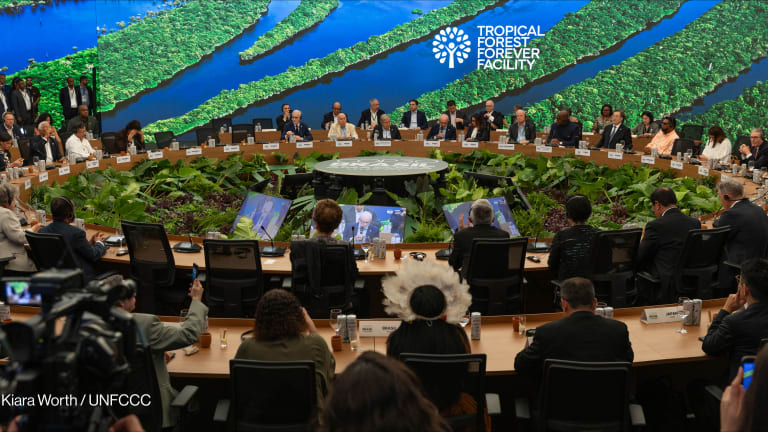
Almost one year ago, several members of the Convention on Biological Diversity, or CBD, stood at the Food and Agriculture Organization in Rome and celebrated the operationalization of the Cali Fund, a United Nations-backed mechanism that aims to raise billions annually from industries that utilize genetic data for conservation purposes. The fund aims to get $1 billion per year. Today, it has accrued just $1,000. This is an extreme version of an increasingly common story. The Fund for Responding to Loss and Damage, developed to provide grants and concessional finance to developing nations heavily impacted by climate-related disasters, aimed to secure $100 billion per year by 2030. So far, it has around $591.42 million. The Adaptation Fund, meant to finance projects that help vulnerable developing countries adapt to the adverse effects of climate change, strived for a minimum of $300 million by the end of 2025 to finance projects in 2026. It received about $135 million in new pledges. The Tropical Forest Forever Facility, or TFFF, a new investment fund to pay forested countries to keep their forests standing, aimed for an initial funding round of $25 billion. In 2025, it received around $6.7 billion. Without their hoped-for cash, these funds can still function — but far below the capacity they had originally intended. Still experts said that there’s a lot of cash sitting unused in many “zombie funds” that could be put toward more actionable projects. And once money is given, it’s tricky to get it back out. A study from 2022 showed that the World Bank Group hosted around 360 trust funds that accounted for $14 billion. These funds are not part of the bank’s balance sheet and the bank doesn’t make decisions around their use. Typically, when a trust fund reaches its agreed closing date, the remaining balance is handled in line with the administration agreement, but the bank did not comment on what happens if the fund lacks the money to carry out the tasks it was created to accomplish. “The World Bank Group manages trust funds as a service for all its shareholders,” a spokesperson for the bank said in a comment to Devex. “Each government decides whether to use this service, how much to contribute, and determines when the funds they provide should conclude.” But experts said that sometimes funds lack such specificity. “Unless there’s a clear sunset date in the creation documents, these funds tend to live on in perpetuity,” Clemence Landers, vice president and senior policy fellow at the Center for Global Development, told Devex. “They become zombie funds — not really actively fundraising, not really financing anything.” Shutting down these funds is extremely complicated. The money given is typically appropriated for a specific purpose and reappropriating it could have legal repercussions. “It’s a huge bureaucratic hurdle to reassign the funds to something else,” Landers said. Many funds, including the loss and damage fund, either have plans to — or are already — distributing funds despite being below their monetary goal. But there are plenty of these zombie funds holding onto money that could be sent elsewhere. The United Nations center for pooled funding, called the Multi-Partner Trust Fund Office, currently hosts 113 “active funds,” including the Cali Fund. Based on its database, the office has 163 inactive funds. The World Bank is also home to 229 stand-alone trust funds and 67 umbrella trust funds, according to a 2024 annual report. There is no publicly available information on how many inactive funds still exist in total. When asked what happens to the money held in those inactive funds, the Multi-Partner Trust Fund Office told Devex that “*if* there are any contributions left following the operational and financial closure of funds (not super common), these are managed in accordance with the signed agreements for those funds.” “I am absolutely adamantly opposed to the creation of new entities and institutions, especially in this current context,” said Landers. “The international community has this habit of going out and creating something new, and everything is just perpetually underfunded. It’s a bad habit.” Inside the Cali Fund The Cali Fund emerged from months of behind-the-scenes work led by legal researchers, data specialists, and accounting experts who were brought in as negotiators. They struggled to agree on how benefit-sharing for digital sequence information — or DSI — should function in practice. Their proposal ultimately led to a voluntary U.N. framework that asks companies using digital genetic sequence data to make annual payments based on their turnover rather than profits. The proceeds from the turnover are then used to support biodiversity conservation and benefit-sharing with countries and Indigenous communities. In November, the fund received $1,000 from U.K. startup TierraViva AI, which uses artificial intelligence to support biodiversity conservation. The startup is run by Paul Oldham, who was part of the initial research for the Cali Fund. The Secretariat of the Convention on Biological Diversity told Devex that “there is substantial work underway” and that the steering committee of the Cali Fund met twice last year and will meet twice in 2026. The committee “approved several foundational and operational documents for the Cali Fund, including the rules of procedure for the Committee meetings and the terms of reference for the Fund” at its most recent meeting in Bonn, Germany. The Cali Fund and TFFF both push the financial burden to deal with the climate crisis onto the private sector rather than fighting for a piece of shrinking government funding. But both also require government buy-in. “The research behind the fund was sound,” said Siva Thambisetty, an associate professor of law at the London School of Economics and Political Science who helped design the Cali Fund’s operational framework. “The worsening [aid] situation makes it more incumbent on states to make sure that the money comes from private entities.” But the problem is that states aren’t encouraging the private sector to get involved. In addition, the final mechanism was voluntary. “I’m a little angry that this has been left entirely to the goodwill of private companies,” said Thambisetty. “This is not the sign of states that want to take the fundraising seriously, and it’s not a sign that states want to take benefit sharing seriously.” Regarding future plans for the Cali Fund despite low government buy-in, the secretariat said that they are reviewing their methodology for “consideration of its overall effectiveness” but that review will only take place in two years at the COP18 biodiversity conference. They are also reviewing contribution rates and company thresholds. However, the CBD secretariat is still constrained by the original plans set out in the fund. “The CBD Secretariat serves the Parties to the CBD and, as such, is not in a position to introduce or develop topics beyond the mandates provided by the Parties,” it told Devex. “Nevertheless, the [secretariat] continues to engage regularly with government representatives, industry and other stakeholders, and representatives of indigenous peoples and local communities to raise awareness of the Cali Fund and to encourage broad collaboration in support of its implementation.” The fund also launched without clear benchmarks for success — no annual fundraising target, and no threshold that would trigger a rethink if contributions failed to materialize. That absence, experts said, has allowed inertia to take hold. Alternatively, TFFF, which had the support of the Brazilian government in its year in the U.N. COP30 climate summit spotlight, had clear parameters for what it was asking from governments versus the private sector, despite the fact that that number has not yet been reached. “If we had said, ‘We need to raise $2 billion a year, and this is what that implies for large users of DSI,’ it would have focused minds,” Thambisetty said. “Instead, we have a fund with no definition of success — or failure.”
Almost one year ago, several members of the Convention on Biological Diversity, or CBD, stood at the Food and Agriculture Organization in Rome and celebrated the operationalization of the Cali Fund, a United Nations-backed mechanism that aims to raise billions annually from industries that utilize genetic data for conservation purposes. The fund aims to get $1 billion per year. Today, it has accrued just $1,000.
This is an extreme version of an increasingly common story. The Fund for Responding to Loss and Damage, developed to provide grants and concessional finance to developing nations heavily impacted by climate-related disasters, aimed to secure $100 billion per year by 2030. So far, it has around $591.42 million. The Adaptation Fund, meant to finance projects that help vulnerable developing countries adapt to the adverse effects of climate change, strived for a minimum of $300 million by the end of 2025 to finance projects in 2026. It received about $135 million in new pledges. The Tropical Forest Forever Facility, or TFFF, a new investment fund to pay forested countries to keep their forests standing, aimed for an initial funding round of $25 billion. In 2025, it received around $6.7 billion.
Without their hoped-for cash, these funds can still function — but far below the capacity they had originally intended. Still experts said that there’s a lot of cash sitting unused in many “zombie funds” that could be put toward more actionable projects. And once money is given, it’s tricky to get it back out.
This story is forDevex Promembers
Unlock this story now with a 15-day free trial of Devex Pro.
With a Devex Pro subscription you'll get access to deeper analysis and exclusive insights from our reporters and analysts.
Start my free trialRequest a group subscription Printing articles to share with others is a breach of our terms and conditions and copyright policy. Please use the sharing options on the left side of the article. Devex Pro members may share up to 10 articles per month using the Pro share tool ( ).
Jesse Chase-Lubitz covers climate change and multilateral development banks for Devex. She previously worked at Nature Magazine, where she received a Pulitzer grant for an investigation into land reclamation. She has written for outlets such as Al Jazeera, Bloomberg, the Organized Crime and Corruption Reporting Project, and The Japan Times, among others. Jesse holds a master’s degree in Environmental Policy and Regulation from the London School of Economics.