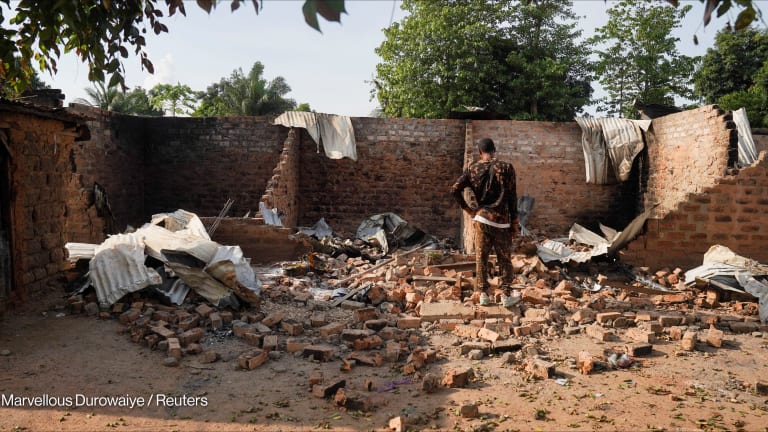
The US brokered peace in eastern DRC. Aid cuts have undermined it
Sweeping U.S. aid cuts have gutted humanitarian programs across the DRC, leaving communities without water, protection, or livelihoods — and casting doubt on whether peace can hold.
It’s been six weeks since Rwanda and the Democratic Republic of Congo signed a peace deal — attempting to end a conflict that for months, has torn through the eastern DRC. The peace agreement, which was brokered by the United States, didn’t bring an end to the violence — it just coincided with a temporary lull. And while today, Marie has stopped falling asleep to the sound of gunfire, life is still nothing like it was before. “The population in the eastern DRC has been going through a double war. Once with the violence from the rebels, and then again with the impacts of the USAID cuts,” said Marie, a civil society leader from the eastern city of Bukavu, speaking through a translator. Like many human rights activists in the country, Marie has been living in hiding after rebel forces tried to track her down — first at her office, and then at her home. Because of that, Devex agreed to use a pseudonym to protect Marie’s identity. For the last eight months, it’s been one blow after another for Marie and her organization. In February, rebel forces took over Bukavu. Soon after, their U.S.-funded program was canceled. The U.S. used to make up the backbone of humanitarian assistance in the DRC, contributing over $1 billion to the country in 2023 alone. “There were no donors, no money, no activities,” said Marie. “The few local organizations that were able to survive, it was because they had different donors.” Marie’s organization was one of those lucky few. But across the country — especially in the conflict-ravaged east — dozens of organizations shut their doors. And for many aid groups working in the area, it’s making the prospect of peace in the DRC feel nearly impossible. “Everybody wants peace,” said Abby Maxman, president and CEO of Oxfam America, speaking to Devex just after she returned from the DRC. “And yet, the scaffolding under which any agreement should be built has been pulled out.” Months of chaos, months of cancellations Before the Trump administration gutted U.S. foreign assistance, the country underpinned 70% of the humanitarian response in the DRC, with the vast majority of that funding going toward emergency food, protection, and medical relief. But in February 2025, the cuts hit the DRC — just days after decades of violence in the country escalated. In late January, the M23 rebel group took control of Goma, the capital of the DRC’s North Kivu province. Millions fled from their homes, many of whom had already been displaced at least once before. And within a month, the country’s prime minister told the United Nations Human Rights Council that more than 7,000 people had been killed, a “significant mass” of whom were civilians. “Every 24 hours, you felt lucky enough to live,” said Marie, who remembered waking up to dead bodies on the porches, streets, and homes of her neighborhood. “And you would just hope that would be renewed for another 24 hours.” The worst of the fighting took place between January and April, Marie said. By that time, UNICEF estimated that a child was reported raped every half hour, a result of the sexual violence M23 has long been accused of committing as a weapon of war. Violence continued to spiral as the needs continued to grow, with gender-based violence spiking by nearly 40% during the first four months of 2025 compared to the same period in 2024. “We can’t talk about peace if people are starving, sick, and scared. Without the support we had before, the peace agreement is only words.” --— Abby Maxman, president and CEO, Oxfam America By July, Oxfam reported that 30 international aid agencies had been affected by the cuts, while 89 national organizations had closed down entirely. And now, 10.3 million people in the region are facing emergency hunger, according to the World Food Programme. “There’s no amount of backfill that would be feasible or conceivable,” said Maxman. “Everyone I spoke with was dealing with the question of: how do you cut more?” Typically, Oxfam doesn’t take funding directly from the U.S. government. But in some cases, there are exceptions — including a water, sanitation, and hygiene program that was supporting hundreds of thousands of people in the DRC, Maxman said. That program was canceled earlier this year, and overnight, 700,000 people lost access to clean water and basic sanitation in displacement sites across Goma. Today, 500 people in the towns of Sake and Minova are sharing one water tap, according to the organization. “This is a full-blown public health emergency,” said Manenji Mangundu, Oxfam’s director in the DRC, in a recent statement. “Families are returning to ruins — no shelters, no toilets, no clean water. … The air reeks of sewage. Hospitals are out of medicine, and we can’t reach cut-off communities with even the most basic aid.” CARE, another international aid group working in the region, has seen much of the same: the organization lost about 40% of its portfolio in the DRC, the organization’s country director, Amadou Bocoum, told Devex. That included a two-year, $6.5 million income-generation project for displaced families, one that aimed to reach 8,000 households in North Kivu. “We lost everything related to gender-based activities, including a major project for refugees,” said Bocoum. “We worked with 24 local organizations before the cuts, and now, one-third of them have had their contracts canceled.” While the violence has settled somewhat since its height in February, in July, the International Crisis Group reported the situation had deteriorated once again; in the Ituri and North Kivu provinces, various armed groups killed 140 late last month, while M23 rebels killed another 170 in mid-July. Both incidents occurred weeks after the U.S. brokered a peace talk between the DRC and Rwanda, the country that has long been accused of backing the M23. On June 27, the top diplomats of all three countries met in Washington to sign the deal — one that President Donald Trump referred to as a “glorious triumph” and a “long time waiting.” For Trump, the agreement is more than just a brokering of peace. Its text mentions plans for the Congolese critical mineral trade, “in partnership, as appropriate, with the U.S. government and U.S. investors.” In theory, the deal could unlock access to the most resource-rich country in the world: the DRC’s raw minerals, such as copper, tin, and cobalt, are estimated to be worth $24 trillion, according to the European Union’s Generalised Scheme of Preferences. But in the eastern DRC, the handshakes in Washington still haven’t translated. “The agreement does not have any effect,” said Bocoum. “The agreement remains political, and on the ground, nothing really changed.” ‘A glorious triumph’ For those like Marie, the peace talks have led to “total confusion” in the DRC’s east. Three weeks after the first peace agreement was signed, delegates from the DRC and the M23 rebel group pledged to sign another accord by Aug. 18. It was a move commended by State Department spokesperson Tammy Bruce — but back in Bukavu, things continued to feel the same. “The rebels are still in the city, the women are still facing violence, the men are being killed, and many are still being enrolled into the army. They don’t have any choice,” Marie added. The region’s banking system has also collapsed: the only way to get cash is to go through the black market, Marie said, while cards and bank accounts have been rendered useless. In the meantime, the support structures people relied upon continue to be broken. CARE has run out of post-exposure prophylaxis — a type of medication critical for protecting rape survivors from HIV. And six months into Congo’s war, Oxfam reported that cholera was killing four people every day, marking a 62% increase since 2024. “What do you need to have a peace process that works?” said Maxman. “You can’t have communities who are hungry, sick, and with nothing — and scared.” Despite that, the U.S. is forging ahead with talk of the DRC’s critical mineral trade, with lawmakers on the Senate Foreign Relations Committee meeting on the topic late last month. The hearing was positioned as a way to tap into opportunities on the continent, while also playing catch-up with China — a country that today, owns or operates 80% of the critical mineral production in the DRC, according to the U.S. International Development Finance Corporation. “Tensions over mineral-rich regions have fueled regional instability for decades,” said Sen. Ted Cruz, a Republican from Texas, at the committee hearing on July 30. Cruz added that the DRC-Rwanda peace agreement “presents a rare opportunity to achieve stability while securing access to strategic resources.” “But if we fail to act now,” he said, “China will be able to shut the United States out of Africa entirely.” Other lawmakers — and many in the aid sector — see the situation differently. In March, the Center for Global Development analyzed the Trump administration’s cuts to USAID at the country level, finding that the DRC lost $387 million this year. That’s the second largest loss by dollar value, following Ukraine (at $1.4 billion) and tied with Ethiopia (at $387 million). The State Department — which has now taken over the little left of USAID — has also been put on the chopping block, with 1,300 staff terminated from the agency last month alone. That includes those with experience on the African continent and with critical minerals, argued Sen. Cory Booker, a Democrat from New Jersey, at the committee hearing. “The Trump administration terminated labor, environmental, and peace-building programs that supported vulnerable communities in conflict areas where critical minerals become a source of corruption, violence, and destruction,” said Booker. “I believe in commercial diplomacy … but commercial diplomacy without a larger strategic plan, without proper funding, staffing, and programming, doesn’t do much.” Jonathan Pratt, the head of the State Department’s Bureau of African Affairs, told Booker that his team had been able to retain all its employees despite the agency-wide reduction-in-force. Still, the bureau had also added two new offices into its fold: one focused on foreign assistance, and another centered on commercial strategies, including critical minerals, Pratt said. “Now we have the challenge with how we will oversee the assistance in Africa,” he added. “We’re very much building this plane as we fly, but I think we’re up to the challenge.” Promises vs. proof On Aug. 8, representatives from the DRC and Rwanda met at the African Union in Addis Ababa. They were there for the first joint security meeting related to the peace agreement signed in Washington, alongside observers from the United States, Qatar, and the AU. But two days earlier, the U.N. confirmed that M23 had killed at least 319 civilians the month prior, an attack that the U.N. high commissioner for human rights, Volker Türk, called “one of the largest documented death tolls” since M23’s resurgence. “Horrified by continued attacks on civilians in #DRC, despite recent ceasefire agreement,” Türk posted on X. “They must end immediately, and all those responsible must be held to account.” For Marie, the diplomats’ promises mean little. Her organization — which supports female entrepreneurs in the eastern Congo — scrambled to pull together money for a contractor, whom they had already agreed to pay to build a small factory before the cuts were announced. They were able to get the funding to fill the gap — but many local organizations, Marie said, could not. She’s seen dozens of local groups, international organizations, and others be affected by the cuts, including those providing support for survivors of violence, conflict, and sexual abuse. “We can’t talk about peace if people are starving, sick, and scared,” said Oxfam’s Maxam. “Without the support we had before, the peace agreement is only words.” So in Bukavu, the streets may be quieter than they were in February. But for those like Marie, that silence feels uneasy — less like peace, and more like a pause before the next blow.
It’s been six weeks since Rwanda and the Democratic Republic of Congo signed a peace deal — attempting to end a conflict that for months, has torn through the eastern DRC.
The peace agreement, which was brokered by the United States, didn’t bring an end to the violence — it just coincided with a temporary lull. And while today, Marie has stopped falling asleep to the sound of gunfire, life is still nothing like it was before.
“The population in the eastern DRC has been going through a double war. Once with the violence from the rebels, and then again with the impacts of the USAID cuts,” said Marie, a civil society leader from the eastern city of Bukavu, speaking through a translator.
This article is free to read - just register or sign in
Access news, newsletters, events and more.
Join usSign inPrinting articles to share with others is a breach of our terms and conditions and copyright policy. Please use the sharing options on the left side of the article. Devex Pro members may share up to 10 articles per month using the Pro share tool ( ).
Elissa Miolene reports on USAID and the U.S. government at Devex. She previously covered education at The San Jose Mercury News, and has written for outlets like The Wall Street Journal, San Francisco Chronicle, Washingtonian magazine, among others. Before shifting to journalism, Elissa led communications for humanitarian agencies in the United States, East Africa, and South Asia.