• News
    • Latest news
    • News search
    • Health
    • Finance
    • Food
    • Career news
    • Content series
    • Focus areas
    • Try Devex Pro
  • Jobs
    • Job search
    • Post a job
    • Employer search
    • CV Writing
    • Upcoming career events
    • Try Career Account
  • Funding
    • Funding search
    • Funding news
  • Talent
    • Candidate search
    • Devex Talent Solutions
  • Events
    • Upcoming and past events
    • Partner on an event
  • Post a job
  • About
      • About us
      • Membership
      • Newsletters
      • Advertising partnerships
      • Devex Talent Solutions
      • Contact us
Join DevexSign in
Join DevexSign in

News

  • Latest news
  • News search
  • Health
  • Finance
  • Food
  • Career news
  • Content series
  • Focus areas
  • Try Devex Pro

Jobs

  • Job search
  • Post a job
  • Employer search
  • CV Writing
  • Upcoming career events
  • Try Career Account

Funding

  • Funding search
  • Funding news

Talent

  • Candidate search
  • Devex Talent Solutions

Events

  • Upcoming and past events
  • Partner on an event
Post a job

About

  • About us
  • Membership
  • Newsletters
  • Advertising partnerships
  • Devex Talent Solutions
  • Contact us
  • My Devex
  • Update my profile % complete
  • Account & privacy settings
  • My saved jobs
  • Manage newsletters
  • Support
  • Sign out
Latest newsNews searchHealthFinanceFoodCareer newsContent seriesFocus areasTry Devex Pro
    • News
    • World Bank annual meetings 2024

    The World Bank’s IDA replenishment: The money, the odds, the high stakes

    A status check on the replenishment of the bank’s concessional fund for the lowest-income countries and the financial and policy implications.

    By Adva Saldinger // 22 October 2024
    With less than two months before the pledging conference to raise money for the World Bank’s International Development Association, its most concessional fund for the lowest-income countries, the bank’s annual meetings this week come at a pivotal moment in the negotiations. Today, the bank is hosting an IDA Forum, where it is expected to share proposals for IDA’s 21st replenishment policy priorities — a draft of which Devex obtained. The discussions so far paint a complex picture of ambitious targets, competing visions, and high stakes for the world’s lowest-income nations, which have been buffeted by headwinds from debt distress to conflict and climate change. IDA is a “lifeline” for the 77 lowest-income countries, World Bank President Ajay Banga said at a recent Reuters event. “We’re critical to their needs” and in many cases the source of half their development money, he added. This IDA21 replenishment could benefit 1.9 billion people over its three-year window, according to the bank, providing funding for everything from primary education to basic health services, clean water, agriculture, infrastructure, and institutional reforms. IDA20, the previous replenishment cycle, hit about $93 billion, with roughly $23 billion coming from donors and the rest leveraged by issuing bonds in private markets. But the goal this time around is bigger. Last year Banga called for the largest replenishment ever, with a target of around $100 billion, although African leaders and development advocates are calling for at least $120 billion. That $120 billion target will require some $30 billion from donors. When Banga announced the target, there was excitement about the ambition. It showed that while the bank’s other reforms were more focused on middle-income countries, it was putting the spotlight back on low-income countries with its IDA push, said Clemence Landers, a senior policy fellow at the Center for Global Development. But now reality has set in. “IDA replenishment is starting to look really, really, really difficult. That should be kind of terrifying for people,” she said, adding that it looks like it will take a “herculean” effort to reach the targets. The path is rocky due to a number of factors, from domestic politics to currency devaluations and more. There are many dynamics at play this week that will shape what happens at the official IDA replenishment in December — including discussions on both the money and the policies that will guide how it is used — and whether the gathering will be a success, or a let-down. The money Getting to $100 billion or more, this IDA replenishment will be a challenge, sources told Devex. Many traditional IDA donors are facing economic troubles at home and cutting aid budgets, including Germany, France, and the United Kingdom. But this replenishment also comes at a time when nearly a dozen development and climate funds are turning to the same group of donors for more capital, what the Center for Global Development called a “replenishment traffic jam” in a recent report. Another key hurdle is currency devaluation — local currencies are worth less compared to the U.S. dollar — in several key IDA donor countries, including Japan, IDA’s second-largest contributor. The ONE Campaign calculated that countries as a whole have to increase contributions by 23% in their own currencies just to match the previous IDA replenishment, David McNair, executive director of global policy at the ONE Campaign, told Devex. That means the bank will need to drum up even more dramatic increases in contributions to hit the current targets. In the case of Japan, it would have to boost its yen contribution by 25% to keep pace with its last IDA commitment and go up 40% to 50% to increase its contribution this time around. “We’re finding it really hard to get through this,” Banga said. But when asked if hitting the $120 billion target was realistic, he said it was, although it would depend on what’s going on in the world. There has been one contribution so far — Denmark announced last month that it would increase its contribution in Danish krone by 40%. Many hope others will follow suit, and while there could be additional announcements this week, most countries will likely wait until the December replenishment meeting in South Korea. Banga did say that Spain and the United Kingdom have indicated they will increase their contribution. The U.K. made a dramatic cut to its contribution during the last replenishment and even if it doubled its contribution, it would still be below its pledge in the IDA19 cycle. It’s unclear where IDA’s largest donor, the United States, will land, although Jay Shambaugh, the undersecretary for international affairs at the U.S. Treasury, recently said: “It will take both donors stepping up and financial creativity to optimize the balance sheet to make sure we can deliver on this important goal.” While President Joe Biden’s administration will determine its IDA contribution, what the U.S. actually provides hinges on the upcoming election. A Biden pledge could be reduced if former President Donald Trump wins the election. It’s happened before. Former President Barack Obama made a commitment to IDA18 in December 2016, but when Trump came into office, he cut the contribution to $3.3 billion from $3.87 billion. Meanwhile, China has steadily increased its IDA contributions, and African leaders recently pushed it to contribute $2 billion, though it’s unclear if Beijing will follow through and IDA didn’t make it into a final agreement at the recent Forum on China-Africa Cooperation, sources told Devex. The trade-offs Securing as much donor money as possible is important because IDA’s form of concessional capital — grants or low-cost loans — is critical to IDA borrowing countries, many of which face debt challenges and have few other sources of financing. Half of IDA countries are in or at a high risk of debt distress and nearly 45% of IDA countries are fragile and conflict-affected states, according to the World Bank. But some are worried that in an effort to hit higher dollar targets in this replenishment, the terms of IDA funding might shift and the World Bank will increase the cost of loans or provide fewer grants — creating a trade-off between size and concessionality. Changing those terms could result in “diluting the quality” of IDA, said Charles Kenny, a senior fellow at the Center for Global Development. “It would be an attractive thing to do if you don’t want to embarrass donors and claim success.” But more money now is also important, said Serah Makka, ONE Campaign’s Africa executive director, and some trade-offs may be worth it. The bank will need to find the right balance. There are a wide range of IDA countries and the bank should carefully calibrate its terms based on the specific situation of each country, not create uniform changes, Landers said. The policies It’s not just about the money, but what that money will do. And this replenishment includes negotiations about the policy guidance that accompanies the new funds — creating potential tensions between competing views of how IDA should operate. The bank recently released a draft of a replenishment report from the executive directors of IDA to the bank’s board of governors — which will be discussed at Tuesday’s IDA Forum. The proposal includes a range of details on how the bank wants IDA21 to work. Some changes are aimed at bringing the IDA21 policy framework in line with broader World Bank reform efforts that would improve the speed of projects and offer greater flexibility to borrowing countries, according to the draft. That includes using the new corporate scorecard, which will track results and progress toward the bank’s key objectives, and the new World Bank Group-wide gender strategy to guide decision-making. It also lays out five focus areas — people, planet, prosperity, infrastructure, and digital transformation — as well as four “lenses”: gender; jobs; private investment; and fragility, conflict, and violence. That then translates to 24 policy commitments including crisis preparedness, gender equality, more and better jobs, private investment, and climate adaptation. Some African countries have been pushing to simplify IDA’s lending requirements so that they would have fewer hurdles to get funds and projects move more quickly, Makka said. “IDA’s value, its competitive advantage, is that it’s demand-driven. We don’t want to straightjacket policy commitments,” Makka said, adding that countries should be able to use the funds in line with their priorities. That message seems to have been received. While previous IDA cycles have had many policy commitments that required specific country-level actions, this time around the bank proposes focusing more on development outcomes and not predetermining how recipients spend the money, according to the draft. But not everyone agrees with that approach. “It is counterproductive to scale back detail and ambition,” Kate Donald, the head of Oxfam’s Washington, D.C., office, told Devex. She said that donors are expressing concerns that a lack of concrete policy commitments will make it harder to push for more funding because there isn’t a clear narrative about what that funding would achieve. “Recipients want fewer strings but higher contributions,” she said. “There is a mismatch of expectations there.” Both the U.S. and U.K. governments have said they want to see more specifics in the policy package. The bank had wanted to have the final policy package ready by the annual meetings, but ongoing negotiations have prevented that, Donald said. There are other concerns in the policy package, notably on the bank’s approach to gender, several sources told Devex. They said the goals on gender equality are less ambitious than IDA20 and include no country-level commitments. When Oxfam said it raised the concern with the bank, the response was that its new gender strategy would apply and “take care of everything,” implying that the specific IDA targets were not necessary. But Donald said she doesn’t think strategies translate into concrete actions in the way specific country-level policy commitments would. Another piece of the policy proposal that will likely garner attention is the expansion of the IDA private sector window designed to mobilize private capital in IDA countries by subsidizing investments made by the International Finance Corporation, the World Bank’s private sector arm. The bank proposed increasing funding to $4 billion, up from $2.5 billion. The private sector window, or PSW, has been a hot-button issue in the past because many development experts believe it is ineffective and a poor use of IDA funds, which they don’t think should subsidize private companies. A recent Center for Global Development report recommended that the PSW get no additional funding without major changes because it had not proven to boost more lending in IDA countries by IFC or increase private capital mobilization. “The private sector window to me is a clear case of an instrument not working on the stated terms and probably a bit misguided with potential perverse effects,” Donald said. “But many people at the bank are ideologically attached to it,” as are some donors and some recipient country representatives. What’s next This IDA process has been more open than previous replenishments, which have often been closed-door discussions, though this time there’s been far more consultation with civil society in particular. But some are worried the World Bank has not done enough to explain the far-reaching impact of IDA, ONE Campaign’s McNair told Devex. “They need to get better at branding this instrument as something fundamentally important to local government budgets, to the services real people actually receive, and to future prosperity of countries,” he said. The World Bank and recipient countries don’t have much time left to promote the value of IDA and to hammer out all the policy details. Negotiations are likely to continue all the way up to the pledging conference in South Korea on Dec. 5 and 6, sources told Devex.

    Related Stories

    Inside the World Bank’s plan to boost jobs by investing in agribusiness
    Inside the World Bank’s plan to boost jobs by investing in agribusiness
    Uncertainty ‘new normal’ as World Bank, IMF meet amid aid cuts, discord
    Uncertainty ‘new normal’ as World Bank, IMF meet amid aid cuts, discord
    Devex Invested: An ‘America First’ vision for the World Bank and IMF
    Devex Invested: An ‘America First’ vision for the World Bank and IMF
    In a changing world, where do World Bank reforms stand?
    In a changing world, where do World Bank reforms stand?

    With less than two months before the pledging conference to raise money for the World Bank’s International Development Association, its most concessional fund for the lowest-income countries, the bank’s annual meetings this week come at a pivotal moment in the negotiations.

    Today, the bank is hosting an IDA Forum, where it is expected to share proposals for IDA’s 21st replenishment policy priorities — a draft of which Devex obtained. The discussions so far paint a complex picture of ambitious targets, competing visions, and high stakes for the world’s lowest-income nations, which have been buffeted by headwinds from debt distress to conflict and climate change.

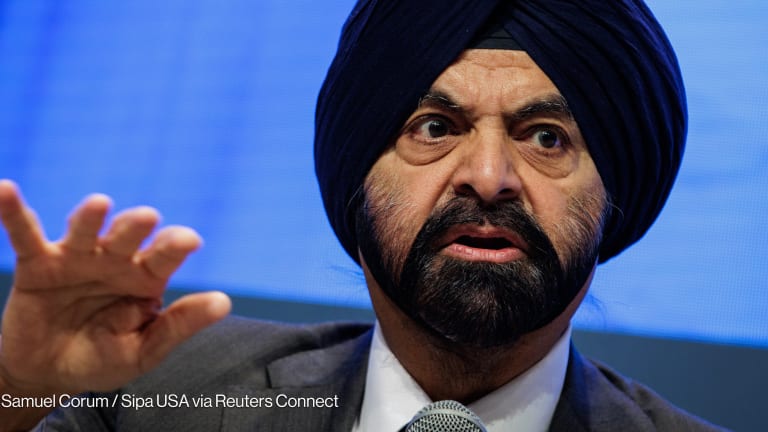
    IDA is a “lifeline” for the 77 lowest-income countries, World Bank President Ajay Banga said at a recent Reuters event. “We’re critical to their needs” and in many cases the source of half their development money, he added.

    This article is free to read - just register or sign in

    Access news, newsletters, events and more.

    Join usSign in
    • Banking & Finance
    • Social/Inclusive Development
    • Funding
    • Trade & Policy
    • Institutional Development
    • Economic Development
    • International Development Association (IDA)
    • World Bank Group
    Printing articles to share with others is a breach of our terms and conditions and copyright policy. Please use the sharing options on the left side of the article. Devex Pro members may share up to 10 articles per month using the Pro share tool ( ).

    About the author

    • Adva Saldinger

      Adva Saldinger@AdvaSal

      Adva Saldinger is a Senior Reporter at Devex where she covers development finance, as well as U.S. foreign aid policy. Adva explores the role the private sector and private capital play in development and authors the weekly Devex Invested newsletter bringing the latest news on the role of business and finance in addressing global challenges. A journalist with more than 10 years of experience, she has worked at several newspapers in the U.S. and lived in both Ghana and South Africa.

    Search for articles

    Related Stories

    World Bank annual meetings 2025Related Stories - Inside the World Bank’s plan to boost jobs by investing in agribusiness

    Inside the World Bank’s plan to boost jobs by investing in agribusiness

    World Bank annual meetings 2025Related Stories - Uncertainty ‘new normal’ as World Bank, IMF meet amid aid cuts, discord

    Uncertainty ‘new normal’ as World Bank, IMF meet amid aid cuts, discord

    Devex InvestedRelated Stories - Devex Invested: An ‘America First’ vision for the World Bank and IMF

    Devex Invested: An ‘America First’ vision for the World Bank and IMF

    World BankRelated Stories - In a changing world, where do World Bank reforms stand?

    In a changing world, where do World Bank reforms stand?

    Most Read

    • 1
      Why NTDs are a prime investment for philanthropy
    • 2
      When business moves faster than politics
    • 3
      Why a new partnership model is key to future of development finance
    • 4
      The direction of the Paris Agreement is right. The pace is not
    • 5
      Climate change mandates more innovation in yellow fever vaccines
    • News
    • Jobs
    • Funding
    • Talent
    • Events

    Devex is the media platform for the global development community.

    A social enterprise, we connect and inform over 1.3 million development, health, humanitarian, and sustainability professionals through news, business intelligence, and funding & career opportunities so you can do more good for more people. We invite you to join us.

    • About us
    • Membership
    • Newsletters
    • Advertising partnerships
    • Devex Talent Solutions
    • Post a job
    • Careers at Devex
    • Contact us
    © Copyright 2000 - 2026 Devex|User Agreement|Privacy Statement