Trump’s 'beautiful Christians' left knocking on White House’s door
The U.S. president has pledged special treatment for the faithful, but religious charities are suffering from foreign aid freeze.
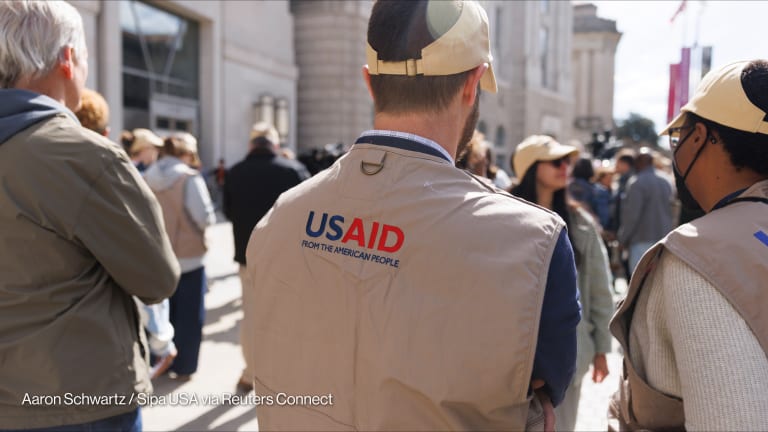
United States President Donald Trump has rewarded what he calls “my beautiful Christians,” establishing an antibias task force and appointing a conservative evangelical firebrand as his White House faith adviser. At the United Nations, the new administration has targeted initiatives that promote gender and sexual and reproductive health rights, key priorities for conservative Christian activists. But those political perks have provided little comfort to Christian missionaries, Jewish relief agencies, and other faith-based aid organizations grappling with an unprecedented freeze on federal aid that has crippled their relief projects. Some of the largest Christian aid organizations, including World Vision, Catholic Relief Services, and Samaritan’s Purse, have been subject to the same cuts as other secular aid agencies, and are competing for waivers. “It’s a disaster. Most of the faith-based organizations’ budgets depend on their partnerships with USAID,” Samah Norquist, who served as the first Trump administration’s religious freedom envoy at USAID, told Devex in a phone interview. “It stopped everything. … Every faith-based organization USAID partners with is unable to deliver … assistance, including food and commodities.” It was not supposed to be like this. During Trump’s first term, the U.S. sought to champion the priorities of religious charities, particularly conservative evangelical Christians, establishing a $50 million program at USAID to promote religious freedom and diversify the agency’s aid recipients, including by granting a larger role for faith-based aid organizations. “The next conservative Administration must champion the core American value of religious freedom, which correlates significantly with poverty reduction, economic growth, and peace,” Max Primorac, a former adviser to former Vice President Mike Pence, wrote in the conservative Heritage Foundation’s Project 2025, which has served as an informal blueprint for Trump’s reforms. “It should train all USAID staff on the connection between religious freedom and development [and] strengthen the mission’s relationship with local faith-based leaders.” But in the last month, any thought of reforming the international development agency has been replaced by a commitment to dismantling it, and perhaps integrating a paired-down version of it into the U.S. Department of State. Norquist maintains the State Department’s “reckless actions” to absorb USAID have undermined previous gains made in advancing the cause of religious minorities in Trump’s first term, according to an opinion piece she wrote in Newsmax. During Trump’s previous administration, USAID expanded its collaboration with faith-based organizations through the 2019 New Partnership Initiative, and Trump’s National Security Strategy “recognized religious freedom as integral to U.S. national security, acknowledging that protecting religious minorities helps prevent instability and extremism.” With White House support, USAID led efforts to protect Christian and Yazidi communities in northern Iraq, she wrote. All that has changed, she said. In Burkina Faso, a Democracy International program to “track violence against Christian communities at risk of being killed” because it lacks funding to provide victims with food, shelter, or relocation services, according to one lawsuit. The recent freeze she said has also set back efforts to protect religious allies. “In May 2024, then-Sen. Rubio spoke at an International Republican Institute (IRI) event honoring exiled Catholic Bishop Rolando Álvarez for his advocacy of religious freedom in Nicaragua,” Norquist wrote. “What Rubio likely didn’t know is that IRI’s work on religious freedom in Nicaragua was funded by USAID.” Ironically, she added, the State Department’s stop-work order prevented IRI from bringing the Nicaraguan bishop to Washington, D.C., to attend the Feb. 4-5 International Religious Freedom Summit, where U.S. Vice President JD Vance delivered a speech underscoring Washington’s commitment to persecuted religious minorities. The Musk-Miller axis The initiative has hit scores of faith-based organizations and stopped funding even programs the administration previously supported, including funding for Christian and other religious and minority groups, including the Yazidis, in territory once occupied by the terrorist group ISIS. The indiscriminate nature of the cuts reflects the ascendancy of Elon Musk, his team of lawyers, tech whizzes from the Department of Government Efficiency, or DOGE, and Stephen Miller, the White House deputy chief of staff and chief architect of Trump’s immigration policy. Peter Marocco, a once-obscure Republican political appointee who cycled through multiple jobs at the Pentagon, the Commerce Department, the State Department, and USAID during Trump’s first term, has emerged as a powerful force. At USAID, Marocco was the subject of a 13-page dissent memo, an official internal channel that allows staff to lodge a protest, which characterized him as belittling staff, undercutting morale, and excessively micromanaging operations. Marocco was recently appointed by Rubio to integrate the development agency into the State Department. Together, Marocco and Musk have taken a bureaucratic and digital poleaxe to the USAID’s $40 billion budget, driven thousands of federal employees, U.N. workers, and contractors out of their jobs, and deprived millions of access to lifesaving assistance. Calling Kim Kardashian For generations, a loose coalition of Catholic, Protestant, Jewish, Muslim, and secular groups in the U.S. and abroad “have worked together across multiple generations to promote one cause: Welcoming the stranger, welcoming refugees,” Elizabeth Campbell, executive director of ODI Global Washington, a global affairs and development think tank, told Devex. “They are not strong stakeholders in the current administration’s priorities,” she added, noting that the influence of faith-based groups has been “completely overshadowed” by efforts to shrink the government and stop foreign assistance. “We are in a stage where the administration is entirely focused on destroying the structures, bureaucracies, funding flows, relationships as we’ve known them to exist, including aspects of faith-based organizations and their work,” she told Devex. It is possible, she noted, that the Trump administration will later turn to faith-based groups to help reinforce potential peace efforts in countries such as Sudan or Ukraine, where religious charities already have long-standing relationships with local populations. “Those groups will be well-placed to step in the way they have historically,” she said. For the moment, Trump’s Christian constituency has been left outside the gates, forcing them to explore creative ways — from lawsuits to flattery — to get the ear of the president. “I’m a big believer in unusual alliances,” the leader of one Christian relief agency told Devex. ”I actually had to think to myself ‘should I be calling Kim Kardashian?’” the megainfluencer who once convinced Trump to pardon a first-time drug offender. “I mean this is just the most upside down world.” Who knew? Since Trump issued his executive order freezing foreign aid, tens of thousands of people have lost their jobs, with more than 10,000 USAID workers out of work. One website estimates that as many as 50,000 American jobs could be lost, and as many as 100,000 globally. “People are going to die, and these deaths are on the hands of this administration,” said Ruth Messinger, a former president of the American Jewish World Service who now serves as its global ambassador. “It seems to me that they’ve just decided to go in with a heavy hand and slash everything they don’t like and excise words and tell people they’re not the gender they think they are,” she said. “If there is some pushback they’ll push it down.” The scope of the clampdown has caught Republican aid advocates by surprise. The Trump campaign was interviewing candidates for the top USAID administrator job through December. But by Inauguration day, most of the leading candidates, including former World Food Programme Executive Director David Beasley, appeared to be out of the running. By mid-January, Marocco — who had been vetting potential candidates for top development jobs from Trump’s Palm Beach residence and club Mar-a-Lago — emerged as the behind-the-scenes favorite to run USAID. In Trump’s first term, Marocco had sought to redirect funding from governance and democracy programs to national security programs and faith-based aid agencies. So far, it remains unclear whether there has been any effort to shield faith-based groups from the cuts. “Nobody in the inner circle tipped that they were going in this direction,” according to a Republican with deep ties in the development community. Say nothing The crisis has created the curious spectacle of American churches and synagogues filing lawsuits against the U.S. government. In the weeks following the foreign aid freeze, several faith-based groups sued the administration on the grounds that its action violated constitutional guarantees ensuring the separation of powers. Some 27 faith-based organizations filed a lawsuit challenging a policy that allows immigration authorities to conduct raids in houses of worship. The world’s oldest immigrant protection agency, Hebrew Immigrant Aid Society, or HIAS, has joined a lawsuit that secured an injunction against the administration because it is violating the constitutional separation of powers. The agency, which was founded in 1881 to help resettle Russian-Jewish victims of anti-Semitism in the U.S., now assists immigrants around the world, a mission that has become increasingly fraught in the United States. It receives some 58% of its budget from the U.S. and it was hit hard by the freeze, which halted $20 million worth of work on fiscal year 2025 grants and $18.5 million in cooperative agreements to assist the most vulnerable Venezuelan immigrants. Since the freeze, HIAS has laid off 500 international staff, deferred payments to vendors, and canceled programs, placing its programs in Africa and South Africa on hold, “including its work helping displaced children who are at high risk of trafficking, sexual exploitation, abuse and neglect. These programs cannot simply be restarted on command.” “We’ve been totally surprised by what’s happened in the last few weeks, which has been far worse than even our worst expectations,” Noah Gottschalk, the senior director of International Advocacy and International Jewish Community Relations at HIAS, told Devex. “What we’ve seen is a sledgehammer being taken to the really delicate and complex lifesaving system that has been built up over the course of decades to serve some of the world’s most vulnerable people.” “I initially thought this was a misunderstanding,” said Gottschalk. “We all wanted to believe that, oh, if we can just explain that actually a pause is really harmful people would say oh, okay, oops that wasn’t our intention, let's fix it. That point has been made and it’s not being heard.” Troll farms This week, the U.S. Conference of Catholic Bishops — which provides food, housing, and English language courses to thousands of legal immigrants — filed a lawsuit against the Trump administration, claiming that the freeze of tens of millions of dollars places the church’s refugee relief programs in peril and violates “multiple statutes, including the Administrative Procedure Act … and undermines the Constitution’s separation of powers.” Catholic Relief Services, which receives about half of its $1.5 billion budget from USAID, has been forced to scale back programs and downsize its staff. “We anticipate that we will be a much smaller overall organization by the end of this fiscal year," CRS President and CEO Sean Callahan wrote in a Feb. 3 email, according to the National Catholic Reporter. A spokesperson for the agency declined to comment for this story. For the Jesuit Refugee Service, which provides food, medicine, nursing, and care for orphans from Colombia to Sudan, the freeze has been followed by a flood of online attacks. In early February, Michael O’Keeffe, a right-wing activist in Ireland with more than 180,000 followers on X, celebrated the U.S. freeze on the religious charity, proclaiming in a tweet, “I love DOGE.” The comment generated 1.9 million views and a flood of responses attacking the Jesuit program, including highly racist and antisemitic posts, including one noting that “Pope Francis is also a Jesuit. They are just as bad as Juze.” A phone message left on the organization’s answering machine accused it of being “involved in what basically is human trafficking” and predicting that “justice is coming.” “We do our work as an expression of our Catholic beliefs. We are called upon to welcome the stranger and to assist the afflicted and needy,” Bridget Cusick, JRS’s director of marketing and communications, told Devex by email. “We now find ourselves — as do other religiously affiliated groups — subject to social media troll farm campaigns filled with wild claims about what we do and in some cases, wishing our staff actual harm.” The president’s executive orders have resulted in a clash with the Catholic Church hierarchy. On Jan. 22, Archbishop Timothy Broglio, the president of the U.S. Conference of Catholic Bishops, issued a statement saying some of the administration’s new policies, including on migration, “are deeply troubling and will have negative consequences, many of which will harm the most vulnerable among us. … It is our hope that the leadership of our Country will reconsider those actions which disregard not only the human dignity of a few, but of us all.” In response, Vice President JD Vance fired back, implying that the Catholic Church’s support for migration was driven less by pastoral concerns than by financial incentives. “I think the U.S. Conference of Catholic Bishops has, frankly, not been a good partner in common sense immigration enforcement that the American people voted for,” the vice president said. “And I hope, again, as a devout Catholic, that they’ll do better.” The remarks provoked a tart response from New York Cardinal Timothy Dolan, who characterized them as “scurrilous” and “nasty,” adding: “You think we make money caring for migrants? We’re losing hand over fist.” Even Pope Francis weighed in, suggesting that an immigration policy based on the use of force “begins badly and will end badly.” But many key Christian aid groups have been careful not to openly criticize the aid crackdown or challenge the administration in court. Franklin Graham, the president of Samaritan’s Purse, issued a statement assuring that “the recent stop order on foreign aid does not affect Samaritan’s Purse because the State Department has issued a waiver for life-saving essential aid such as food and medicine.” Samaritan’s Purse press spokesperson did not respond to a request for comment. World Vision declined to make an official available to discuss the impact of the cuts on its operations. Instead, it provided Devex with an official statement, attributable to an unnamed official: “We recognize and support the importance of ensuring accountability in foreign assistance. Our focus is on minimizing disruptions to lifesaving programs.” “We are actively monitoring the situation and seeking ways to mitigate the negative impact on the children, families, and communities served in our publicly funded programs,” the spokesperson’s statement said. “During this time, we are vigorously working to secure the necessary federal agency approvals consistent with the waivers to resume critical programs as soon as possible.” The leader of one Christian organization said that it would have no difficulty prevailing in a courtroom to claw back money. But it would not be worth the cost of alienating potential allies, such as Secretary of State Marco Rubio, who has previously served as one of the aid community’s greatest champions in the Republican Party. “Win the battle, lose the war,” the source told Devex. “You’ll never hear me saying Marco Rubio is weak. He is a leader in this area. It is so great that he was picked, and I actually believe that,” said the head of a Christian relief agency, who believes that Musk is the driving force behind the foreign aid clampdown. “I think the key is to keep saying Elon Musk thinks he is president and is damaging Trump’s legacy. We should have a Twitter campaign that says ‘remove President Musk.’”
United States President Donald Trump has rewarded what he calls “my beautiful Christians,” establishing an antibias task force and appointing a conservative evangelical firebrand as his White House faith adviser. At the United Nations, the new administration has targeted initiatives that promote gender and sexual and reproductive health rights, key priorities for conservative Christian activists.
But those political perks have provided little comfort to Christian missionaries, Jewish relief agencies, and other faith-based aid organizations grappling with an unprecedented freeze on federal aid that has crippled their relief projects. Some of the largest Christian aid organizations, including World Vision, Catholic Relief Services, and Samaritan’s Purse, have been subject to the same cuts as other secular aid agencies, and are competing for waivers.
“It’s a disaster. Most of the faith-based organizations’ budgets depend on their partnerships with USAID,” Samah Norquist, who served as the first Trump administration’s religious freedom envoy at USAID, told Devex in a phone interview. “It stopped everything. … Every faith-based organization USAID partners with is unable to deliver … assistance, including food and commodities.”
This article is free to read - just register or sign in
Access news, newsletters, events and more.
Join usSign inPrinting articles to share with others is a breach of our terms and conditions and copyright policy. Please use the sharing options on the left side of the article. Devex Pro members may share up to 10 articles per month using the Pro share tool ( ).
Colum Lynch is an award-winning reporter and Senior Global Reporter for Devex. He covers the intersection of development, diplomacy, and humanitarian relief at the United Nations and beyond. Prior to Devex, Colum reported on foreign policy and national security for Foreign Policy Magazine and the Washington Post. Colum was awarded the 2011 National Magazine Award for digital reporting for his blog Turtle Bay. He has also won an award for groundbreaking reporting on the U.N.’s failure to protect civilians in Darfur.