UN chief outlines plans for thousands of new job cuts
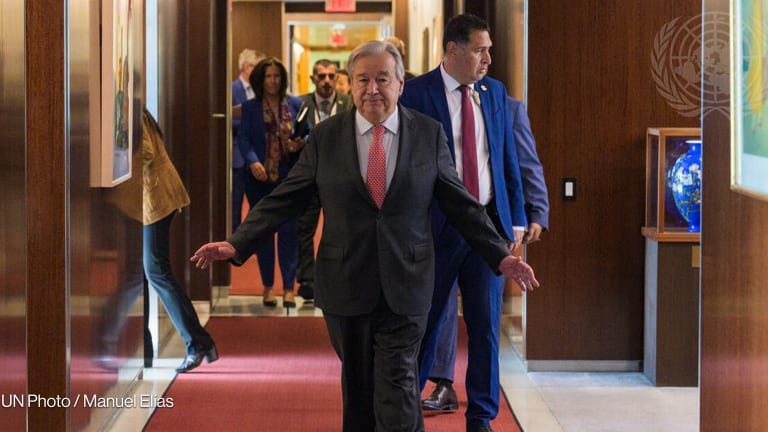
United Nations Secretary-General António Guterres calls for eliminating 20% of jobs in the U.N. Secretariat.
United Nations Secretary-General António Guterres is seeking to eliminate 20% of jobs across the U.N. Secretariat, which employs some 35,000 people, and reduce spending in the U.N.’s nearly $3.7 billion regular budget by up to 20% in 2026, according to an internal memo by the U.N. comptroller. The proposed cuts — which could result in the loss of thousands of jobs — are part of Guterres’ reform initiative, dubbed UN80, designed to prepare the world body for a massive reduction in U.S. financial support. The United States, which contributes some 22% of the U.N. regular budget, has proposed large-scale cuts in contributions. “The Secretary-General launched the UN80 Initiative as a blueprint to ensure the United Nations remains effective, relevant and capable of delivering for the people we serve,” the U.N. comptroller, Chandramouli Ramanathan, wrote in a May 27 letter to U.N. department heads. “It is an ambitious effort to ensure that the United Nations is fit for purpose to support twenty-first century multilateralism, reduce human suffering and build better lives and futures for all.” The memo was addressed to more than 75 senior U.N. officials, who were instructed to report by June 13 on how they could achieve the proposed cuts in their departments. The reductions would take place by January 2026. “I count on your cooperation for this collective effort whose aggressive timelines are recognized,” Ramanathan wrote. “My team and I will do our best to support your efforts in this context, as we jointly navigate the revision of the proposed budget for 2026.” The initiative has faced criticism from U.N. union representatives and outside observers as a hasty, ill-thought-out plan to ward off an American assault on the U.N. budget. The current quest for savings is just “about cuts,” the former U.N. emergency relief coordinator, Martin Griffiths, recently told Devex. “That’s not about reform. I think that’s wrong.” “The letter asks for massive structural changes, with far-reaching consequences, to be decided within two weeks,” said Ian Richards, head of the U.N. staff union in Geneva. “While providing some guidance, managers still have no idea how to implement this.” “It’s not clear whether the SG [secretary-general] has really thought things through,” he added. The memo instructs department heads to include mid- to high-level employees, including assistant secretary-generals, in the cuts, and to preserve a pathway for U.N. entry-level positions at the professional and senior levels. But the U.N.’s most senior and highest-paid employees, under-secretary-generals, appear to be spared for now from cuts. “There is a mathematical enigma here,” Richards said. “The higher the post the bigger the budget impact. Therefore by cutting higher posts you can reach 20 percent savings without cutting 20 percent of the posts.” The cuts would strike a broad range of U.N. departments and agencies, including those that oversee peacekeeping, political affairs, disarmament, development, and human rights. But it would not apply to many of the quasi-autonomous specialized agencies, such as the World Food Programme, UN Human Rights, and the International Organization for Migration. Those agencies, which depended heavily on voluntary donations from states, were hit harder and earlier than the U.N. Secretariat, and have already begun the process of laying off thousands of workers. The reductions would not apply to the International Court of Justice, the secretariat of the U.N. Joint Staff Pension Fund, or impact contributions to the U.N. Peacebuilding Fund, or the administrative office of the U.N. Joint Staff Pension Fund. The Ramanathan memo urges department heads to seek to “minimize” the negative impact of the cuts on programs mandated by U.N. member states. However, if reductions are unavoidable, they must explain why they are necessary and include “mitigation measures.” U.N. department heads, he added, should also be “mindful of the need to prioritize the funding for servicing meetings of intergovernmental bodies.” “The Secretary General has set an ambitious target, to achieve a meaningful reduction (between 15% and 20%) of the regular budget for 2026, including a reduction of 20% of post, for the UN Secretariat,” Ramanathan wrote. “While proposing reductions of no-post expenditures, entities should be mindful of the need to prioritize the funding for serving meetings of intergovernmental bodies and other mandate support,” The one-time cost of terminating workers' employment would be financed separately and should not be included in the 2026 budget, or the costs of relocating staff, according to Ramanath. The memo “disguises the true costs of the changes by asking managers not to budget for transition,” Richards said. “Further there is no transparency on how the UN will deal with the eventual downsizing processes that this will bring about,” “Clearly the aim is to address concerns made in the past about mission creep,” he added.
United Nations Secretary-General António Guterres is seeking to eliminate 20% of jobs across the U.N. Secretariat, which employs some 35,000 people, and reduce spending in the U.N.’s nearly $3.7 billion regular budget by up to 20% in 2026, according to an internal memo by the U.N. comptroller.
The proposed cuts — which could result in the loss of thousands of jobs — are part of Guterres’ reform initiative, dubbed UN80, designed to prepare the world body for a massive reduction in U.S. financial support. The United States, which contributes some 22% of the U.N. regular budget, has proposed large-scale cuts in contributions.
“The Secretary-General launched the UN80 Initiative as a blueprint to ensure the United Nations remains effective, relevant and capable of delivering for the people we serve,” the U.N. comptroller, Chandramouli Ramanathan, wrote in a May 27 letter to U.N. department heads. “It is an ambitious effort to ensure that the United Nations is fit for purpose to support twenty-first century multilateralism, reduce human suffering and build better lives and futures for all.”
This article is free to read - just register or sign in
Access news, newsletters, events and more.
Join usSign inPrinting articles to share with others is a breach of our terms and conditions and copyright policy. Please use the sharing options on the left side of the article. Devex Pro members may share up to 10 articles per month using the Pro share tool ( ).
Colum Lynch is an award-winning reporter and Senior Global Reporter for Devex. He covers the intersection of development, diplomacy, and humanitarian relief at the United Nations and beyond. Prior to Devex, Colum reported on foreign policy and national security for Foreign Policy Magazine and the Washington Post. Colum was awarded the 2011 National Magazine Award for digital reporting for his blog Turtle Bay. He has also won an award for groundbreaking reporting on the U.N.’s failure to protect civilians in Darfur.