
US abandons Financing for Development conference
The Trump administration's withdrawal sets the stage for the broader U.N. membership to approve a declaration for formal adoption in Spain.
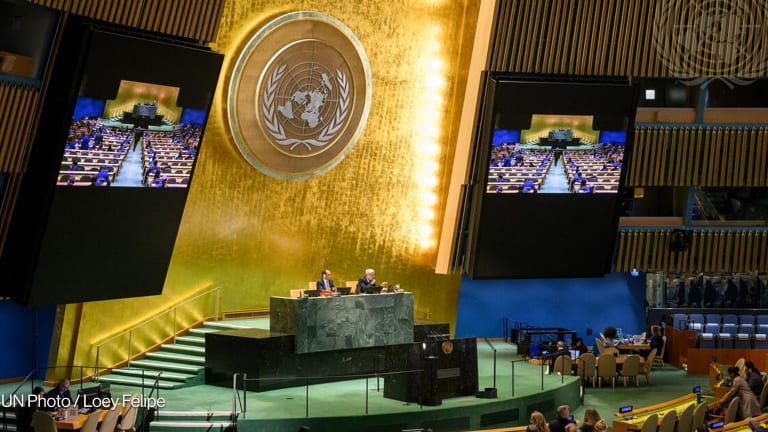
By Colum Lynch // 18 June 2025The Trump administration on Tuesday withdrew from United Nations negotiations on a global pact to finance the world body’s Sustainable Development Goals, rejecting calls for increased lending by development banks and asserting that the text improperly seeks to usurp the existing governance role of international financial institutions. The withdrawal, while not surprising, set the stage for the broader U.N. membership to approve a declaration for formal adoption at the Fourth International Conference on Financing for Development, FfD4, scheduled to take place in Seville, Spain, from June 30 to July 3. “We reaffirm our commitment to realize sustainable development, including effectively implementing the 2030 Agenda for Sustainable Development and its 17 Sustainable Development Goals,” the 38-page declaration states. “We recommit to end poverty and hunger everywhere, leaving no one behind.” The U.S. move marked simply the latest instance of the Trump administration breaking away from multilateral institutions it disagrees with. Since President Donald Trump was inaugurated in January, he has pulled the U.S. out of the Paris Agreement, the U.N. Human Rights Council, U.N. tax convention negotiations, and threatened billions in funding cuts for other international organizations. “The United States regrets that the text before us today does not offer a path to consensus,” said Jonathan Shrier, U.S. representative at the talks, noting that the U.S. no longer recognizes the U.N. SDGs and will not participate in the Spain conference. “The text presented here crosses many of our long-standing red lines.” The adoption of the financing text followed weeks of often contentious closed-door negotiations that pitted Washington, and some other Western powers, against a coalition of low- and middle-income countries seeking commitments from donor countries to extend better debt relief terms, address climate shocks, and help channel more financial resources to spur development in the world’s most disadvantaged countries. At one stage of the talks, the U.S. proposed more than 400 amendments to the draft outcome document. In his address to U.N. delegations, Shrier said the U.S. objected to multiple provisions of the declarations, including a call to triple the lending capacity of multilateral development banks and a proposal to start U.N. negotiations on a new sovereign debt process to improve terms for indebted nations. “Colleagues, on the matter of debt, we must be clear, the proposals that envision a role of the U.N. in the global debt architecture are unacceptable. Creditors and borrowers themselves should remain at the core of sovereign debt discussions, supported by expert advice of the [International Monetary Fund] and the World Bank.” He also cited U.S. displeasure with provisions dealing with trade, international taxation, and gender. “The United States withdraws from this preparatory process … and will not participate in FfD4 in Sevilla, Spain,” he concluded. “The United States sought to work toward a concise outcome document that could capture shared ambitions for development finance, rather than one that imposes new requirements, creates duplicative new structures, and impinges on the sovereignty of member states. We regret the missed opportunity.” Development advocates said the outcome, while not nearly as ambitious as they had hoped, nevertheless offered a path forward on development finance. “The FFd outcome is a good reflection of the state of multilateral cooperation,” said Minh-thu Pham, the co-founder of Project Starling. “The rest of the world is rapidly adapting and showing it can and will move on.” “This was a great outcome for the global south,” she added, noting that the final declaration included commitments to triple development bank lending, an increase in overseas development assistance, and a U.N. process for addressing shortcomings in the international debt architecture. “Basically, this outcome shows the resolve of the rest of the world to move forward with or without the U.S.” Ishaan Shah, who has been tracking the negotiations for the U.K.-based Young Feminists Caucus, welcomed the approval of a text, but said “it needed to be more ambitious. We need the political and financial will to turn these commitments on paper into transformative action.” Several delegations also expressed disappointment with the compromises required to secure agreement on the final text. New Zealand, speaking on behalf of a CANZ coalition, which includes Australia and Canada, decried the 11th-hour removal of language of a provision on climate change, noting that “it is a difficult concession, particularly for those at the front lines of climate impacts.” And Poland, speaking on behalf of the European Union and its member states, also expressed disappointment that the final declaration did not include stronger, previously agreed-upon language on climate change. It also said the Europeans intended to “disassociate” themselves with a provision that called for establishing an intergovernmental process at the U.N. to make “recommendations for closing gaps in the debt architecture,” and to begin a dialogue between the U.N. member states and key multilateral and private lending institutions. The provision, Poland’s delegate noted, “would lead to a duplication of existing debt frameworks, thereby complicating practices rather than improving them.” But in the end, the Europeans praised the adoption of the final declaration. “The document that we are recommending today is ambitious. It contains forward-looking aspirations and goals,” E.U. ambassador to the U.N., Stavros Lambrinidis, told delegates. “Colleagues, the EU has repeated time and again that this process is about more than financing for development, more than the 2030 Agenda, or about achieving the SDGs. It is about all those, yes. But it is also fundamentally about showcasing that multilateralism delivers.”
The Trump administration on Tuesday withdrew from United Nations negotiations on a global pact to finance the world body’s Sustainable Development Goals, rejecting calls for increased lending by development banks and asserting that the text improperly seeks to usurp the existing governance role of international financial institutions.
The withdrawal, while not surprising, set the stage for the broader U.N. membership to approve a declaration for formal adoption at the Fourth International Conference on Financing for Development, FfD4, scheduled to take place in Seville, Spain, from June 30 to July 3.
“We reaffirm our commitment to realize sustainable development, including effectively implementing the 2030 Agenda for Sustainable Development and its 17 Sustainable Development Goals,” the 38-page declaration states. “We recommit to end poverty and hunger everywhere, leaving no one behind.”
This article is free to read - just register or sign in
Access news, newsletters, events and more.
Join usSign inPrinting articles to share with others is a breach of our terms and conditions and copyright policy. Please use the sharing options on the left side of the article. Devex Pro members may share up to 10 articles per month using the Pro share tool ( ).
Colum Lynch is an award-winning reporter and Senior Global Reporter for Devex. He covers the intersection of development, diplomacy, and humanitarian relief at the United Nations and beyond. Prior to Devex, Colum reported on foreign policy and national security for Foreign Policy Magazine and the Washington Post. Colum was awarded the 2011 National Magazine Award for digital reporting for his blog Turtle Bay. He has also won an award for groundbreaking reporting on the U.N.’s failure to protect civilians in Darfur.