• News
    • Latest news
    • News search
    • Health
    • Finance
    • Food
    • Career news
    • Content series
    • Focus areas
    • Try Devex Pro
  • Jobs
    • Job search
    • Post a job
    • Employer search
    • CV Writing
    • Upcoming career events
    • Try Career Account
  • Funding
    • Funding search
    • Funding news
  • Talent
    • Candidate search
    • Devex Talent Solutions
  • Events
    • Upcoming and past events
    • Partner on an event
  • Post a job
  • About
      • About us
      • Membership
      • Newsletters
      • Advertising partnerships
      • Devex Talent Solutions
      • Contact us
Join DevexSign in
Join DevexSign in

News

  • Latest news
  • News search
  • Health
  • Finance
  • Food
  • Career news
  • Content series
  • Focus areas
  • Try Devex Pro

Jobs

  • Job search
  • Post a job
  • Employer search
  • CV Writing
  • Upcoming career events
  • Try Career Account

Funding

  • Funding search
  • Funding news

Talent

  • Candidate search
  • Devex Talent Solutions

Events

  • Upcoming and past events
  • Partner on an event
Post a job

About

  • About us
  • Membership
  • Newsletters
  • Advertising partnerships
  • Devex Talent Solutions
  • Contact us
  • My Devex
  • Update my profile % complete
  • Account & privacy settings
  • My saved jobs
  • Manage newsletters
  • Support
  • Sign out
Latest newsNews searchHealthFinanceFoodCareer newsContent seriesFocus areasTry Devex Pro
    • Opinion
    • Opinion: Gender equality

    A USAID-funded demographic survey is in peril. The global south can save it

    Opinion: The Demographic and Health Surveys Program, funded for some 40 years by USAID, provided vital data for policymakers. Its future must be locally led.

    By Pooja Joshi // 29 October 2025
    In 2021, then-Vice President Isatou Touray of Gambia learned via a survey that 46% of women above the age of 15 in her country had experienced physical violence. This was part of the reason that last year, President Adama Barrow announced a 10-year National Gender Policy targeting this and other challenges faced by women in the country. But as of 2025, the Gambian government has been rendered blind to whether and how their efforts are working. The survey Touray saw was the 2019-20 Gambia Demographic and Health Survey. For decades, data from the USAID-funded Demographic and Health Surveys, or DHS, has been the main source for tracking gender-based violence in low- and middle-income countries. While other health surveys are looking at disease prevalence, the DHS domestic violence module, or DVM, is the only nationally representative measure of critical issues such as intimate partner violence in many countries. Across the world, these data points informed policymaking and advocacy efforts by human rights organizations. A few examples: Thanks to the Kenya DHS 2022, we know that over 40% of Kenyan women experience intimate partner violence. In rural Cambodia, 53% of adult women who faced gender-based violence in 2021-22 never sought help. In Tajikistan, 32% of women experienced gender-based violence in 2017. DHS was the source of truth for countless dissertations, policy analyses, and advocacy efforts. One could call it the empirical cornerstone of global gender policy. But now, DHS as we knew it is gone. So, what next? Recent surveys from the Kaiser Family Foundation show that Americans recognize the negative global health consequences of shuttering USAID, but 47% think those funds could and should be redirected to domestic programs. While I could expound on all the reasons funding global health benefits us all, the bottom line is this — even if Democrats regain Congress in the midterms or the White House in 2028, justifying rebuilding USAID to taxpayers won’t be easy. And with so many other priorities, it’s unlikely we’ll see a return to the funding levels we observed in the post-COVID era anytime soon. We must continue the important work of the DHS program — but the only way to do so sustainably is for the global south to take the lead. Here’s what needs to be done: 1. Taking ownership of DHS’ former functions Regional organizations in the global south are best positioned to take ownership of DHS’s former functions. We’re already seeing promise from such organizations in developing the foundations of a new global health architecture. This year, the African Union launched the African Medicines Agency in Kigali with expansive visions of transforming how pharmaceuticals are regulated, manufactured, and distributed across the African continent. Similar initiatives should be deployed for data collection on health broadly, and gender-based violence more specifically. Rather than duplicating efforts in every country on the continent, the AU can leverage economies of scale, as DHS did, and develop institutional knowledge that can be transferred across countries. 2. Streamlining costs Artificial intelligence and other emerging technologies can be leveraged to streamline costs. A key challenge in capturing gender-based violence data is that gold standard interviews must be conducted in private, one-on-one settings, where the interviewer must create an atmosphere of trust, given the sensitivity of the content. That is operationally difficult and expensive. But recent evidence from Poverty Action shows that audio computer-assisted self-interviewing, or ACASI, methodologies might get better response rates than in-person interviews. Kenya is the poster child for fintech leapfrogging with its widespread adoption of M-Pesa mobile currency — it’s time to imagine what a similar leap could look like for running health surveys. Computer-based and even mobile-based interviewing can be deployed at scale more cheaply than traditional methods, so even funders with far fewer resources than the U.S. government can fill meaningful gaps. 3. Sharing expertise Global north experts need to proactively provide technical assistance to support local researchers. The DHS program itself was implemented by ICF, an American consulting firm. While one of ICF’s goals was developing local capacity, global south institutions have never been the true owners of the data being collected in their backyards. We need more universities, experts, and research organizations to support capacity building through educational exchange programs, remote learning opportunities, and open-source codebooks, so this crucible moment can also catalyze the true decolonization of gender-based violence research and ensure the data collected in the future is reliable. The world’s ability to combat gender-based violence depends on its ability to see it. If localized solutions don’t emerge to fund and manage data collection in the global south, the suffering faced by millions of women risks disappearing from the record entirely.

    Related Stories

    Demographic and Health Surveys reemerge with Gates funds after Trump cut
    Demographic and Health Surveys reemerge with Gates funds after Trump cut
    Devex CheckUp: The global health boy’s club
    Devex CheckUp: The global health boy’s club
    Devex CheckUp: ‘America First,’ but what about PEPFAR?
    Devex CheckUp: ‘America First,’ but what about PEPFAR?
    Family planning faces 'funding emergency' as top donors cut aid budgets
    Family planning faces 'funding emergency' as top donors cut aid budgets

    In 2021, then-Vice President Isatou Touray of Gambia learned via a survey that 46% of women above the age of 15 in her country had experienced physical violence. This was part of the reason that last year, President Adama Barrow announced a 10-year National Gender Policy targeting this and other challenges faced by women in the country.

    But as of 2025, the Gambian government has been rendered blind to whether and how their efforts are working.

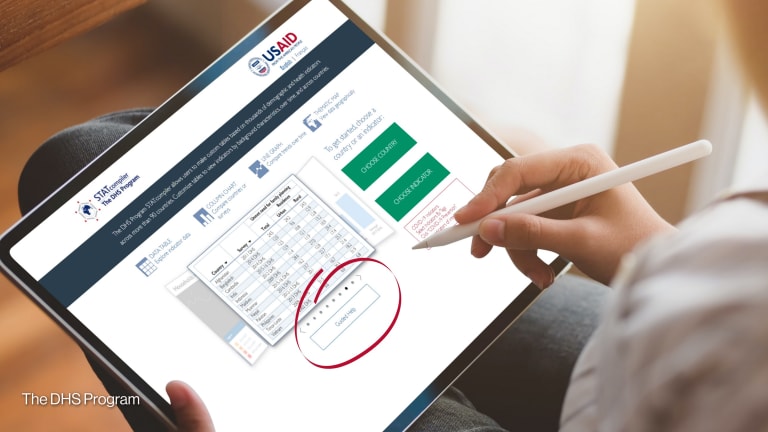
    The survey Touray saw was the 2019-20 Gambia Demographic and Health Survey. For decades, data from the USAID-funded Demographic and Health Surveys, or DHS, has been the main source for tracking gender-based violence in low- and middle-income countries.

    This article is free to read - just register or sign in

    Access news, newsletters, events and more.

    Join usSign in
    • Democracy, Human Rights & Governance
    • Global Health
    • Social/Inclusive Development
    • Research
    Printing articles to share with others is a breach of our terms and conditions and copyright policy. Please use the sharing options on the left side of the article. Devex Pro members may share up to 10 articles per month using the Pro share tool ( ).
    The views in this opinion piece do not necessarily reflect Devex's editorial views.

    About the author

    • Pooja Joshi

      Pooja Joshi

      Pooja Joshi is an MPP/MBA student and George Fellow at the Harvard Kennedy School and Harvard Business School. Previously, she worked in management consulting and health care in emerging markets. She holds a Bachelor of Science in public health from UNC Chapel Hill, where she was a Morehead-Cain Scholar.

    Search for articles
    Related Stories

    The Future of Global HealthRelated Stories - Demographic and Health Surveys reemerge with Gates funds after Trump cut

    Demographic and Health Surveys reemerge with Gates funds after Trump cut

    Devex CheckUpRelated Stories - Devex CheckUp: The global health boy’s club

    Devex CheckUp: The global health boy’s club

    Devex CheckUpRelated Stories - Devex CheckUp: ‘America First,’ but what about PEPFAR?

    Devex CheckUp: ‘America First,’ but what about PEPFAR?

    Sexual and Reproductive Health and RightsRelated Stories - Family planning faces 'funding emergency' as top donors cut aid budgets

    Family planning faces 'funding emergency' as top donors cut aid budgets

    Most Read

    • 1
      One year on: Is Africa’s surgical equity push delivering real change?
    • 2
      Ending HIV globally requires action in Eastern Europe and Central Asia
    • 3
      How to deliver results at scale for people and planet
    • 4
      US launches $4.5B platform inviting NGO support for bilateral health deals
    • 5
      What will it take to unlock private financing in a changing era?
    • News
    • Jobs
    • Funding
    • Talent
    • Events

    Devex is the media platform for the global development community.

    A social enterprise, we connect and inform over 1.3 million development, health, humanitarian, and sustainability professionals through news, business intelligence, and funding & career opportunities so you can do more good for more people.

    • About us
    • Membership
    • Newsletters
    • Advertising partnerships
    • Devex Talent Solutions
    • Post a job
    • Careers at Devex
    • Contact us
    © Copyright 2000 - 2026 Devex|User Agreement|Privacy Statement