Biden nominates ex-Mastercard CEO Ajay Banga to lead World Bank
The White House put forth the Indian-born American citizen and former chief executive of Mastercard to lead the World Bank as it faces pressure from shareholders to reform in order to better meet global challenges.
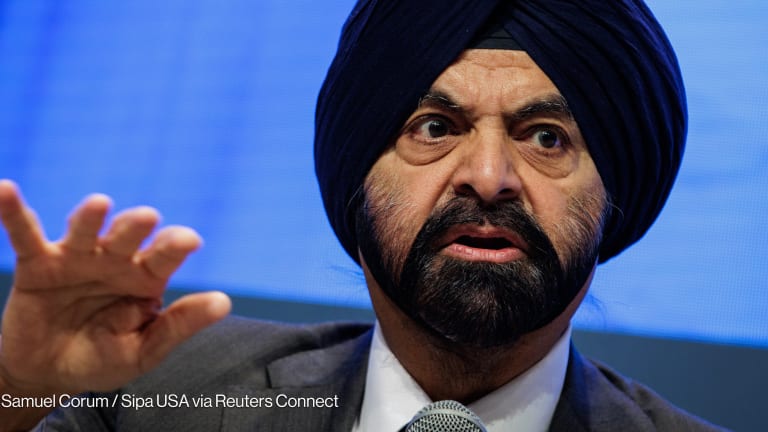
United States President Joe Biden nominated Ajay Banga, an Indian-born American citizen and former chief executive of Mastercard, to lead the World Bank as it faces pressure from key shareholders to reform in order to better meet global challenges such as climate change and pandemics. The surprise pick came a week after the bank’s embattled current president David Malpass announced he will step down in June, nearly a year before his five-year term was set to end in April 2024. Some global development experts and world leaders had been calling for the bank’s next leader to be a woman — the institution has never had a woman serve as its permanent chief — as well as a climate advocate. And just a day before Biden’s announcement, the bank’s board of executive directors said it “would strongly encourage women candidates to be nominated.” Banga is “uniquely equipped” to lead the anti-poverty lender “at this critical moment in history,” Biden said in a statement Thursday. Banga “has critical experience mobilizing public-private resources to tackle the most urgent challenges of our time, including climate change,” Biden continued. “Raised in India, Ajay has a unique perspective on the opportunities and challenges facing developing countries and how the World Bank can deliver on its ambitious agenda to reduce poverty and expand prosperity.” A Wall Street veteran, the 63-year-old Banga is currently the vice chair of the U.S. investment firm General Atlantic and previously served as Mastercard president and CEO for a decade. At Mastercard, he oversaw the creation of the Mastercard Center for Inclusive Growth, which promotes financial inclusion in low-income settings worldwide. “As a renowned executive, Mr. Banga has led a global organization with nearly 20,000 employees, advocated for diversity and inclusion, and delivered results,” U.S. Treasury Secretary Janet Yellen said in a statement Thursday. “His efforts have helped bring 500 million unbanked people into the digital economy, deploy private capital into climate solutions, and expand economic opportunity through the Partnership for Central America.” Notably, among Banga’s supporters is U.S. Rep. Patrick McHenry, a Republican and chairman of the House Financial Services Committee who typically disagrees with Biden’s nominees for leadership roles. “The next World Bank President must focus on the Bank’s core mission of alleviating global poverty and the necessary reforms to confront China’s economic aggression, rather than progressive pet projects,” McHenry said in a statement. “I am confident in Mr. Banga’s ability to fulfill this role.” Banga, who is based in New York City, was in Washington, D.C., on Feb 6. for meetings at the White House related to the Partnership for Central America, a White House initiative that Banga co-chairs under the leadership of Vice President Kamala Harris. It works with private companies to address the root causes of migration in Central America by mobilizing investment in the region. Malpass announced he would step down just over a week later, on Feb. 15. The official process to replace Malpass opened Thursday morning, with a final selection expected by early May. As the bank’s largest shareholder, the U.S. has traditionally chosen the institution’s president, though it requires approval by other shareholders as well. Other countries may still put forth their own nominees. Banga’s personal background and résumé mean he could be well-placed to bring about the reforms shareholders are demanding that could see the bank’s role massively expanded. Key Western shareholders already support reforming the bank so it can lend more for climate issues — though the backing of India and China will be key as well. India, for its part, currently holds the Group of 20 presidency. G20 finance ministers and central bank chiefs are gathered this week in Bengaluru, India, where World Bank reform will feature on the sidelines of high-level talks about debt relief for low-income countries, among other issues. Born in India, Banga became a U.S. citizen in 2007. He is a founding trustee of the U.S.-India Strategic Partnership Forum, a former member of the National Committee on United States-China Relations, and chairman emeritus of the American India Foundation. Yellen has piled on the pressure for the bank to lend more money to help lower-income countries cope with a litany of global challenges, from high debt and inflation to climate change and the lingering effects of the pandemic. Meanwhile, the bank publicly released its reform road map last month. Among its ideas is a capital increase, something demanded by key shareholders including the U.S. and Germany. But not all of the bank’s shareholders are on board with the proposed changes, and it will be up to the new chief to gain their support. Several global development experts applauded Biden’s nomination. Open Society Foundations President Mark Malloch-Brown said Banga is a “really interesting choice,” adding that he “was a legendary leader of Mastercard because of his attention to social impact and environmental issues.” “Known as a strong visionary leader and a good manager, he may be just what the Bank needs,” added Malloch-Brown, who previously worked at the World Bank. “Banga has a low profile in development circles, but if he has bipartisan confidence in the U.S., that may be most important for the success of the World Bank’s reform,” said Amanda Glassman, executive vice president of the Center for Global Development. “His private equity experience could bring some new energy to IFC as well,” she told Devex, referring to the International Finance Corporation, the World Bank’s private-sector arm. “Disappointing not to see a woman nominated by the U.S. in 75 years,” she added, saying that the country’s “rhetoric does not match reality.” Echoing Malloch-Brown, Vijaya Ramachandran, director for energy and development at The Breakthrough Institute, called Banga “a good choice to lead the bank.” “My hope is that he will address the very significant problem of energy poverty, understanding that the poorest countries need significant investments in cheap and reliable energy to generate growth and reduce poverty,” she wrote to Devex. “More broadly, Banga must make the priorities of the Bank’s clients (rather than its rich-country shareholders) central to the Bank’s work. In addition to energy, these would include investments in education and in agriculture and rural development, as well as the whole set of interventions around jobs and poverty reduction.” Meanwhile, a number of progressive and climate activist groups criticized Biden’s pick, calling it a missed opportunity to select a candidate with deep public sector or climate credentials. “While Mr. Banga may have extensive experience on Wall Street, we had hoped that President Biden would use this opportunity to ditch the old gentlemen’s agreement of World Bank and IMF appointments in favor of a more transparent and merit-based global process,” said Christian Donaldson, Oxfam International’s senior policy advisor on international financial institutions, in a statement. “Banga has no background in public service, mitigating climate change, promoting sustainable agriculture, reducing poverty or supporting a just energy transition,” said Kate DeAngelis, international finance program manager for Friends of the Earth. In an interview with Devex last week, Malpass said his successor will have to be an excellent manager in order to handle the massive lender, but also needs to “have a vision for where development needs to go and recognition of the severity of the current crises.” Update, Feb. 23, 2023: This story has been updated with additional reactions on Biden’s nomination of Ajay Banga.
United States President Joe Biden nominated Ajay Banga, an Indian-born American citizen and former chief executive of Mastercard, to lead the World Bank as it faces pressure from key shareholders to reform in order to better meet global challenges such as climate change and pandemics.
The surprise pick came a week after the bank’s embattled current president David Malpass announced he will step down in June, nearly a year before his five-year term was set to end in April 2024.
Some global development experts and world leaders had been calling for the bank’s next leader to be a woman — the institution has never had a woman serve as its permanent chief — as well as a climate advocate. And just a day before Biden’s announcement, the bank’s board of executive directors said it “would strongly encourage women candidates to be nominated.”
This article is free to read - just register or sign in
Access news, newsletters, events and more.
Join usSign inPrinting articles to share with others is a breach of our terms and conditions and copyright policy. Please use the sharing options on the left side of the article. Devex Pro members may share up to 10 articles per month using the Pro share tool ( ).
Shabtai Gold is a Senior Reporter based in Washington. He covers multilateral development banks, with a focus on the World Bank, along with trends in development finance. Prior to Devex, he worked for the German Press Agency, dpa, for more than a decade, with stints in Africa, Europe, and the Middle East, before relocating to Washington to cover politics and business.