

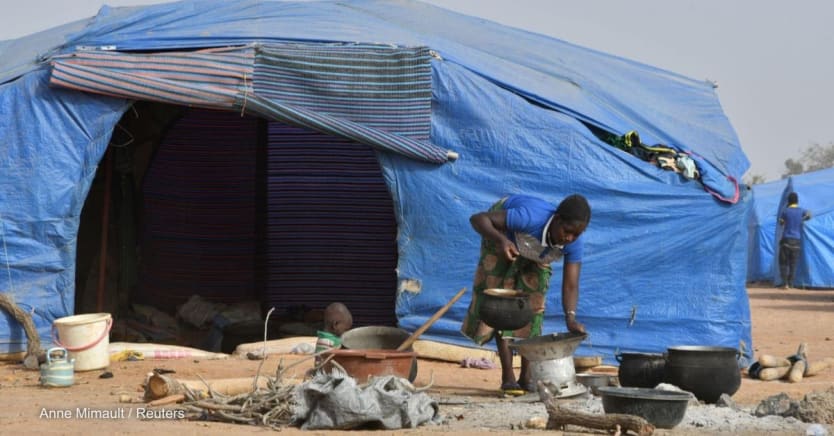
OUAGADOUGOU, Burkina Faso — For 43-year-old Assiata Sawadogo, feeding her 10 children used to mean risking her safety. After she and her family fled jihadist attacks in Burkina Faso’s center north region two years ago, she was forced to look for firewood in the forest, often confronting men who terrified her. But a new United Nations program providing displaced people with gas for cooking means she no longer has to venture into the bush to find wood for cooking.
“When we went into the bush, we were afraid something bad could happen to us,” Sawadogo told Devex by phone from Kaya town where she now lives. “Even the smallest noise scared us. We were just going there because we didn’t have any other choice,” she said.
More than 1.4 million people in Burkina Faso have been displaced by violence linked to al-Qaida and the Islamic State, creating the fastest growing displacement crisis in the world last year. More than 50% of displaced people are women — according to the U.N. — who have become subject to increasing sexual assault by both jihadists and civilians.
In the center north region, which has the largest displaced population in the country, rape cases increased five-fold — from two to 10 reported cases — during a three-month period last year, according to a report by humanitarian groups.
“There's a big difference between the gas and the wood … With the gas, when your children are crying and you start cooking, just in a short amount of time you have finished cooking so they can eat.”
— Assietou Sawadogo, internally displaced person from Burkina FasoAs the number of displaced people increases, resources deplete, forcing women to walk further to find wood, putting them at greater risk. Between August and December last year, the UN Refugee Agency documented 11 cases of rape in Kaya, five of which happened while collecting wood, said the group.
In an attempt to address the problem, last February, UNHCR launched a pilot program providing 900 displaced families in Kaya with one six-kilogram cylinder of gas. Some of them also received $45 to buy food and roughly $360 to invest in businesses to generate income so they could afford to buy gas refills.
“In this crisis … the level of gender-based violence cases [are] quite huge. So our action is to limit [the] gender-based-violence risk situation … [which is highest where] … we have a lot of people [and] the environment around is more and more scarce,” said Benoit Moreno, senior staff with UNHCR and part of the team working on the alternative energy project.
“This is the kind of area you need to focus on,” he said.
A sustainable, holistic approach
While the program is a first in Burkina Faso, it’s already been tested in neighbouring countries. In 2015, UNHCR provided approximately 17,000 Malian refugees with gas in Niger, after noticing that despite being given food aid, malnutrition rates were increasing, said Moreno. Malians were selling their food to buy wood because there weren’t enough trees in the area, he said. The following year, UNHCR gave gas to approximately 170,000 displaced people across 40 villages in Niger’s Diffa region.
The price women and girls are paying for Ethiopia's war
Following reports of alarming levels of sexual assault in the conflict in Ethiopia’s northern region of Tigray, Devex visits the refugee camps in eastern Sudan to document how survivors are coping with unwanted pregnancies and widespread trauma.
The objective was to create a sustainable win-win approach by establishing partnerships with the private sector to provide gas in areas where there previously weren’t any companies, said Moreno. Today, the program is running without additional help from UNHCR, and gas is nearly four times less expensive in the area than it was without the presence of a private company, he said. Moreno believes it’s also helped protect women from sexual violence.
“It is impossible to measure how many cases of sexual assault and violence during wood collection the [project] has avoided, but the figure must be very high [and] this is priceless,” he said.
As displacement crises escalate globally, Moreno says governments and aid groups need to stop looking at energy in a silo and take a more holistic and long-term approach to including it across all sectors. Using gas instead of wood not only saves money, it protects the environment — 1 kg of gas saves 10 kg (22 lbs.) of wood a year — is better for people’s health and is also faster for women to cook with, he said. The agency hopes to expand the project in Burkina Faso to areas with high costs of wood and where there are protection concerns. It’s already started discussions with public and private gas providers in the country.
‘When you’re displaced, you’re definitely not in a mindset to try new things’
But even if the government and organizations start giving displaced people gas, one of the biggest challenges is getting people to shift their mentality.
“When you’re displaced, you’re definitely not in a mindset to try new things. If you’re sort of stable and a little bit more well off you can afford to take a little bit more of a risk,” said Max Gopfert, managing director of Bboxx in the Democratic Republic of Congo, a private company that provides solar electricity and clean cooking solutions in Africa.
Gas is considered dangerous in Africa because people think it will explode, he said.
In July, Bboxx announced its first clean energy program in the country, in a joint venture with Geocoton Advens Group, a French agro-industrial group. The goal is to increase energy access — only 5% of people in the country’s rural areas have access to energy — by bringing clean energy to two million people. While it’s not currently targeting displaced populations in Burkina Faso, Bboxx has provided areas in Congo and Rwanda with high numbers of displaced people, solar power services, as well as in the Kakuma refugee camp in Kenya.
UNDP's Achim Steiner: Energy is 'central' to economic progress
It's easier than ever for nations to combine their energy access goals with clean energy goals, Achim Steiner, administrator of the United Nations Development Programme told Devex leading up to the U.N. High-Level Dialogue on Energy.
Gopfert says agencies running refugee or displacement camps need to prioritize providing gas from the initial setup of the sites.
“It’s not hard, it’s [just] not necessarily been on the agenda,” he said. “You should have no camps cooking on charcoal or firewood, it’s just crazy. People [are] just burning their lungs putting themselves at risk, destroying the environment. That shouldn’t happen in the 21st century,” he said.
Local companies focused on alternative energy say the government needs to tackle the problem by reducing poverty so people don’t have to worry about being able to afford gas and don’t resort to cutting trees.
“Using wood to cook is more difficult than using gas. So if people are using wood it is because they don’t have the financial means. With the increase in displaced people the situation is getting more complicated as they’ve lost everything,” said Augustin Onadja, director of IE Innova, a company providing solar energy in Burkina Faso.
Those participating in UNHCR’s program say that since they’ve shifted to gas, they’ve actually been saving money.
Twenty-four-year-old Assietou Sawadogo was displaced to Kaya when her village in the center north region of Burkina Faso was attacked by gunmen two years ago. Unable to find wood in the forest because it was all cut down, she was forced to spend nearly $1 a day purchasing it. Since using the gas, she saves approximately $20 per month and uses the extra money to buy food for her children.
“There's a big difference between the gas and the wood … With the gas, when your children are crying and you start cooking, just in a short amount of time you have finished cooking so they can eat,” she said. Adding that since she no longer has to go in the bush, she is also “safe from problems.”
About the author

Sam Mednick
Sam Mednick is a Devex Contributing Reporter based in Burkina Faso. Over the past 15 years she has reported on conflict, post-conflict, and development stories from the Middle East, Africa, Asia, South America, and Europe. She recently spent almost three years reporting on the conflict in South Sudan as the Associated Press correspondent. Her work has also appeared in The New Humanitarian, VICE, The Guardian, Foreign Policy, and Al Jazeera, among others.