


Every year, Davos transforms from a quiet Alpine town to a global stage — and halfway through this week, the World Economic Forum is vibrating with energy.
Three thousand people are here to forge alliances, shape agendas, and strike deals. But in a world marked by rising inequality and plummeting foreign aid, even the wealthiest seemed to notice a strain.
“Many of the people who are most affected by what we talk about here will never come to this conference,” said billionaire Larry Fink, CEO of BlackRock and interim co-chair of the forum, speaking from the Davos stage. “That’s the central tension of this forum. Davos is an elite gathering trying to shape a world that belongs to everyone.”
That elite access has drawn United Nations leaders, civil society, and global south heads of state, all pushing their missions forward. And as the world order shifts, there’s a sense that there’s more to be gained and lost than normal.
ICYMI: Davos tests the limits in a world of power, profit, and inequality
Opinion: Davos post-Schwab — can new leadership restore trust, or just rebrand the club?
Mountain tensions
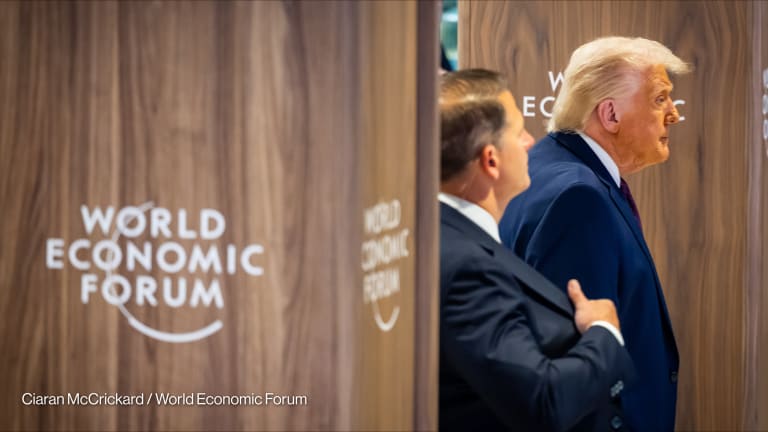
Even before President Donald Trump’s speech at the Congress Center this afternoon, the forum has been hanging on the U.S. president’s every word. The forum is happening at the same time that Trump’s threats to buy Greenland — and impose tariffs on countries that push against him — have reached a breaking point.
“The world has its eyes on the U.S. president and what he’s going to say,” Philippe Bolopion, the executive director of Human Rights Watch, told me. “It feels a bit like a perfect storm of a democratic rescission, an aggressive China and Russia on human rights issues, and now a U.S. government that’s undermining the world order.”
To say Davos is on edge is an understatement. And for those in the global development community, Trump’s speech comes at an even starker moment: It is exactly one year and one day since his administration began dismantling USAID.
“[Trump] has succeeded in derailing or distracting most of Davos to talk about Greenland and Denmark and tariffs and coercion rather than what is genuinely urgent, which is the humanitarian crises of Sudan and Gaza, the urgency of delivering electricity and water and health care and preventing the next pandemic,” said U.S. Sen. Chris Coons, a Democrat from Delaware, speaking from Davos this morning.
Board of contention
Trump is also speaking just days after creating a Board of Peace to oversee restabilization in Gaza, one that costs member nations $1 billion for a permanent spot.
The initiative’s executive board includes U.S. Secretary of State Marco Rubio and World Bank chief Ajay Banga — and with a charter that appears to sidestep the United Nations, it has raised alarm among politicians and development officials alike.
“I’m learning more about it on an hourly basis, and the more I learn, the more ominous it appears,” said California Governor Gavin Newsom, who spoke to me after blasting Trump’s moves on Greenland and domestic policy from the Congress Center.
Over the last few days, Trump has invited a slew of world leaders to the initiative, including Russian President Vladimir Putin. He also reposted a message on his social media platform, Truth Social, that said “China and Russia are the boogeymen when the real threat is the U.N., NATO and [Islam].” A signing ceremony is expected to take place in Davos tomorrow, according to reporting by Bloomberg.
“The existing multilateral architecture is under siege,” Charles Kupchan, a senior fellow at the Washington, D.C.-based think tank Council on Foreign Relations, told me. “And it’s under siege because the main designer of that architecture is walking away from it.”
Friends in high places
The U.S. president is far from the only one making the news. Yesterday, European Commission President Ursula von der Leyen shared the stage with French President Emmanuel Macron and Canadian Prime Minister Mark Carney, the latter of whom pushed the world’s smaller countries to work together.
“To help solve global problems, we’re pursuing variable geometry,” said Carney, whose speech was met with a standing ovation from the crowd. “In other words, different coalitions for different issues based on common values.”
It’s an idea that’s percolating across Davos, and not just in the geopolitical space. For Nabil Ahmed, the director of economic and racial justice at Oxfam America, it's the coalitions created by other countries, institutions, and organizations outside of the U.S. that “might actually be the biggest geoeconomic story” of the week.
“You’ve seen some trade cooperation between north and south. You’ve seen tax cooperation, for example, that came out of Sevilla last year,” he said, referring to the outcomes of the fourth Financing for Development conference in Sevilla, Spain, which the U.S. declined to attend. “In an unintended way, the sheer regressivity of the Trump administration pushes some other countries to try to do better.”
Read: The old aid model is dead. Now comes the fight over what replaces it
Opinion: As AI rises and aid declines, can Davos shape a new compact for development?
A $50 million cure
Speaking of new partnerships, this morning, the Gates Foundation and OpenAI committed $50 million to support AI-infused health programs across Africa, the result of a new, country-led venture called Horizon1000.
Beginning in Rwanda, the goal is to reach 1,000 primary health care clinics by 2028 — and to do so by using artificial intelligence to close the health care worker gap. Today, sub-Saharan Africa is experiencing a shortfall of nearly 6 million health care workers, the Gates Foundation reports. And World Health Organization figures show that low-quality care contributes to 6 million to 8 million deaths in low- and middle-income countries every year.
“Today’s AI can help save those lives by reaching many more people with much higher-quality care,” wrote Bill Gates, in a blog post released today. “These AI tools will support health workers, not replace them.”
Throughout the week, the Gates Foundation has placed its health care innovations on display. In the heart of the Davos promenade, a decked-out shipping container is spotlighting the current and coming technologies Gates has prioritized, from AI-powered portable ultrasounds to contraceptive patches.
Further reading: As foreign aid falters, can AI step in? (Pro)
+ Devex Pro members can get the most out of our coverage on how AI is being integrated into global development work. Not yet gone Pro? Experience unlimited access to expert analyses, hidden funding opportunities and career resources, and connect with key sector players and influencers at exclusive events and briefings when you start your 15-day free trial of Pro today.
Seeding the future
It’s the type of tech optimism that, typically, Davos feels steeped in. But on Tuesday, Sierra Leonean President Julius Maada Bio had a different take. When asked if he felt the new economy provided Africa with more opportunities or challenges, Bio voted for the latter.
“We have serious problems with energy supply, connectivity, and other issues, and the continent is not exactly prepared,” said Bio. “It will take us time to have the wherewithal to put the necessary infrastructure, the digital public goods, and the energy required that is not only affordable, but reliable.”
Internet usage among Sierra Leone’s population is growing rapidly, jumping from just 1% in 2010 to 21% in 2023, according to data from the World Bank. But still, that still leaves 4 in 5 people without access to the platform driving the global economy today.
Bio was more optimistic about another sector, though: agriculture. In 2023, he launched a flagship project to boost agricultural productivity across Sierra Leone, doing so through a blended finance approach called Feed Salone. Sierra Leonean media reported that rice imports had decreased by 16% — and output increased by 8% — since Feed Salone began.
Bits and pieces
Actor Matt Damon was in town to promote his new initiative Get Blue, which would partner with businesses to feed funds to nonprofit Water.org. Two billion people lack safe water and 3.4 billion lack adequate sanitation, he said — and those people “have two things in common: they don’t have safe water, and they’re not here in Davos.” Get Blue would work like the (RED) campaign for HIV, with branded products from partners such as Starbucks, Gap, and Amazon.
The German Agency for International Cooperation, or GIZ, pitched its ICAMA initiative to the Davos elite earlier this week. The hope is to mobilize $250 million for emerging African businesses, and to funnel investments into startup companies across the African continent.
Sarah Rogers, the U.S. undersecretary for public diplomacy, defended free speech at the U.S. House on Tuesday, calling the U.K.’s Online Safety Act a “censorship tariff” after a British woman was jailed over an anti-immigrant tweet. Marija Manojlovic, the executive director of Safe Online, noted the woman’s conviction relied on a 1986 law against incitement to racial hatred. “We can protect free expression while requiring platforms to be safe for children and other vulnerable users,” she said.
Spotted
Amy Pope, the director-general of the International Organization for Migration, skiing down the Davos slopes just before the World Economic Forum began.
Claudia Romo Edelman, former chief of communications at the United Nations Secretary General’s Office, launching her new brand of Mexican spirit.
Gavin Newsom telling reporters that European leaders need to “develop a backbone, speak with one unified voice, [and] punch [Trump] in the face.”
Justin Trudeau, the former prime minister of Canada, walking casually along the Davos promenade with no entourage — or girlfriend Katy Perry — in tow.
“NO KINGS” lights emblazoned on Davos’ Magic Mountain, a small ski resort connected to town by cable car, the night before Trump’s arrival.
Sign up to Newswire for an inside look at the biggest stories in global development.
About the author

Elissa Miolene
Elissa Miolene covers U.S. foreign assistance from Washington, D.C. She previously covered education at The San Jose Mercury News, and has written for The Wall Street Journal, the San Francisco Chronicle, and other news outlets across the world. Before shifting to journalism, Elissa led communications for aid agencies in the United States, East Africa, and South Asia.
Search for articles


Most Read
- 1
- 2
- 3
- 4
- 5