Devex Pro Insider: Power on display in Davos, but does dialogue wield any of it?
What to expect at this week's World Economic Forum in Davos. Plus, one health leader announces her bid for U.S. Congress, while another criticizes the state of Nigeria’s health system.
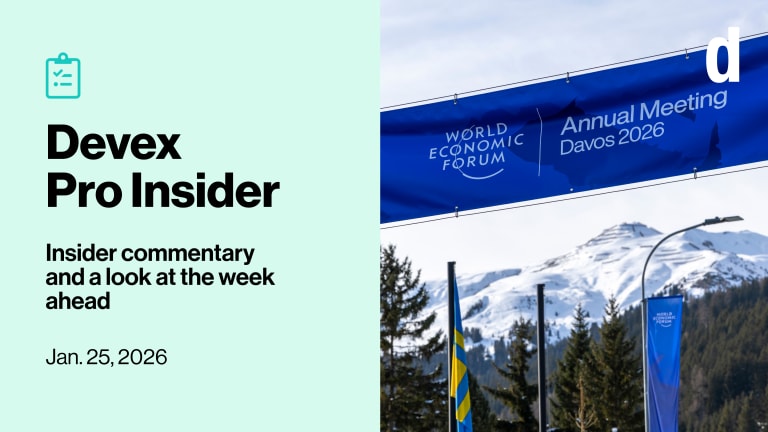
The World Economic Forum kicks off its annual Swiss chalet shindig in Davos tomorrow — although “shindig” may not be the right word to describe the intense concentration of wealth and power that will be on display. It comes at a moment when the world is talking past itself. Wars grind on, trust is thin, institutions are wobbling, and technology is moving faster than politics can absorb. The question hanging over the Alps isn’t whether dialogue is nice to have — it’s whether it still has power. That question gets sharper with U.S. President Donald Trump back in the room (so long as the agenda remains not “woke”). Trump's presence comes exactly a year after he shocked the world — including the Davos set — by halting all U.S. foreign assistance, triggering the downfall of the U.S. Agency for International Development (an anniversary we’ll be reflecting on all this week). In the year since, the U.S. president has eliminated most aid programs, stepped away from multilateral commitments, and treated cooperation among traditional allies as optional. Davos has always been built around the idea that talking — and listening — matters. Trump’s record challenges that premise head-on. This isn’t abstract anymore. The fallout from shrinking aid and weakened cooperation is already showing up, from fragile health systems to climate-vulnerable countries losing support. When major players step back, the gaps don’t stay theoretical — they get filled by instability. There will be plenty of talk this year about innovation, especially artificial intelligence — one of several big themes organizers say demands renewed dialogue. The promise is huge. But so are the worries: jobs changing faster than people can adapt, gains piling up in only a handful of places, and fewer shared tools to manage the disruption. The same unease runs through climate conversations. Everyone agrees that prosperity can’t come at the planet’s expense. The problem is turning that consensus into action when coordination is getting harder, and politics is looking inward. All of this will play out in rooms packed with power. By the numbers, Davos will bring together 400 political leaders, including nearly 65 heads of state and six of the Group of Seven leaders, alongside around 850 CEOs and chairs, and roughly 100 unicorn founders and tech pioneers. In total, close to 3,000 participants from more than 130 countries are expected under the banner of “A Spirit of Dialogue,” with 200-plus sessions livestreamed to the public. And despite the Trump administration’s skeptical view of multilateralism, the U.S. delegation alone is rumored to have booked 100 rooms. But Davos 2026 isn’t really about panels or pledges. It’s about whether global leaders still believe in cooperation enough to defend it — especially when walking away is politically easier. If Davos falls flat this year, it won’t be because of a lack of attendance or ambition. It will be because consensus proved easier to agree on than to act on. My colleague Elissa Miolene will be there all week, so if you are in Davos, reach out to her at elissa.miolene@devex.com. She also has a curtain-raiser publishing tomorrow, so keep your eyes peeled. Also in today’s edition: One health leader goes on the U.S. campaign trail while another goes after Nigeria’s medical hypocrisy, agriculture gets the AI treatment, and messy career transitions. Bits and pieces Extradition limbo. Ghana’s former finance minister Ken Ofori-Atta has been detained in the U.S. over immigration issues, his lawyers say, even as Ghana continues to seek his extradition on corruption allegations. His legal team insists the case is politically motivated and says Ofori-Atta — described as “law-abiding” — is applying to change his immigration status so he can stay in the U.S. “past the period of validity of [his] visa,” expecting the matter to be resolved “expeditiously.” Ofori-Atta, who left Ghana last year for medical reasons, faces dozens of charges tied to his time in office. His lawyer has said he is “committed to fully complying with the laws of Ghana and ... answering for anything he did when he was finance minister,” as the case plays out under Ghana’s new, corruption-focused government. From health to House. Nina Schwalbe, a long-time global public health leader, is running for Congress in New York’s 12th Congressional District, pitching herself as a candidate with real-world experience at a moment she says demands new leadership. Schwalbe argues on LinkedIn that federal systems meant to keep people safe — and the guardrails of democracy itself — are under threat, and says her career fixing broken health systems has prepared her to make New York healthier, more affordable, and better prepared for what’s ahead. Ag meets AI. Gladys Morales Guevara, global head of innovation at the International Fund for Agricultural Development, or IFAD, said a $2 million Global Environment Facility grant is a go, alongside cofinancing from IFAD, the European Space Agency, the Inter-American Development Bank, CIMMYT, and others. A central pillar of the program is IFAD’s AgroWeb3.0, a blockchain-based digital public good designed to support inclusive AI and measurable development impact. Morales Guevara also flagged the European Innovation Summit, taking place May 8-9 in Rome, as the next opportunity to advance collaboration on AI, innovation, and inclusive growth. Deadly neglect. Dr. Emmanuel Agogo, a global health leader, issued a stark warning on his LinkedIn page about the state of Nigeria’s health system, arguing that it’s no longer just broken but “fatal.” He points to the death of Nnamdi, the son of Nigerian writer Chimamanda Ngozi Adichie, as a devastating reminder that neither status nor talent offers protection in a system lacking basic patient safety. Agogo contrasts these failures with political leaders who routinely seek care abroad while underinvesting at home, accelerating brain drain, neglecting infrastructure, and normalizing unsafe emergency care. His message is blunt: “Life is cheap in this neighborhood” because leaders are not made to pay a price for failure — and until that changes, the tragedies will continue. Macron’s moment. In a speech to France’s ambassadors, President Emmanuel Macron made a pointed case for reinvesting political capital in the United Nations, arguing that the moment demands leadership — especially when its largest shareholder, the United States, no longer believes in it and China is both engaged and unsettling to others. Framed more broadly, Macron warned against European diplomacy becoming mere commentary on global affairs. Instead, he signaled plans to use the G7 as a bridge to the BRICS via India to push for a renewed vision of global governance — hinting at a more political reset beyond technocratic U.N. reform. With France’s 2027 elections looming, it may be Macron’s last real window to shape that agenda. Scaling Africa’s health voice. The Africa Centres for Disease Control and Prevention has inked a new partnership with Informa Markets to level up its flagship public health convenings — starting with the International Conference on Public Health in Africa, or CPHIA. The MoU brings together Africa CDC’s scientific leadership and Informa’s global events muscle at a moment when coordinated health leadership across the continent is more urgent than ever. “This partnership reinforces Africa CDC’s commitment to strengthening continental ownership of public health priorities,” said Africa CDC Director-General Dr. Jean Kaseya, calling CPHIA “a critical forum for African experts and leaders to set the continent’s health security agenda.” InInforma Markets President for Middle East, India, Türkiye & Africa Peter Hall said the goal is clear: “Together, we will ensure CPHIA 2026 delivers lasting value for Africa’s public health ecosystem.” The fifth edition of CPHIA will take place in Addis Ababa in 2026, with thousands of delegates expected to attend. Poverty backslide. A sobering snapshot from the World Bank: 1 in 4 developing countries is poorer today than it was before COVID-19 hit in 2019. Many low-income countries — particularly in sub-Saharan Africa — have yet to recover from years of shocks, conflict, and weak growth, even as parts of the global economy prove more resilient. The bank says global growth has “downshifted” since the pandemic and is now “insufficient to reduce extreme poverty and create jobs where they’re needed most.” Chief Economist Indermit Gill was blunt about the causes, warning: “These trends cannot be explained by misfortune alone. In far too many developing countries, they reflect avoidable policy mistakes.” The messy middle. After leaving the Gates Foundation, Sonia Vera shared on LinkedIn a candid account of what comes after a high-profile role — what she calls the “messy middle.” Vera writes about the shock of losing institutional prestige, the anxiety of life without a paycheck (even with careful planning), and the disorientation that comes with losing the teams, systems, and structure that once made everything run smoothly. She is writing a book and building a business, but her takeaway cuts through the glossy “I quit my big job and found my soul” narratives: “The path from success to soul isn’t a straight line,” she wrote on her post. It’s uncomfortable, uncertain, and full of doubt — and that, she argued, is exactly what makes it worth examining. Moving on Elias Manuel Abou-Charaf has started a new role as senior country manager for middle-income countries at Gavi, the Vaccine Alliance. The National Endowment for Democracy named Eddy Acevedo as vice president for policy and government relations. Most recently, he served as chief of staff and senior adviser to the president and CEO of the Wilson Center, Mark Green, after senior roles on Capitol Hill and at USAID. ActionAid UK has named Hannah Bond and Taahra Ghazi as its permanent co-CEOs, with the duo taking up their roles in January 2026 as the organization enters its next phase of feminist leadership and transformation. The appointments come as ActionAid doubles down on shifting power to women, girls, and grassroots movements, and scaling partnerships that drive systems change led by those most affected by injustice. “We recognise the pivotal moment at which we step into these roles and the responsibility entrusted to us,” Bond and Ghazi said, pointing to what they describe as an “unprecedented crisis for women’s rights” globally. Faraz Tasnim, interim chair of ActionAid UK, said the board is confident the pair bring “the experience and vision needed to lead ActionAid UK with integrity, accountability and strong governance” — and to turn feminist, movement-led leadership into meaningful change. ILX has appointed Kirstine Damkjaer as chief investment officer, adding her to its management board and investment committee when she joins in March. Damkjaer brings experience from UNOPS, EKF Denmark, the International Finance Corporation, and the World Bank Pension Fund, with a track record in scaling sustainable finance and mobilizing private capital. Aleksander Dardeli, president and CEO of IREX, a global development and education organization, has joined the board of the U.S. Global Leadership Coalition. Dardeli said the coalition’s bipartisan work is important as the U.S.’s global role is debated, praising its ability to bridge political divides and build consensus around diplomacy, development, and defense. Vitessa Del Prete has started a new role as chief of overseas grants and programs, and undersecretary for public diplomacy and public affairs at the U.S. State Department. Aniqa Islam Marshall has started a new role as senior manager of immunization financing and sustainability at Gavi, the Vaccine Alliance. Jay Knott is taking a new position as president and CEO at the American Association of Blacks in Energy. Formerly head of the Metropolitan Group, he’s a member of the board of Results for Development and the board of directors for the Society of International Development’s D.C. chapter. Vanina Laurent-Ledru has taken on a new dual role as chief public health and government affairs officer at bioMérieux, a multinational biotechnology company, alongside her responsibilities at Institut Mérieux. Laurent-Ledru said the role reflects a push to put public health at the center of decision-making, strengthen a unified global external affairs approach, and engage more deeply on critical health challenges. The Gates Foundation has named Sri Mulyani Indrawati to its governing board, adding one of Indonesia’s longest-serving and first female minister of finance — and the former managing director and chief operating officer of the World Bank — at a pivotal moment for the foundation. “Sri Mulyani brings deep experience in shaping equitable economic outcomes — expertise that is essential to achieving the foundation’s long-term goals,” said Mark Suzman, Gates Foundation CEO and governing board member. Indrawati said she is “honored” to join the board as it moves into a 20-year spend-down focused on maternal and child survival, infectious disease, and poverty reduction. The foundation also announced a new Africa and India Offices Division, led by Ankur Vora as president, and appointed Hari Menon as president of global growth and opportunity — signaling a sharper focus on country-led strategy as Gates works toward its planned 2045 sunset. After six years, Vincent Petit has moved into a new position as senior participation adviser at the UNICEF headquarters in Nairobi. Petit previously served as UNICEF’s global lead for social and behavior change, or SBC, working across multiple strategic plans, country programs, major emergencies, and the COVID-19 response. Petit also shared that Massimiliano Sani has taken on the lead of UNICEF’s SBC — which champions an approach focused on influencing behaviors, social norms, and community practices to improve outcomes for children and families. Beth Roberts — formerly of the U.S. International Development Finance Corporation and the Millennium Challenge Corporation — has joined the global public policy team at General Motors. Joe Sanders has started a new role as executive director of the Daugherty Water for Food Global Institute at the University of Nebraska, taking the helm of the institute’s work on water, agriculture, and global food security. Alice Ruhweza, president of AGRA, announced the appointment of Carl Manlan as chief of partnerships and business development. Global eye care NGO Orbis International named Kathleen Sherwin as president and CEO. She brings more than 25 years of experience across health equity, gender equality, and sustainable development. Sherwin, most recently chief strategy and engagement officer at Plan International, says the mission is clear: “Eye health must be understood not as a standalone issue, but as a fundamental driver of equity, education, economic stability, and health system readiness.” Christine Sow has started a new role as CEO of Heluna Health, calling it a chance to bring decades of global health and development experience closer to home. Sow spent five years at the helm of Humentum, where she navigated COVID-19, expanded key partnerships, launched major initiatives, and set its 2025–2027 strategy. Job of the week Your Devex Pro membership includes access to the world’s largest global development job board. Here’s the latest opportunity: head of project economics at the Asian Infrastructure Investment Bank. Search for more opportunities now.
The World Economic Forum kicks off its annual Swiss chalet shindig in Davos tomorrow — although “shindig” may not be the right word to describe the intense concentration of wealth and power that will be on display. It comes at a moment when the world is talking past itself. Wars grind on, trust is thin, institutions are wobbling, and technology is moving faster than politics can absorb. The question hanging over the Alps isn’t whether dialogue is nice to have — it’s whether it still has power.
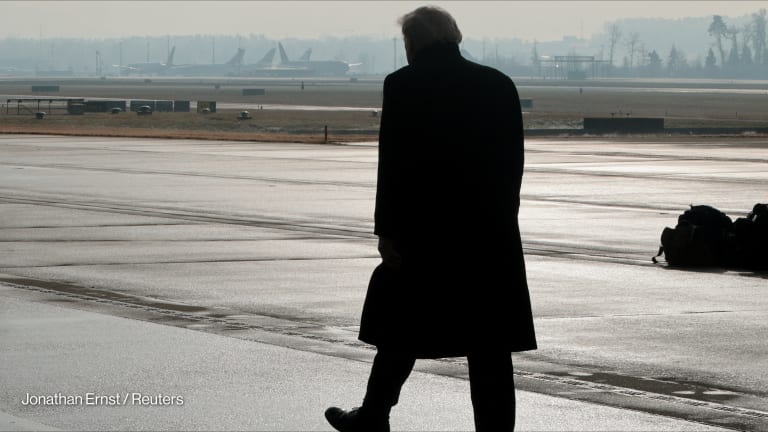
That question gets sharper with U.S. President Donald Trump back in the room (so long as the agenda remains not “woke”). Trump's presence comes exactly a year after he shocked the world — including the Davos set — by halting all U.S. foreign assistance, triggering the downfall of the U.S. Agency for International Development (an anniversary we’ll be reflecting on all this week).
In the year since, the U.S. president has eliminated most aid programs, stepped away from multilateral commitments, and treated cooperation among traditional allies as optional. Davos has always been built around the idea that talking — and listening — matters. Trump’s record challenges that premise head-on.
This story is forDevex Promembers
Unlock this story now with a 15-day free trial of Devex Pro.
With a Devex Pro subscription you'll get access to deeper analysis and exclusive insights from our reporters and analysts.
Start my free trialRequest a group subscription Printing articles to share with others is a breach of our terms and conditions and copyright policy. Please use the sharing options on the left side of the article. Devex Pro members may share up to 10 articles per month using the Pro share tool ( ).
Helen is an award-winning journalist and Senior Editor at Devex, where she edits coverage on global development in the Americas. Based in Colombia, she previously covered war, politics, financial markets, and general news for Reuters, where she headed the bureau, and for Bloomberg in Colombia and Argentina, where she witnessed the financial meltdown. She started her career in London as a reporter for Euromoney Publications before moving to Hong Kong to work for a daily newspaper.