
Devex Dish: How AI is guiding India’s farmers through climate change



Presented by The Crop Trust
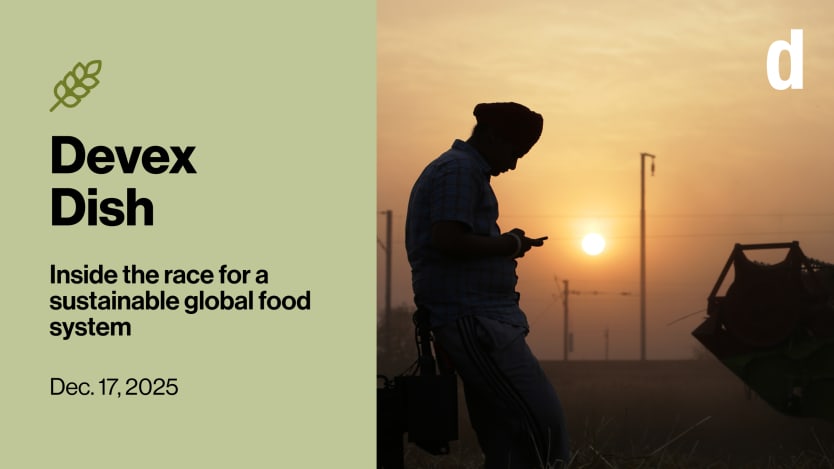
India’s farmers are using a new tool to plant and harvest healthier crops: artificial intelligence. They’re accessing it through a variety of smartphone apps that offer early warnings on impending disasters, assess fertilizer needs, analyze soil health, and support pest and disease management.
When monsoon rains threatened Yuvraj Mohite’s sugarcane crop in western India’s Kolhapur district earlier this year, he turned to an app called Fasal, meaning “crop” in Hindi, which uses on-farm sensors to guide irrigation and highlight pest risks. Its precise watering advice helped him salvage 80 tons of sugarcane, well above what he thought would survive the deluge of rains in June. “The app helped save water and fertilizer, which led to cost-cutting too,” he tells Devex contributor Cheena Kapoor.
As weather patterns grow increasingly erratic, these types of apps are becoming a lifeline for Indian farmers trying to adapt to climate change. They’re multiplying — there’s also KisanGPT and Krushimandi — and app downloads are skyrocketing. These are the types of digital tools the Gates Foundation is trying to boost with the $1.4 billion investment for smallholder farmers in South Asia and sub-Saharan Africa that it announced at the United Nations COP30 climate change conference last month in Belém, Brazil. The funds are being channeled through initiatives such as the Agricultural Innovation Mechanism for Scale, or AIM for Scale.
“India has built a robust digital infrastructure, but hyperlocal weather forecasting is still limited. Our partnerships aim to fill these gaps and help ensure farmers receive the most localized monsoon information possible,” Ana Maria Loboguerrero, director of adaptive and equitable food systems at the Gates Foundation, told Cheena. One expert estimates AI-driven advisories could help Indian farmers save $5.59 billion per year by cutting losses.
Still, AI is no silver bullet in the face of climate extremes. Raju Shetti, a former member of India’s Parliament and founder of farmers’ rights organization Swabhimani Shetkari Sanghatana, argues AI has its limitations. “AI apps can guide farmers on regular days, but they are of no use during incessant rain or when the mercury rises beyond 47-48 degrees Celsius. Instead, farmers need strong insurance policies, which will provide compensation when there are crop failures,” Shetti tells Cheena. But such policies are scarce and offer limited payouts.
Experts stress that AI is just one component of a broader climate adaptation strategy for farmers, alongside insurance and access to credit. Another persistent challenge is reaching the “last-mile farmer,” or those with limited connectivity, low literacy, and no smartphones. “There are plenty of promising ideas out there, but the real challenge is getting the right information to farmers and convincing them it’s useful,” says Paul Winters, the executive director at AIM for Scale.
Read: Can AI drive climate adaptation for India’s farmers?
See also: UN agriculture fund bets big on innovation to improve food security
Related: The AI apps helping the world’s low-income farmers work smarter (Pro)
+ Devex Pro members can get the most out of our coverage on how AI is getting integrated into globaldev work. Not yet gone Pro? Experience unlimited access to expert analyses, hidden funding opportunities and career resources with recruiter insights, and connect with key sector players and influencers at exclusive events and briefings when you start your 15-day free trial of Pro today.
Skipping meals
Thank you for reading and writing to us during this roller coaster of a year for global development. Devex will take our annual companywide holiday break from Dec. 25 through Jan. 1. You’ll get a final Dish edition of 2025 in your inbox on Christmas Eve next Wednesday, and then we’ll see you in early January!
A lasting legacy
Earlier this month the food systems space lost a giant: Nicholas Haan, the humanitarian and technologist who built the world’s most influential tool for measuring hunger crises and galvanizing humanitarian responses to them. He died Dec. 2 at age 60.
Twenty-one years ago, Haan created the Integrated Food Security Phase Classification, or IPC — a five-scale, United Nations-backed system used by aid agencies, governments, and donors to measure food crises across countries and over time. It has helped guide decisions and billions of dollars in humanitarian funding to people facing conflict, drought, and economic shocks, my colleague Ayenat Mersie writes. “Nick turned data into decisions that saved lives, and inspired many of us to do better for the people we serve,” Simon Renk, a senior monitoring officer at the World Food Programme, commented on a LinkedIn post.
Haan began his career as a Peace Corps volunteer in rural Kenya in the late 1980s. He learned to speak Swahili and was drawn to the region for the rest of his life. His vision for the IPC emerged while working with the Food and Agriculture Organization in East Africa in 2003 as some 200,000 people faced extreme food shortages in Somalia, but there was no standard way to communicate the severity of conditions to decision makers.
Back in August, I spoke with Haan for an edition of Dish as IPC had determined famines in Gaza and Sudan — the first time in IPC history when two famines were ongoing simultaneously. At the time he said there’s no excuse for either crisis and urged compassion.
“So the lesson learned is, it’s not the information, actually — even though my expertise in this whole profession is creating the information for action,” he told me. “It’s not even in the funding. It’s in the political will and, ultimately, our moral conscience on having a sense of solidarity with people across the world.” He expressed hope that technology would soon disrupt the aid industry and enable individuals and civil society to distribute more aid “based on common values — true humanitarian values that don’t get filtered through government priorities,” as traditional donors pull back. “I think the more efficient, the more personal, the more direct, the more timely, the more verifiable aid is, the better. And that’s all going to be accelerated with technology,” he said.
He also had a message for humanitarians: “Don’t back away, and do what you can. Don’t accept the sliding standards of humanitarian action. You should always be striving for higher standards, not loosening them.”
Read: Nicholas Haan, architect of global system to detect famines, dies at 60
See also: Lessons from twin famines in Gaza and Sudan
And don’t miss: As famine data dries up, can AI step in?
Number munching
$3 trillion
—That’s the annual cost that four groups of toxic chemicals pose to global health, fertility, economies, and ecosystems, according to a new study by Systemiq. These “invisible ingredients” — phthalates, bisphenols, pesticides, and PFAS (aka “forever chemicals”) — are embedded at every stage of the food system, from fertilizers and pesticides to processing equipment to packaging. They also enter our food supply unintentionally through chemical reactions or via contamination in soil, water, and air.
The report finds that exposure begins long before birth, with lifelong risks to humans in every region of the globe. It finds that these chemicals cost the world between $1.4 trillion and $2.2 trillion in annual health care costs, $640 billion in annual ecological damage, and at least 3% to 4% of global GDP. They will also lead to as many as 700 million fewer births between now and the end of this century.
That all may sound depressing, but the report stresses that these outcomes are not inevitable — and that phasing out these chemicals is ultimately the most profitable path forward. Existing policies and technologies could cut these health and ecological costs by around 70% and save the world $1.9 trillion annually, it finds.
The power of potash
Bringing home the bacon
Your next job?
Senior Director, Humanitarian Advocacy
CARE
United States | Worldwide (remote)
Whoever controls the fertilizer supply controls food security. Farmers have been saying that for years. Yet the broader public and policymakers are slowly recognizing the importance of potash — a general term for fertilizer based on potassium, the element that helps crops withstand drought and disease, Farhad Abasov, chair of Millennial Potash Corp., writes in an opinion piece for Devex.
For much of the last century, potash was reliable and cheap. Those days are over. Russia and Belarus, two major global producers, face sanctions and other restrictions, while the Trump administration has threatened U.S. tariffs on potash from Canada, which provides more than 79% of the U.S. supply.
A critical mineral earns the label when economies can’t function without it, when supply is concentrated, and when no alternative exists. “Potash fits every condition,” Abasov writes.
And development leaders are starting to treat fertilizer minerals the way they once treated energy. Earlier this year, the U.S. International Development Finance Corporation backed a feasibility study for a potash project owned by Abasov’s company along Gabon’s southern coast. It’s DFC’s first foray into this area of mining.
“Because the deposit lies right on the Atlantic coast, it can ship directly to Brazilian, African, and U.S. markets without costly overland transport or rail,” Abasov writes, meaning it can serve both the global north and global south and reduce reliance on a handful of countries.
Opinion: The critical mineral that puts food on the table for half the world
Chew on this
A new lawsuit filed by the city of San Francisco likens food companies such as Kraft Heinz and PepsiCo to Big Tobacco. But it’s much harder to regulate junk food than cigarettes. [The Atlantic]
A study finds that although international funding to help countries meet the “30x30” biodiversity goal is rising, the world is on track for a $4 billion annual shortfall by 2030. [Mongabay]
Ozempic generics are coming. But will low-income countries benefit? [Devex]
An analysis finds that official IPC estimates of global food insecurity underestimate hunger and miss approximately 1 in 5 acutely hungry people. [Nature]
About the author

Tania Karas@TaniaKaras
Tania Karas is a Senior Editor at Devex, where she edits coverage on global development and humanitarian aid in the Americas. Previously, she managed the digital team for The World, where she oversaw content production for the website, podcast, newsletter, and social media platforms. Tania also spent three years as a foreign correspondent in Greece, Turkey, and Lebanon, covering the Syrian refugee crisis and European politics. She started her career as a staff reporter for the New York Law Journal, covering immigration and access to justice.
Search for articles


Most Read
- 1
- 2
- 3
- 4
- 5