
Devex Dish: In Nepal, nutrition gains begin to unravel without USAID


Presented by The Crop Trust
As the one-year anniversary of USAID’s dismantling approaches next month, the human impacts of shutting down the world’s biggest foreign aid agency are becoming very visible and very hard to deny.
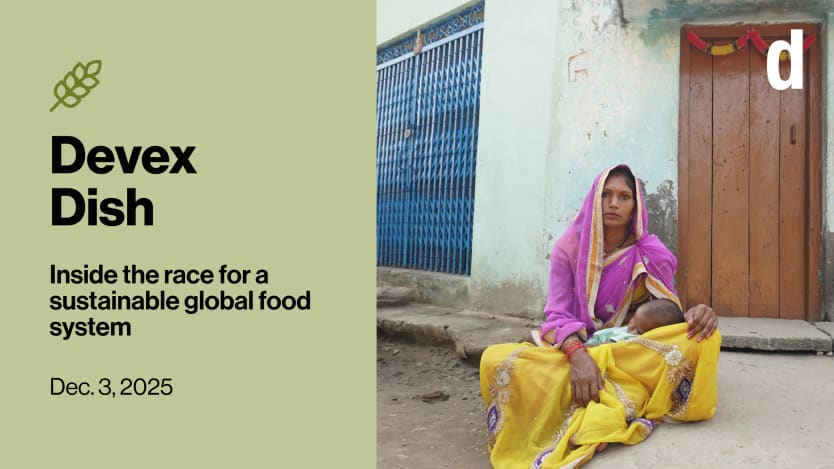
In Nepal, decades of progress on ending malnutrition may be coming undone. The country once had some of the world’s highest child malnutrition rates — 57% of children under 5 were stunted in 1996. Today it’s about 25%. But that progress is suddenly under threat, Devex contributor Sunita Neupane reports from Nepal.
In the western town of Krishnanagar, the risks are painfully clear. Genmati Kahar lost one of her twins, Ruhi, to malnutrition last year. Her surviving daughter, Aarohi, is just over 2 years old and remains trapped in cycles of severe acute malnutrition despite repeated attempts to get care. When health workers last measured the circumference of her arm, a means of screening for malnutrition, it read 9.5 centimeters — far below safe levels. She cannot walk, sit upright, or hold her head steady. “I can never take my eyes off my children,” Kahar says. “It feels like I’m paying for the sins of my past life in this one.”
The Kahar family’s case underscores the deep vulnerabilities that Nepal’s new Integrated Nutrition program was meant to address. The multisector effort aimed to link nutrition, hygiene, sanitation, infant feeding, and food security across 498 municipalities. Led by Helen Keller Intl in partnership with Nepal’s government, it was backed by a USAID award expected to total between $72 million and $99 million from 2024 through 2029. And it was meant to expand Nepal’s U.S.-funded nutrition work.
Instead, the program was suspended in January under the Trump administration’s stop-work order and officially terminated in April. What had functioned as a coordinated safety net is now a patchwork, or in some places nothing at all. Health posts are short on therapeutic foods and basic supplies. Staff have lost their jobs. Screening and counseling have stopped.
“These resources, which previously saved many children from severe malnutrition, are now unavailable, putting countless young lives at serious risk,” says Shankar Bhattarai, Krishnanagar municipality’s health coordinator.
National officials acknowledge the gap and say Nepal doesn’t have the budget to replace the system on its own. “It is a matter of great shame for us that we are still dependent on donors,” says Lila Bikram Thapa, chief of the nutrition section at the Department of Health Services in Nepal.
Sunita’s reporting is part of The Aid Report, Devex’s new editorial and data project tracking how U.S. foreign aid cuts are reshaping programs and services on the ground. This editorially independent project is funded by the Gates Foundation. The Aid Report combines original reporting, verified updates, and curated data to give an evidence-based view of what’s happening across sectors and countries. Watch this space for more.
Read: A decade of nutrition gains at risk as US-funded systems vanish in Nepal
+ If your organization has data or examples of how programs and people are being affected by the U.S. foreign aid cuts — whether positively or negatively — please email editor Kelli Rogers at kelli.rogers@devex.com. You can also reach Kelli securely on Signal or fill out this short survey.
Rocky road
The dismantling of USAID has raised a major, recurring question: What will happen to Food for Peace, the United States’ massive in-kind food assistance program that fed around 4 billion people worldwide over its 71-year existence?
It remains popular among Americans: 81% of respondents in one national poll said they supported such in-kind assistance, according to the Campaign for America First International Assistance.
In the latest appropriations bill that ended the government shutdown last month, Congress added language on moving Food for Peace to the U.S. Department of Agriculture. It set aside $1 million for the USDA, working with the State Department and other agencies, to conduct an interagency review and outline what the transfer would require. (Separately, the bill also allocated $1.2 billion for Food for Peace. The program delivered about $2 billion in global assistance in 2023.)
But the transfer may already be underway. “We are very encouraged and excited to have Food for Peace over at USDA. I think we’re going to be able to focus very successfully and efficiently with that program,” USDA Secretary Brooke Rollins said at a media roundtable last week. At the event, Rollins, along with Luke J. Lindberg, USDA’s under secretary for trade and foreign agricultural affairs, highlighted the department’s existing international programs and noted that it has long partnered with USAID on Food for Peace, especially in commodity procurement.
But there have been persistent concerns about USDA’s capacity to manage Food for Peace. When news of the potential transfer first emerged earlier this year, many humanitarians and development experts told me they were skeptical about USDA’s ability to run such a big and complex program. And that skepticism remains.
“On paper, the move may sound logical — USDA works with farmers, after all. In practice, it would be disastrous for the world’s hungry and offer little benefit to American farmers,” Dina Esposito writes in an opinion piece for Devex.
Esposito served as assistant administrator of USAID’s Bureau for Resilience, Environment, and Food Security under the Biden administration and was director of Food for Peace from 2010 to 2016.
“USDA has no humanitarian mandate, no expertise in targeting countries most in need, and no incentive to choose foods that most effectively address hunger and malnutrition,” Esposito writes.
Esposito also points to what has gone wrong in the past. In the 1990s, U.S. rice shipments flooded Haiti, devastating local farmers. The fallout was so severe that President Bill Clinton later apologized: “It may have been good for some of my farmers in Arkansas,” he said, “but …it was a mistake. I have to live every day with the consequences.”
“If Secretary of State Marco Rubio is serious about ensuring fewer children die on his watch, he should immediately reactivate Food for Peace, and keep it where it belongs, in the hands of humanitarian experts battling starvation,” Esposito writes.
Opinion: The US is breaking a lifesaving global food aid system
Background reading: As USAID is dismantled, Republicans fight to save a food aid program
Related: What good is in-kind food aid? (Pro)
+ Today’s the last day to take advantage of 50% off an annual Devex Pro membership. This is your chance to join the thousands of global development professionals who use Devex Pro to get deeper analysis and insights into the fast-changing $200 billion aid industry for less than $17 per month. Sign up now. Want to try it out first? Your membership includes a free trial. If you don’t find what you’re looking for, simply cancel within 15 days for a full refund.
No deal
Nations have failed to reach consensus on how to strengthen the world’s commitments to preserving seeds and plant genetic material following a week of deliberations in Lima, Peru. The talks, more than a decade in the making, sought to amend aspects of the Food and Agriculture Organization’s International Treaty on Plant Genetic Resources for Food and Agriculture to make it work better for a more complex world — while also strengthening the rights of farmers.
But intense negotiations fell apart in the final hours. Alwin Kopše, chair of the treaty’s governing body, introduced a compromise proposal late Saturday that would have delayed a decision on payment rates for use of plant genetic material from gene banks until the body’s next scheduled meeting in 2027 in Rome. It would also have postponed a decision on expanding the list of 64 food and forage crops that the treaty governs. But global south nations rejected the proposal, stressing disagreement with the payment structure and complaining of a lack of transparency during negotiations, along with little time to review a legally binding document as the meeting raced toward its close.
“Parties ran out of time to be able to adopt a revised Standard Material Transfer Agreement (SMTA). A major divide continued to exist between North and South on how to integrate Digital Sequence Information (DSI) in the benefit-sharing modalities,” said Álvaro Toledo, FAO’s deputy secretary for the treaty.
Some small-scale farmers criticized the talks. “Lack of information on the process, documents circulated only in English, contact groups without interpretation often obliged negotiators to deal with very sensitive matters in complete discomfort,” the International Planning Committee for Food Sovereignty, an observer to the negotiations, said in a statement that also accused the global north of trying to “legalize biopiracy.”
Michael Keller, secretary general of the International Seed Federation, which represents the seed sector, called the outcome “disappointing” and urged parties to “build on the many examples of successful public–private partnerships” to reach a future agreement that can generate sustainable contributions for the treaty’s benefit-sharing fund while supporting farmers and respecting national sovereignty.
Background reading: Can nations hammer out a deal to preserve crop diversity?
The dirt on dirt
While uncertainty over foreign aid hangs over us, a more cautiously hopeful story might be found literally right under us. And with World Soil Day coming up on Friday, the timing is fitting.
A report last month found that the world’s soils may be holding far more carbon than we thought. The top meter of soil stores about 2,822 gigatons of carbon — about 45% more than earlier estimates. For comparison, global greenhouse gas emissions in 2024 were 57.7 gigatons.
The study, from the International Union for Conservation of Nature, Save Soil, Aurora, and the World Commission on Environmental Law, also comes with a warning: Soil only locks away that carbon if it stays healthy. Degradation from erosion and nutrient loss is rising, and the report estimates damaged soils are already releasing 4.81 billion metric tons of carbon dioxide a year — roughly the annual emissions of the U.S. About 30% of soils worldwide are already moderately to highly degraded.
“For too long, soil has been treated as dirt. However, it is the living skin of the planet. Every handful of healthy, living soil is a microcosm of life and a storehouse of carbon and water,” says Praveena Sridhar, chief science and technology officer at the Save Soil movement and one of the report’s authors. “Securing soil is not just an environmental duty,” she adds. “It’s a generational responsibility, and essential to climate change mitigation.”
Read: Soils hold 45% more carbon than thought, study finds
Chew on this
Kenyan high court declares law banning seed sharing unconstitutional. [Associated Press]
The United Nations has designated 2026 as the International Year of Rangelands and Pastoralists. This week, FAO launched its global campaign to raise awareness about the importance of rangelands. [FAO]
How unsustainable global supply chains exacerbate food insecurity. [The Conversation]
About the author

Ayenat Mersie
Ayenat Mersie is a Global Development Reporter for Devex. Previously, she worked as a freelance journalist for publications such as National Geographic and Foreign Policy and as an East Africa correspondent for Reuters.
Search for articles


Most Read
- 1
- 2
- 3
- 4
- 5