




Presented by Friedman School of Nutrition Science & Policy at Tufts University

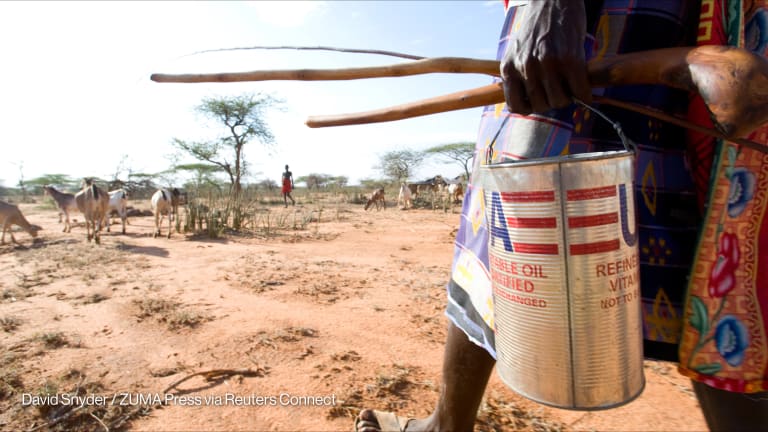
In Isiolo, Kenya, the livestock market is one of the first places drought shows up.
Isiolo lies about 285 kilometers north of Nairobi, at the gateway to Kenya’s arid north. Here, cattle, goats, and camels are not just animals. They also represent savings, insurance, and school fees. When the rains are good, pasture returns and herds recover. When they are not, the shock moves quickly from grazing land to household budgets.
This season, the short rains were weak. Grazing has deteriorated and herders are selling early, before animals lose more weight. The result is a glut in local markets and collapsing prices. A goat that once sold for around 9,000 Kenyan shillings (approximately $70) now fetches closer to KES 2,000 (around $15). At the same time, food prices are edging up again — particularly for vegetables. Supply is tightening just as disposable income and real wages are declining.
Until recently, some of that volatility was cushioned. A USAID-backed initiative launched in 2023 worked across nine northern Kenya counties to strengthen water governance and expand access for productive use. In Isiolo, that translated into irrigation canals, upgraded boreholes, extended pipelines and solarized pumps that lowered operating costs. The investments did not stop drought. But they helped keep water flowing, sustain pockets of food production, and ease pressure on grazing areas.
But when funding halted last year with the Trump administration’s freeze on U.S. aid, some projects stalled midstream and coordination weakened. As pasture shrinks in neighboring counties, herders are moving into Isiolo in search of water and grazing, heightening competition in areas already under strain.
All of this is unfolding against a tighter economic backdrop nationwide. Between 2020 and 2025, USAID committed roughly $2.5 billion to Kenya, or about $470 million per year, with much of it directed to health. As those inflows decline, the external financing that has long underwritten key social sectors is receding in an already constrained fiscal environment. Debt servicing consumes roughly 70% of government revenue, limiting the government’s ability to absorb shocks.
In Isiolo, the convergence is visible. Climate stress, rising food costs, and shrinking donor support are landing at the same time, in livestock markets, at water points, and in the daily calculations families make about what to sell, what to save, and what they can no longer afford.
Read more: A year without USAID — in Kenya, the shock reaches herders and hospitals
Related reading: Aid cuts could lead to millions of deaths by decade’s end, new study finds (Pro)
+ Stay ahead of the curve in this crucial time for global development by signing up for a Devex Pro membership with a 15-day free trial today and gain unlimited access to all our expert analyses and one-on-one briefings with sector leaders, funding data and opportunities from top donors, exclusive news content, and more.
McCain’s exit
Meanwhile in Rome, one of the most prominent women in global food aid is exiting the stage.
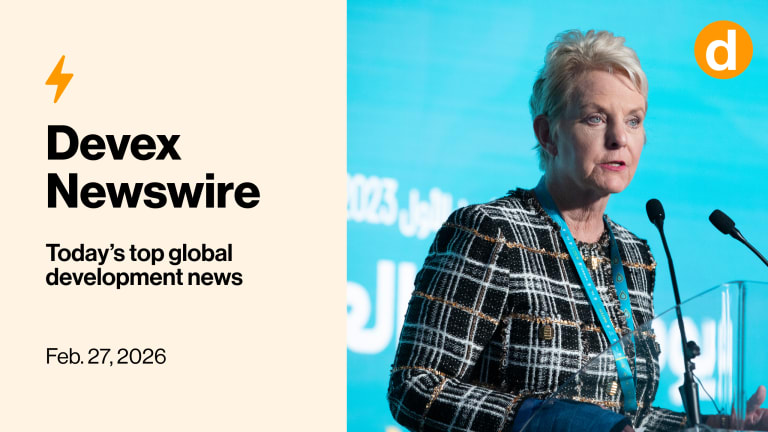
In three months Cindy McCain will step down as executive director of the World Food Programme, cutting short a term that was set to run through 2028. Who succeeds her in this moment of tight budgets and multiplying crises will be consequential.
McCain, who suffered a mild stroke in October, said she would be stepping down to focus on her recovery. Her deputy, Carl Skau of Sweden, will serve as officer in charge during the transition.
She took the helm in 2023 after David Beasley presided over a dramatic expansion of WFP during a period of record spending. But the surge proved unsustainable. In her first year, WFP received just $8.3 billion of the $23.5 billion it sought, forcing deep ration cuts. U.S. contributions, long the backbone of the agency’s funding, have also fallen sharply since their peak at the onset of the Ukraine crisis.
Her departure gives the Trump administration its first opportunity to put forward its own candidate to lead a major U.N. humanitarian agency: The WFP post is traditionally held by an American. Among those being discussed as potential successors, insiders tell Devex, are Lynda Blanchard, the U.S. representative to the U.N. agencies in Rome, and Kip Tom, who served in the same role during President Donald Trump’s first term.
At last week’s WFP executive board meeting, Blanchard laid down a marker. “U.S. citizens, including American farmers, remain committed to feeding the world, but they also demand better results,” she said. “Our objective: less waste, more lives saved.”
She urged WFP and the Food and Agriculture Organization to eliminate duplication and work better together, warned against waste and fraud — citing food aid theft in Somalia — and emphasized that WFP’s “core strength is saving lives through emergency food assistance.”
With funding tighter and scrutiny rising from Washington, WFP’s next leader will inherit not only a budget gap, but pressure to prove its efficiency and stay squarely focused on emergency food aid.
Read more: WFP Executive Director Cindy McCain to step down, citing health concern
Further reading: Already strapped for cash, WFP faces post-USAID future
Celebrating women farmers
Sunday is International Women’s Day, which makes it a good time to consider women’s massive contribution to agrifood systems.
Bringing home the bacon
Your next job?
Director, Corporate Engagement
Sustainable Agriculture Network
Worldwide (remote)
Today, I want to spotlight a conversation I had with Sophia Campello Beckwith, senior director of strategy and client success at Opportunity International, about one of the most persistent barriers facing women farmers: access to finance. The U.S. nonprofit provides microfinance loans and training to millions of people in the global south.
Across rural Africa, women anchor informal finance. They lead village savings and loan associations, or VSLAs — small groups that save together and lend to one another. They repay. They keep records. Yet many remain invisible to banks.
One strategy is scale. Opportunity International helps bring several VSLAs together into larger cooperatives representing a few hundred farmers. At that size, banks are more willing to engage. The organization also works with cooperatives on governance and financial management so they can pass due diligence and be treated as credible borrowers. Another program centers on collateral. Women own a tiny share of titled land in many countries — around 10% in Kenya, for example — which means they often cannot put land forward as security for a loan. In some contexts, Opportunity International offers a collateral subsidy for qualified women farmers so they can meet lending requirements without relying on a husband’s title.
When we spoke on the sidelines of the Sankalp summit in Nairobi last week, Beckwith also pointed to product design. Banks often extend standard SME loans to farmers. But farms are a particular kind of small and medium-sized enterprises. If income comes at harvest, wouldn’t repayment cycles tied to seasons make more sense than fixed monthly schedules? In Rwanda, some lenders have introduced maternal repayment breaks to account for pregnancy and early child-rearing.
Opportunity International is now building country-by-country models to quantify the gender value proposition, mapping how many women remain unfinanced and what their repayment rates look like.
The message to banks: This is not charity. It is an underserved market with data to back it up.
Related: Why fighting for gender equality will help save the food system
Chew on this
Ireland backs former EU agriculture and trade commissioner Phil Hogan to lead FAO. [Politico]
Beyond oil: In the wake of U.S. and Israeli strikes on Iran, the slowdown of commercial shipping through the Strait of Hormuz could affect nitrogen fertilizer — and thus, the global food supply. [Forbes]
Agriculture is taking over grasslands, wetlands, and other overlooked ecosystems. [World Resources Institute]
Resilient Food Systems Index: A new global ranking of 60 countries assesses affordability, availability, quality and safety, and climate risk. [Economist Impact]
A report from FAO shows that ownership, tenure, or use rights of only 35% of the world’s land is formally documented. [FAO]
Elissa Miolene contributed to this edition of Devex Dish.
About the author

Ayenat Mersie
Ayenat Mersie is a Global Development Reporter for Devex. Previously, she worked as a freelance journalist for publications such as National Geographic and Foreign Policy and as an East Africa correspondent for Reuters.
Search for articles

Most Read
- 1
- 2
- 3
- 4
- 5