




Presented by Scaling Community of Practice Forum
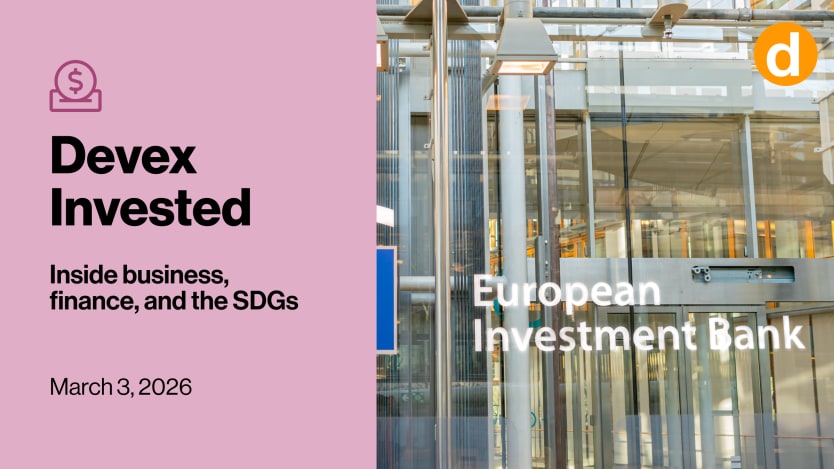
The European Investment Bank is kicking off its annual meetings today, and I’m here in the tiny palatial town of Luxembourg — the world’s last remaining sovereign grand duchy — to better understand what direction this institution is heading.
EIB is one of the largest development banks in the world, signing €88.8 billion ($103 billion) in new financing in 2024, and it is sitting on roughly $232 billion in unused lending capacity.
The forum comes at a pivotal moment for Europe’s economic strategy and long-term support for development finance as a whole. Negotiations over the European Union’s next long-term budget — the multiannual financial framework — are intensifying, and with them a broader debate about EIB’s future role both inside and outside the bloc. At stake is not just how the bank supports climate and development goals abroad, but how it underpins economic stability at home.
This year’s forum is expected to lean heavily into competitiveness and defense — with climate change on the agenda, but increasingly framed through an industrial lens. Experts tell me that the shift is visible in the themes as well as the guests, with executives from major industry groups attending, alongside the major multinational oil company Eni.
The first part of the conference features talks on clean tech, industrial strategy, and de-risking private investment, while the second half expands to broader development issues. Branded “EIB Global Days,” the event will spotlight the bank’s activities outside the EU — closely tied to the EU’s Global Gateway strategy, which is widely seen as Europe’s answer to China’s Belt and Road Initiative.
Frank Vanaerschot, director of the Brussels-based coalition Counter Balance, tells me that “commercial interests are predominant throughout this forum.” EU development guarantees, funneled through EIB Global, are increasingly being steered toward strategic and commercial interests that can benefit European countries — from critical raw materials to health supply chains abroad. The institution does seem eager to spotlight its climate credentials, boasting several panels on energy and climate, which is a notable contrast to the more muted climate focus at recent World Bank gatherings.
EIB regularly reports its financing as aligned with the Sustainable Development Goals, reinforcing its self-styled role as the EU’s “climate bank.” The rhetoric around climate and sustainable energy has largely held steady under EIB President Nadia Calviño, with officials insisting EIB will continue to prioritize green infrastructure and uphold its commitment to end financing for unabated fossil fuels.
“Reinforcing our role as the Climate Bank remains our top priority,” EIB Vice President Ambroise Fayolle told me in an email, adding that financing climate and defense go hand in hand.
“Financing climate and financing security and defence share an essential common objective: European Union’s strategic autonomy,” she said, pointing out that in 2025, a record €57 billion of EIB’s total financing went to green projects, and security and defense investments quadrupled to more than €4 billion.
But behind the messaging, civil society groups are raising red flags about what they see as a softer rollback in transparency and safeguards. In October, EIB replaced its detailed environmental and social due diligence procedures with more general language, prompting concerns that internal checks on projects’ impacts have been weakened, Anna Roggenbuck, a policy officer at Bankwatch, tells me.
Overall, the bank is under pressure to prove it can pivot quickly — shedding its reputation as a slow-moving cargo ship and responding faster to geopolitical demands, says Karim Karaki, head of the European Centre for Development Policy Management’s economic recovery and transformation team.
One key question likely to surface in corridor conversations is risk: whether shareholders, largely EU finance ministries, are willing to tolerate greater exposure in emerging markets to help European firms expand abroad. Advocates argue that if EIB is to marry Europe’s economic interests with its development ambitions, it may need to recalibrate how it assesses risk outside the EU — or risk being sidelined as companies look elsewhere for backing.
Read: EIB says it’s ‘carrying the flag of development’
Background reading: Europe’s biggest development bank is sitting on €200 billion
Plus: EU seeks major boost to development in budget amid ‘Europe First’ shift
Wheeling and dealing
In Nairobi, the 37th edition of the Sankalp Forum last week felt unusually well-timed, my colleague Ayenat Mersie tells me. Long a convening ground for impact investors and entrepreneurs, it zeroed in on two themes dominating development debates right now: global south-south cooperation and the role of private capital in tackling systemic challenges.
Convened by Intellecap, the advisory arm of the Aavishkaar Group — an impact investing platform backing small and medium-sized enterprises across Africa and Asia — Sankalp brings together venture capital funds, development finance institutions, foundations, and growth-stage companies seeking capital.
The mood was upbeat and hands-on. Much of the agenda revolved around workshops and smaller group discussions digging into specific bottlenecks: what is stopping investors from financing climate adaptation, what needs to be in place before capital can flow into refugee-hosting contexts, and how particular blended-finance transactions have been structured across sectors. On the main stage, Kenya Investment Authority CEO John Mwendwa highlighted an ambitious target: mobilizing $2 billion in a single day at the upcoming Kenya International Investment Conference, set for March 25–27. The aim is to turn that gathering into a platform for signing bankable, investment-ready deals.
One new vehicle formally launched at Sankalp was the Multiply Health Fund, a blended finance collaboration led by Villgro Africa and partners aimed at helping high-impact health enterprises bridge the “missing middle.” Aavishkaar Capital’s $250 million Global Supply Chain Support Fund — designed to provide $2 million–$5 million in tailored supply-chain financing to enterprises across Africa, India, and emerging Asia — was also discussed.
The next development finance battle
The recent standoff between the U.S. Pentagon and artificial intelligence company Anthropic over access to its AI models has surfaced a new fault line in global development finance: Who ultimately controls the world’s most powerful digital infrastructure?
Your next job?
Chair of the Scientific and Technical Advisory Panel to the Global Environment Facility
United Nations Environment Programme
Worldwide (remote)
The Trump administration has argued that the state must have full operational access to privately built AI systems for national security, while Anthropic has refused to remove safeguards around uses such as mass surveillance and autonomous weapons.
At the same time, leaders in New Delhi, which hosted the recent India AI Impact Summit, and across the global south are confronting a different version of the same dilemma — how to access AI systems largely built by U.S. and Chinese firms without locking in long-term dependence.
The latest episode of Devex's new Global Progress in the AI Era podcast hosted by my colleague Catherine Cheney tackles some of these emerging questions. It’s aptly titled “How the global south can finance AI infrastructure on its own terms.”
Barbados’ minister of innovation, industry, science, and technology, Jonathan Reid, tells Catherine that smaller economies can position themselves as “test beds” for ethical AI — shaping systems on their own terms rather than becoming passive testing grounds.
But doing so requires new financing models that prioritize institutional capacity, long-term maintenance, and domestic ownership, says Alaa Murabit of the venture capital firm 500 Global.
“A country with strong institutional capacity and mediocre AI tools will outperform a country with world-class AI and no ability to govern it, every time,” Murabit says.
The takeaway for development financiers: AI isn’t just a technology play. It’s an infrastructure and governance bet — and the structure of the capital will determine who captures the value.
Listen: How the global south can finance AI infrastructure on its own terms
Related reading: Is Anthropic building Rwanda’s AI future — or its dependence? (Pro)
+ Not yet gone Pro? Experience Devex Pro with a 15-day free trial and explore expert analyses, unlock hidden funding opportunities, connect with key players at exclusive events, and access a wealth of knowledge you won’t find anywhere else. Check out some of the content exclusive to Pro readers.
What we’re reading
How debt relief for low-income countries could help reverse the devastating consequences of U.K. aid cuts. [The Independent]
President Donald Trump’s push for a U.S. sovereign wealth fund is transforming a major agency. [Bloomberg]
The World Bank doesn’t need to generate more knowledge. It needs to want it. [Center for Global Development]
Catherine Cheney and Adva Saldinger contributed to this edition of Devex Invested.
About the author

Jesse Chase-Lubitz
Jesse Chase-Lubitz covers climate change and multilateral development banks for Devex. She previously worked at Nature Magazine, where she received a Pulitzer grant for an investigation into land reclamation. She has written for outlets such as Al Jazeera, Bloomberg, the Organized Crime and Corruption Reporting Project, and The Japan Times, among others. Jesse holds a master’s degree in Environmental Policy and Regulation from the London School of Economics.
Search for articles


Most Read
- 1
- 2
- 3
- 4
- 5