


Presented by RADIAN
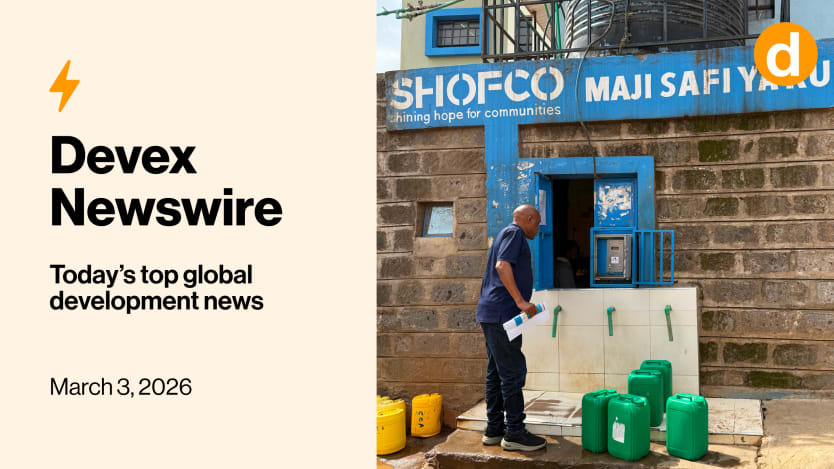
The localization movement always progressed — and regressed — in fits and starts, but it seems to have been completely derailed by the great aid shake-up of 2025. Will it bounce back in 2026? Or will an entirely new movement emerge?
Also in today’s edition: Anthropic comes to the global south, but does it come bearing gifts or hoarding profits?
+ With the development sector tightening, “business as usual” won’t land your next role. Join us today for a Devex Career Briefing featuring Alder Bartlett, a trained executive leadership coach who successfully navigated a career transition after 16 years at USAID. In this briefing, you’ll learn the blueprint for a strategic job search. Don’t just search — position yourself for impact. Save your spot now.
Localization goes south
Last year, the words “aid” and “cut” probably appeared in nearly every article we wrote — or some version of them (“slashed” was one of my favorites). But before the Trump administration’s dismantling of USAID, “localization” was the buzzword du jour.
Yet with foreign assistance in the midst of a redefining reckoning, is localization still important?
Yes, according to people Devex contributing reporter Jessica Abrahams spoke to for her story on the subject, although it’s not that simple. (Then again, when was localization ever simple?)
For one thing, USAID — an imperfect but vocal proponent of localization — is gone. And many donors, especially governments, have gone silent on the issue, preferring to lie low in this high-risk environment.
At the same time, the existential questions confronting development today could pry the door open for localization to finally take hold, whether by moral design or sheer financial necessity.
For example, the jolt of the past year seems to have made NGO boards more open to supporting radical changes and considering creative solutions, said Ruth Rhoads Allen, president of CDA, a U.S.-based nonprofit now in the process of merging with a Kenyan INGO.
“From all the devastation and destruction … there’s so much potential,” she said.
But for others, that devastation and destruction showed the fallacies of localization to begin with, according to Gunjan Veda, global secretary of the Movement for Community-Led Development. “To me, localization was always a way of making an extremely unbearable, unjust, colonial system slightly more bearable, slightly less unjust. It was much more about ‘do less harm’ than ‘do no harm,’” she said.
The suddenness with which donors pulled the rug out from underneath local communities also ripped away trust, which won’t come back even if the money does, argued Kennedy Odede, founder and CEO of the Kenyan grassroots organization Shining Hope for Communities, or SHOFCO. Development was always an “unfair business,” he said. But now “it’s black and white: We are on our own.”
Yet he added that it’s difficult to predict what will happen next, which again, could be a window of opportunity to create something bigger and better than outdated notions of localization. “Now is the era to reimagine development,” he said. “Let’s give ourselves time.”
Read: Does the global south still want localization — or does it want more? (Pro)
+ Unlock the power of Devex Pro with a 15-day free trial. Discover the expert analyses and wealth of knowledge that drive global development. Connect with key players at exclusive events and uncover hidden funding opportunities you won’t find elsewhere. Check out all the exclusive content available to Pro members.
An Anthropic double-edged sword?
There’s another dynamic that will force a reimagining of development: artificial intelligence, which is moving full speed ahead, as evidenced by a recent three-year partnership between Anthropic and Rwanda to deploy AI tools in health and education.
But the deal — which is short on details — is evidence of something else: the debate over whether AI will be a net gain or loss for the global south. Specifically, will it build local talent and infrastructure, or will it foster a new age of dependency?
Ayantola Alayande of the Global Center on AI Governance is in the skeptic camp, cautioning that the deal is a form of market capture, whereby Anthropic aims to secure a dominant industry position in the country. Alayande believes that for African nations to avoid dependence on the rest of the world, “companies need to actually be invested in infrastructure, which is what a lot of the big techs don’t do.”
But not everyone is a skeptic, writes Eden Harris for Devex. Anupam Chander of the Georgetown University Law Center says access to frontier AI systems could help African countries avoid falling further behind. “These tools could be especially meaningful in expanding access to health and education,” he says.
Rwanda has already been on the receiving end of Western partnerships, as the first country to participate in a new Gates Foundation and OpenAI $50 million health care partnership called Horizon1000.
Mutale Nkonde — a visiting policy fellow at the Oxford Internet Institute who’s worked with the U.S. Congress on ways to regulate the use of AI — believes Rwanda can capitalize on its new partnership with Anthropic by “training Rwandan top tech talent, like they’re developing an MIT-type environment,” he says, “and if they’re really bolstering that labor market and that knowledge base, then yes, that could be really positive.”
Read: Is Anthropic building Rwanda’s AI future — or its dependence? (Pro)
+ In a fast-moving sector, you can’t afford to miss the headlines on AI. We’ve gathered all of our coverage — from exclusive interviews with U.N. tech envoys to field reports on AI-driven health innovations — into one place. Stay ahead of the curve here.
Silver lining
The conversation over how the global south can benefit from AI is the timely topic my colleague Catherine Cheney explored in the latest episode of her special edition podcast, where she was joined by Jonathan Reid, the Barbadian minister of innovation, industry, science, and technology; Kate Kallot, founder and CEO of Amini, a company building data infrastructure across Africa and the tropical belt; and Alaa Murabit, managing partner for sustainable growth at 500 Global.
They discussed how small countries can take back financial and data sovereignty — and ensure access to AI without losing agency.
That’s especially important given the uneven historical power dynamics between the global south and the West.
“Right now, a lot of [global south countries] are still being left as a sort of natural resource ground — extraction of data, transformation elsewhere, and then the models are sold back to your population at a premium,” Kallot said. But, she said, by identifying priority data, global south countries can invest in much less computing capability and still keep the sovereignty that truly matters to them. Meanwhile, Murabit pointed out the importance of training regulators as well as developers, and of investing for the long run in AI as infrastructure.
For Reid, retaining national sovereignty will be a laborious process — one that must be negotiated in each partnership, deal by deal. “I think sovereignty is that you have to have a reasonable component of control,” he said. “I think there’s somewhere between zero and 100 that you’re going to land.”
But that local control could answer one of Reid’s main questions in the AI debate: “How do you scare people less, and how do you help people more?”
Listen: How the global south can finance AI infrastructure on its own terms
ICYMI: UN tech envoy talks AI governance and the private sector
Continental drift
Africa — like practically every corner of the planet — is wondering if AI will add or subtract jobs. But it’s also reeling from the immense job losses stemming from foreign assistance cuts by both the U.S. and Europe.
During a recent Devex Career Briefing, Allwell Akhigbe, CEO and cofounder of Travaille Ensemble, described the impact as catastrophic, noting that aid organizations and U.N. agencies had provided the vast chunk of the continent’s development funding.
Jacqueline Sambu, CEO and founder of Tai Talent Matters, said there is now a dense pool of experienced professionals competing for very few job options. One silver lining over the past year, however, is a greater focus on locally led solutions, creating more opportunities for local professionals, Sambu said.
But where there is hiring, it’s unlikely to be at the same level of seniority and salary as previously seen, she cautioned. “What that means is that what you would consider to be overqualified candidates will now be applying down, so competition will sort of be very stiff across all positions or levels.”
Read: How Africa’s development job market is changing in 2026 (Career)
+ With a Devex Career Account membership, you will get access to our monthly members-only career events, as well as to the world’s largest global development job board, a highlighted profile on the Devex database, and thousands of articles containing expert career advice, practical tools, and insights from leading recruiters. Not yet a Career Account member? Start your 15-day free trial today.
In other news
U.K. cuts hundreds of millions in funding for climate programs in low-income countries, undermining its £11.6 billion global climate finance pledge. [The Guardian]
During Brazilian President Luiz Inácio Lula da Silva’s ongoing four-year term, more than $48 billion in sustainable investments will be mobilized, prioritizing the implementation of current climate and ecological projects. [Reuters]
Israel says it is lifting the temporary closure of the Kerem Shalom crossing today in order to resume aid and medical access into Gaza, after it was closed Saturday due to U.S.-Israeli strikes on Iran. [Le Monde]
Sign up to Newswire for an inside look at the biggest stories in global development.
About the author

Anna Gawel
Anna Gawel is the Managing Editor of Devex. She previously worked as the managing editor of The Washington Diplomat, the flagship publication of D.C.’s diplomatic community. She’s had hundreds of articles published on world affairs, U.S. foreign policy, politics, security, trade, travel and the arts on topics ranging from the impact of State Department budget cuts to Caribbean efforts to fight climate change. She was also a broadcast producer and digital editor at WTOP News and host of the Global 360 podcast. She holds a journalism degree from the University of Maryland in College Park.
Search for articles




Most Read
- 1
- 2
- 3
- 4
- 5