



Presented by Asian Infrastructure Investment Bank
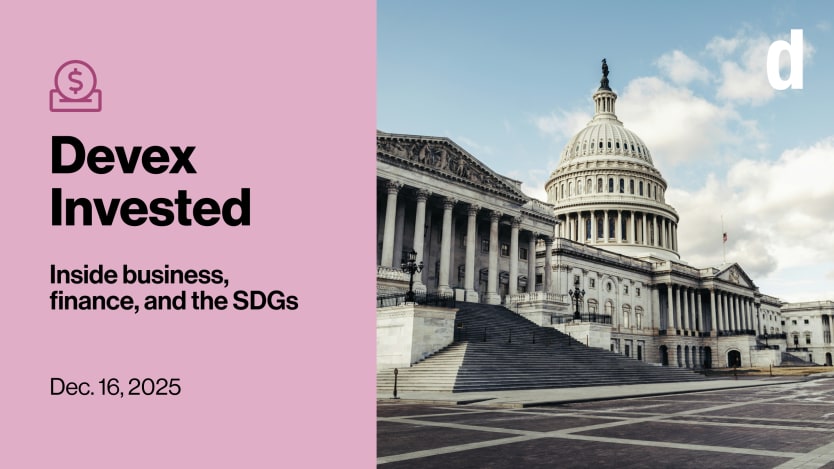
After weeks of tense negotiations and legislative limbo, the U.S. International Development Finance Corporation, or DFC, is poised for a transformative shift. Lawmakers have attached the DFC Modernization and Reauthorization Act of 2025 to the must-pass National Defense Authorization Act, signaling an end to the agency’s temporary extensions and the beginning of a new, much larger era.
If the legislation is passed, DFC will see its firepower more than triple, my colleague Adva Saldinger writes. The agency’s total spending cap is set to jump from $60 billion to $205 billion, and for the first time, it will have the authority to invest in high-income countries.
But as Rob Mosbacher, the former CEO of the defunct Overseas Private Investment Corporation, tells Adva, neither side got exactly what they wanted. The bill is a classic example of “horse-trading” among lawmakers when it comes to the key sticking points about expanding the agency’s work — particularly in high-income countries — and guarding its core development mission.
So what’s in the deal?
• The HIC compromise: DFC can now work in high-income countries, but with strict guardrails. These deals are capped at 10% of the agency's total limit, and DFC cannot fund more than 25% of any single project in these nations.
• Strategic exceptions: While the bill bans investment in the world’s 20 wealthiest nations and "countries of concern" — such as China and Russia — it carves out exemptions for energy, critical minerals, and technology.
• Equity power: A new $5 billion equity revolving fund will allow DFC to retain and reinvest earnings — a major boost for its ability to act like a bank.
• The price of expansion: To get the votes, the agency accepted what one expert calls “potential layers of bureaucracy.” The bill establishes a congressional strategic advisory group and demands rigorous notification for deals over $20 million.
The bottom line: DFC is getting the war chest it needs to compete on the global stage, but the rigorous oversight attached to the money means it will be operating under a microscope.
“The greatest concern in my mind is the potential layers of bureaucracy and decision-making that will result from more rigorous congressional oversight and reporting,” Mosbacher says.
Read: Reauthorization of the US development finance corporation gains traction
+ This week, we’re closing out a critical year in the international development sector with a series of Pro Briefings on how to find new pathways for development.
On Thursday at 10 a.m. ET, we’ll sit down with experts and former officials to discuss the shifting currents inside the U.S. Millennium Challenge Corporation and what these changes mean for the agency’s role in the evolving U.S. foreign assistance and economic policy landscape. Save your spot now.
Guess who’s back
After expiring in September, the United States’ African Growth and Opportunity Act, or AGOA, is finally being resurrected, with the House of Representatives’ Ways and Means Committee approving a bipartisan three-year extension. This isn’t just about restoring duty-free trade; lawmakers frame the renewal as a crucial geopolitical strategy to secure supply chains and counter China’s growing influence in the region. With over $500 billion in historical trade at stake, the move aims to prevent damaging tariff spikes and reassure nervous investors who have been left in limbo since the expiration.
While it is a compromise, this three-year deal bridges the gap between lawmakers seeking long-term modernization and the Trump administration’s preference for a short-term “America First” realignment. African leaders have warned that failure to act poses a major threat to their economies, while U.S. businesses are clamoring for predictability. The bill now faces a critical path through the full House and Senate to prove that the U.S. remains a stable and committed partner to the continent.
Read: Can the US-Africa trade program AGOA be resurrected?
ICYMI: AGOA, the Lobito corridor, and the future of US-Africa engagement (Pro)
+ Not yet a Devex Pro member? Start your 15-day free trial today to experience an unrivaled analysis of the development sector with expert insights, unlock hidden funding opportunities, connect with key sector leaders and influencers at exclusive events, get timely career resources and recruiter insights, and more.
Harder, better, faster, stronger
Breaking a 25-year precedent of leadership distance, the World Bank and Asian Development Bank have unveiled a “Full Mutual Reliance Framework” designed to streamline development finance and help reduce the multiple rules, missions, and procurement steps of different banks. The goal is to address a “capacity strain” low- to middle-income countries are facing by allowing the banks to rely on each other’s systems.
The partnership will launch immediately with two major pilot efforts: an urban connectivity project transforming roads and water supply in Tonga that will be led by ADB, and a regional health operation reaching 2 million people across Fiji, Kiribati, and other parts of the Pacific, led by the World Bank. A pipeline of 20 additional projects has already been identified.
“One plus one must be equal to three,” said World Bank Group President Ajay Banga in a speech earlier this month. “They asked us: Can you make our lives easier? Can you work faster? Can you be better partners together, because we do not have the capacity to deal with both of you and multiple sets of rules, multiple documentation, multiple missions, multiple procurement steps, and all this strains their capacity.”
The framework could serve as a test case for broader MDB harmonization, with talks already underway to include the European Bank for Reconstruction and Development, Inter-American Development Bank, and African Development Bank.
Speaking of ADB …
ADB is keeping busy. In addition to partnering with the World Bank, it has revised its economic outlook for developing Asia upward to 5.1% for 2025, citing a boom in semiconductor exports and the stabilization of commercial ties following recent trade agreements with the United States.
The outlook notes that easing inflation — projected to drop to 1.6% — and solid financial conditions are effectively countering global uncertainty. While the 2026 outlook was also nudged up to 4.6%, ADB Chief Economist Albert Park cautions that sustained resilience will depend on governments maintaining open investment channels amid a still-clouded external environment.
Stronger-than-expected domestic demand in major economies is fueling the surge, with India’s 2025 forecast jumping to 7.2% on the back of consumption-boosting tax cuts, and China’s outlook inching up to 4.8% due to continued fiscal stimulus. Southeast Asia and the Caucasus and Central Asia regions also saw upward revisions, driven by robust public investment and remittances. However, the report balances this optimism with clear warnings: The region remains vulnerable to renewed trade friction, geopolitical instability, and potential deterioration in China’s property sector, all of which could dampen momentum heading into 2026.
The end of ‘Big Aid’
Your next job?
Head of Project Economics
Asian Infrastructure Investment Bank
Beijing, China
Is foreign aid dead? While roughly 70% of Americans believe the U.S. overspends on foreign assistance and budgets are tightening, aid is not dying but rather evolving from a “post-material” focus on governance to a “materialist” model built on tangible growth, Kusi Hornberger and Ben Schatz argue in an opinion piece for Devex. Both work at Dalberg, a global group of social impact advisory, research, and design firms.
With only 18% of U.N. Sustainable Development Goal targets on track and an annual financing gap that has swelled to $3.5 trillion, the authors contend that the new playbook must prioritize visible infrastructure — such as roads, ports, and power grids — that drives real economic mobility and addresses the practical failures of the current system.
Bridging this gap requires a massive recalibration of capital, shifting focus from limited official assistance to the $11.6 trillion held by developing-country pension and sovereign funds. Mobilizing just 10% of these domestic assets could cover one-third of the SDG financing gap, effectively rebranding aid from charity to strategic national investment. By standardizing scalable partnerships that deliver mutual economic returns — securing supply chains and opening markets — donors can achieve development goals while presenting a narrative of shared prosperity that is far easier to sell to the median voter.
Opinion: Rethinking development funding means making it matter to the median voter
What we’re reading
Military-led West African states launch a regional investment bank. [Bloomberg]
The OPEC Fund for International Development approved $600 million in financing for 15 new development projects. [OPEC Fund for International Development]
Washington’s new model of foreign aid for economic growth. [ChatGDP]
The African Development Bank seeks $25 billion for low-cost lending amid waning U.S. engagement. [Reuters]
About the author

Jesse Chase-Lubitz
Jesse Chase-Lubitz covers climate change and multilateral development banks for Devex. She previously worked at Nature Magazine, where she received a Pulitzer grant for an investigation into land reclamation. She has written for outlets such as Al Jazeera, Bloomberg, the Organized Crime and Corruption Reporting Project, and The Japan Times, among others. Jesse holds a master’s degree in Environmental Policy and Regulation from the London School of Economics.
Search for articles


Most Read
- 1
- 2
- 3
- 4
- 5