



Presented by Operation Smile
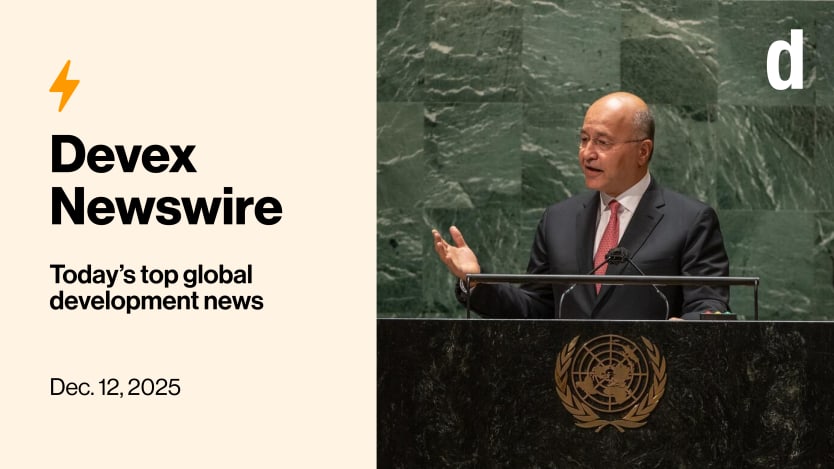
The United Nations’ main refugee agency, UNHCR, is set for a major leadership shift with former Iraqi President Barham Salih taking the top job. His selection signals a move beyond the agency’s long-standing European dominance. It also lands at a moment when funding from traditional donors is tightening.
Also in today’s edition: The Gates Foundation’s latest warning. Plus, philanthropy and funding, job search 2026, and This week in global development.
+ Next week, we’re closing out a critical year in the international development sector with a series of Devex Pro briefings on how to find new pathways for development.
On Monday, we’ll be in conversation with Kanika Bahl, CEO of Evidence Action, on what it will take to turn AI’s potential into population-level impact. Register now for the event.
A break with tradition
Barham Salih is set to lead the UN Refugee Agency — a big break from its decades of mostly European chiefs, according to well-informed sources.
He beat out about a dozen candidates, including top Europeans, and will replace Filippo Grandi at year’s end, writes Senior Global Reporter Colum Lynch. António Guterres, U.N. secretary-general, made the final call after narrowing the list, which included former IKEA chief Jesper Brodin.
Now a senior fellow at Harvard University’s Belfer Center for Science and International Affairs, Salih had been a key figure in Iraq’s reconstruction following the U.S. invasion of the country and previously served as prime minister of the Kurdistan Regional Government.
In written answers to ICVA, a global network of nongovernmental organizations, he laid out his vision: “As humanitarian space narrows and trust in multilateralism falters, UNHCR must lead with renewed moral clarity and operational discipline. … My vision is a UNHCR that places refugees at the center, recognizing that humanitarian aid is meant to be temporary.” He added that “far too many refugees remain displaced for years” and that “UNHCR must also remain a steady anchor in an unpredictable world.”
UNHCR, founded in 1950 to help resettle refugees after World War II, has almost always been led by Europeans. Salih’s (not yet public) selection ends that streak and comes as traditional donors in Europe and the U.S. scale back funding.
Exclusive: Former Iraqi president picked to lead UN Refugee Agency
Almost doesn’t count
Child deaths are rising for the first time this century — a grim milestone the Gates Foundation’s Goalkeepers Report says will define 2025. Last year, 4.6 million children died before age 5; this year, that number is expected to hit 4.8 million, just as global health funding collapses by 26.9%.
“We need to resume the kind of progress that the world has seen,” says Mark Suzman, CEO of the Gates Foundation, warning that cuts “should not come at the expense of the world's very poorest and most vulnerable.” His message: “We cannot stop at almost.”
Bill Gates echoes that urgency: “Even in a time of tight budgets, we can make a big difference … with millions of lives on the line, we have to do more with less.”
The foundation points to low-cost wins: primary care — “the workhorse of every health system” — can prevent up to 90% of child deaths for under $100 per person annually, and every $1 spent on immunization returns $54.
But aid cuts from major donors — including the United States, the United Kingdom, and Germany — are pushing global health funding down nearly 30% in a year. Suzman praises the U.S.’ $4.6 billion contribution to the Global Fund to Fight AIDS, Tuberculosis and Malaria but calls the lack of support for Gavi, the Vaccine Alliance “very challenging,” noting that these cuts represent a “tiny, tiny” share of national budgets yet result in “hundreds of thousands of lives saved.”
Even so, he’s hopeful, writes Managing Editor Anna Gawel: “We remain very optimistic about what can be done by 2045. We believe that we can persuade … governments, philanthropists, and other partners to step up and resource these important priorities, to save mothers’ and kids’ lives.”
Read: Child deaths rise in historic reversal, Gates Foundation reveals
Can philanthropy fill in?
With aid budgets shrinking, philanthropies are suddenly in the spotlight — the only major funding source still poised to grow. Open calls appear occasionally (they’re listed on the Devex Funding Platform), but the real question is whether the biggest foundations can absorb the shock of falling government aid.
Think Gates Foundation, Mastercard Foundation, Wellcome, Open Society Foundations, Children’s Investment Fund Foundation, Susan T. Buffett Foundation, Ford Foundation, Howard G. Buffett Foundation, Bloomberg Family Foundation, and the IKEA Foundation. Their collective giving can rival top bilateral donors — but is it enough?
OECD’s Private Philanthropy for Development dataset offers a snapshot, writes our resident number cruncher Alecsondra Kieren Si. Using data — and some estimates — from 40 major philanthropies, OECD calculates that from 2019 to 2023, they provided $57.3 billion, including almost $12 billion in 2023.
Gates led the pack with $5.5 billion, followed by the Mastercard Foundation, at $1.3 billion, and Wellcome with $887.7 million. Africa received the most — $4.5 billion — largely from Gates, with $1.7 billion and Mastercard, with $1.2 billion.
Explore the interactive data: Which countries did Gates and other philanthropies fund the most? (Pro)
+ A Devex Pro membership gives you unlimited access to all our exclusive expert analyses, regular insider briefings with sector leaders and influencers, industry intelligence on funding opportunities and donors, and a deep dive into global development trends you won’t find anywhere else. Start your 15-day free trial now.
Reset your search
It’s been a tough year for global development job seekers: the USAID shutdown sparked mass layoffs, many organizations froze hiring, and most openings shifted to short-term contracts. After months of searching, the instinct is to apply for everything — but experts say that’s exactly what not to do.
Instead, they recommend resetting your mindset and being more intentional. Here are the essentials from their advice:
• Prioritize your mental health. Burnout stalls your search.
• Get clear on your goals. Don’t apply from fear. Identify what really matters — location, salary, skills, or long-term trajectory.
• Build a system, not longer hours. Set simple, daily metrics such as one targeted application or five outreach messages.
• Lean on your transferable skills. Many NGO skills map well to philanthropy or adjacent sectors. Fundraising, for example, is all about people skills, seeing opportunities.
• Network for insight, not instant leads. And ensure you stay visible through thoughtful follow-ups on LinkedIn.
• Ask for introductions. Outbound networking matters!
• Own your transitions. Explain pivots or gaps with a simple, clear line.
• Use AI wisely. Artificial intelligence helps with identifying requirements, polishing writing, and interview practice, but overuse leads to almost identical CVs.
• Prepare smarter. You can’t script every interview — but you can know who’s going to be talking to you and what the organization cares about.
• Explore emerging skills. Areas such as AI, global health digitization, blended finance, and impact investing are worth adding to your toolkit.
Read: 10 resolutions to kick-start your job search in the new year (Career)
+ Looking for your next job in global development? If you haven’t already, sign up for a Devex Career Account membership today and get full access to our job board, special reports, and exclusive insights from recruiters and career coaches. Start your 15-day free trial now.
Kenya First
For the latest episode of our weekly podcast series, we unpack the U.S. State Department’s first bilateral health agreement — a major deal with Kenya that will channel up to $1.6 billion over five years. It’s a controversial shift in how the U.S. delivers global health aid, and we explore what this new model could mean for future negotiations across Africa.
We also break down Kenya's $1 billion debt-for-food swap with the U.S. International Development Finance Corporation — an innovative way to cut external debt while redirecting savings into food security programs — and examine the potential impact of a State Department decision to cut funding for resilience programs in chronically food-insecure regions.
Listen: A look at Kenya’s new deals with the US, and the latest on food aid cuts
+ You can also listen on Spotify, Apple Podcasts, or Soundcloud, and watch on YouTube — or just search “Devex” wherever you get your podcasts.
In other news
Heavy rain and cold weather across the Gaza Strip have caused flooding and complicated an already difficult humanitarian situation for Palestinians, the overwhelming majority of whom live in tents and other temporary shelters after two years of war. [CNN]
The United States warned it could cut foreign aid to South Sudan, accusing the government of imposing exorbitant fees on humanitarian groups and obstructing their operations. [AP]
The Trump administration sided with officials from Saudi Arabia, Russia, and Iran in a successful effort to block part of a United Nations report about the dire state of the planet because it called for phasing out fossil fuels, switching to clean energy, and reducing plastics. [New York Times]
Sign up to Newswire for an inside look at the biggest stories in global development.
About the author

Helen Murphy
Helen is an award-winning journalist and Senior Editor at Devex, where she edits coverage on global development in the Americas. Based in Colombia, she previously covered war, politics, financial markets, and general news for Reuters, where she headed the bureau, and for Bloomberg in Colombia and Argentina, where she witnessed the financial meltdown. She started her career in London as a reporter for Euromoney Publications before moving to Hong Kong to work for a daily newspaper.