



Presented by RADIAN

Sometimes you don’t know whether to laugh or to cry. For USAID supporters, TV host John Oliver likely made them do both in his comedic yet cutting takedown of the Trump administration’s dismantling of the agency.
Also in today’s edition: The State Department is fleshing out — and broadening — its vision for an “America First” approach to global health.
+ Can the U.N. survive the Trump administration? Can it reinvent itself to meet this moment of crisis, coupled with unprecedented financial constraints? Join us today for a Devex Pro Briefing where we’ll discuss the U.N.’s make-or-break year. This event is exclusively for Pro members. Not a Pro member yet? Start your 15-day free trial.
The sting of satire
We almost always highlight our own work in this newsletter, but I’m making an exception today to spotlight a searing piece of commentary on USAID’s demise that was featured on “Last Week Tonight with John Oliver,” a show that blends satire and news (though full disclosure, some of our reporting was referenced in the segment).
USAID proponents will cheer it. USAID opponents will hate it. Some in the middle might be curious to learn more about the defunct agency. But wherever you are on the political spectrum, you can’t deny that Oliver holds nothing back.
For over 30 minutes, Oliver eviscerates a parade of administration figures who led — and rejoiced in — the rapid shuttering of USAID. In a way, he feeds them through Elon Musk’s proverbial wood chipper, sparing no one.
U.S. Secretary of State Marco Rubio is seen repeating his controversial claim that no one has died because of the U.S. aid cuts, juxtaposed with a speech of his praising USAID. Even more jarring is the animated meme that the White House created of President Donald Trump, Vice President JD Vance, and Musk as pallbearers carrying a coffin with the USAID logo on it.
Later in the show, we see the real-life video of the coffin of a boy being lowered into the ground. He died after his USAID-funded health clinic closed.
Yes, the monologue is one-sided. And again, Oliver doesn’t hold back, though to be fair, neither did the officials who eliminated a decades-old, once 10,000-strong operation — regardless of whether you think that operation saved millions of lives, wasted billions of dollars, or served as a front for the CIA.
The fact that Oliver intersperses his diatribe with lighter (and profanity-laden) moments is, hate him or love him, a testament to his comedic skill.
But that levity comes with hard-hitting opinion, as Oliver delivered at the end: “I know the Trump administration’s constantly spitting out disasters. I really do, and I’m sure they’d like nothing more than for people to move on from this, but it is crucial not to let what they've done be forgotten, because while the numbers of those hurt or killed by these cuts can be genuinely hard to wrap your head around, the individual people aren’t. USAID was not perfect, but it was working miracles, and this government decided to retract those miracles on purpose. This is a man-made disaster.”
To watch the show, click here.
Read the Devex articles featured:
• What another Trump presidency means for foreign aid
• One year after US aid freeze, HIV care in Africa is in retreat
It’s NGO time
Of course, not everyone will agree with Oliver’s polarizing accusations, and he himself acknowledges that the Trump administration is restarting some health assistance — albeit under the premise that governments need to take more ownership of their own spending.
And in a major development in Trump’s “America First” health strategy, the State Department just unveiled a new platform detailing — for the first time — how it will operationalize that strategy beyond the bilateral health compacts it’s been signing over the last several months.
The total estimated funding for the “Advancing Global Health” program is up to $4.5 billion — subject to availability — with awards ranging from $500,000 to $250 million, spanning up to 100 projects.
The program offers a long-anticipated window into how the Trump administration plans to engage entities outside of governments around global health, my colleague Sara Jerving writes. Importantly, INGOs, local NGOs, faith-based organizations, companies, universities, and government entities are eligible to apply.
The NGO part is particularly notable because the Trump administration has so far opted for government-to-government health agreements, accusing NGOs of being “bloated” and largely sidelining them.
But this newly launched framework establishes a way for the State Department to “identify and support projects that complement, extend, and/or fill identified gaps in the implementation” of the bilateral agreements — creating an unexpected opening for NGOs, at least on paper.
The initial thrust of the program will focus on two priority areas:
• Child development, care, and protection to “address the needs of children vulnerable to violence, exploitation, abuse, and neglect, and to promote safe, nurturing family environments for children worldwide”
• Rapid outbreak response, which includes projects to “support countries with comprehensive responses to infectious disease outbreaks”
Statements of interest are due by May 31, with a March 27 deadline to submit questions to the State Department.
Read: US launches $4.5B platform inviting NGO support for bilateral health deals
ICYMI: US State Department signs first Western Hemisphere bilateral health deal
Related: State Dept taps African faith groups for bilateral health deal consults (Pro)
+ Liked what you read? Get more of our expert analysis by signing up for Devex CheckUp — our free weekly newsletter on global health.
Pilot cleanser
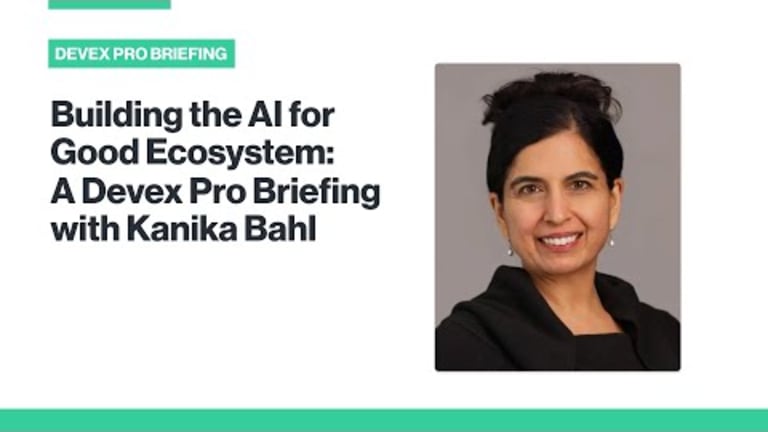
The road to hell is often paved with good intentions. Development is no different. And as my colleague Catherine Cheney explores in a new episode of her podcast series, for all the investment pouring into the “AI for good” movement, too many projects end up in “digital graveyards” — pilots that die before they reach people.
Kanika Bahl, the CEO of Evidence Action, argued that when it comes to “AI for good,” the development sector risks repeating a familiar pattern of innovation without scale.
That’s why she’s stepping down from Evidence Action to lead a new effort called the AI Access Initiative.
“We are at an exciting inflection point in ‘AI for good,’” Bahl said in an interview for Devex’s special edition podcast series, Global Progress in the AI Era. “There’s both early excitement and traction, and also many actors doing strong work in research, design, and building. But … much more work is needed to ensure scaled reach.”
And Bahl is ambitious in her scale: aiming to improve the lives of hundreds of millions of people.
But she described a core — and highly complicated — bottleneck standing in the way: “It’s actually fragmentation across policy, funding, benchmarking, last-mile delivery, and like any technology, frontier labs, frontier tools can’t solve distribution, trust, and regulatory gaps,” she explained.
In other words, without the right interlocking systems in place, promising pilots may never move beyond that promise.
Bahl sees parallels with her experiences at the Clinton Health Access Initiative, working on pediatric HIV treatments. Coordinated action between CHAI and others across the value chain — from manufacturers to donors to national health systems — ultimately drove prices down and accelerated uptake. That coordination can apply to AI as well.
“I think that is the type of coordinated action that you need to be seeing here to prevent the situation where great products are simply not being uptaken, a lot of money is potentially being spent, but with very low return,” she said.
Listen: Can a new effort scale ‘AI for good’ to reach hundreds of millions?
+ In a fast-moving sector, you can’t afford to miss the headlines on AI. We’ve gathered all of our coverage — from exclusive interviews with U.N. tech envoys to field reports on AI-driven health innovations — into one place. Stay ahead of the curve here.
Rising from the ashes
The debate over U.S. foreign assistance is an ongoing flashpoint, but there is life after USAID — and we’ve been profiling what that looks like for many former employees. For Siobhan Green, it meant returning to her entrepreneurial roots after working as a senior digital development adviser for USAID.
The result is Fenix Digital, a consultancy focused on leveraging digital technology for social good, set up by Green and 10 former USAID colleagues with expertise ranging from artificial intelligence to climate, connectivity, and digital government.
She was able to rely on her network of colleagues from USAID in the face of a highly competitive job market to launch something of her own. And like other consultancies that have sprung up following the layoffs, Fenix Digital has found monetizing those strong on-the-ground networks to be invaluable.
“The power of people’s networks in our community is just crazy, including really senior people across the world,” she says.
Read: How a former USAID staffer returned to entrepreneurship (Career)
+ The post-USAID job market is more competitive than ever, driving many development professionals toward consulting. But how do you turn a string of assignments into a stable, high-impact portfolio career? Join us on March 16 to learn how to build a diversified, high-influence portfolio career. Register now. This event is exclusively for Career Account members. Not yet a member? Start your 15-day free trial.
In other news
The U.S. is pushing the U.N. to reassess the budget of its mission in Afghanistan, raising concerns about additional cuts to aid programs while 4.7 million Afghans face emergency hunger. [Reuters]
Israel’s attacks on Iran’s oil infrastructure are producing mounting environmental damage to ecosystems across the region, which the experts warn will grow more severe and harder to quantify each day the war continues. [The Guardian]
Momentum is building behind Africa’s energy transition, with the Sustainable Energy Fund for Africa planning to more than double its financing to $2.5 billion within the next two years, supported by rising contributions seen last year. [AP News]
Sign up to Newswire for an inside look at the biggest stories in global development.
About the author

Anna Gawel
Anna Gawel is the Managing Editor of Devex. She previously worked as the managing editor of The Washington Diplomat, the flagship publication of D.C.’s diplomatic community. She’s had hundreds of articles published on world affairs, U.S. foreign policy, politics, security, trade, travel and the arts on topics ranging from the impact of State Department budget cuts to Caribbean efforts to fight climate change. She was also a broadcast producer and digital editor at WTOP News and host of the Global 360 podcast. She holds a journalism degree from the University of Maryland in College Park.
Search for articles


Most Read
- 1
- 2
- 3
- 4
- 5