
• News
    • Latest news
    • News search
    • Health
    • Finance
    • Food
    • Career news
    • Content series
    • Focus areas
    • Try Devex Pro
  • Jobs
    • Job search
    • Post a job
    • Employer search
    • CV Writing
    • Upcoming career events
    • Try Career Account
  • Funding
    • Funding search
    • Funding news
  • Talent
    • Candidate search
    • Devex Talent Solutions
  • Events
    • Upcoming and past events
    • Partner on an event
  • Post a job
  • About
      • About us
      • Membership
      • Newsletters
      • Advertising partnerships
      • Devex Talent Solutions
      • Contact us
Join DevexSign in
Join DevexSign in

News

  • Latest news
  • News search
  • Health
  • Finance
  • Food
  • Career news
  • Content series
  • Focus areas
  • Try Devex Pro

Jobs

  • Job search
  • Post a job
  • Employer search
  • CV Writing
  • Upcoming career events
  • Try Career Account

Funding

  • Funding search
  • Funding news

Talent

  • Candidate search
  • Devex Talent Solutions

Events

  • Upcoming and past events
  • Partner on an event
Post a job

About

  • About us
  • Membership
  • Newsletters
  • Advertising partnerships
  • Devex Talent Solutions
  • Contact us
  • My Devex
  • Update my profile % complete
  • Account & privacy settings
  • My saved jobs
  • Manage newsletters
  • Support
  • Sign out
Latest newsNews searchHealthFinanceFoodCareer newsContent seriesFocus areasTry Devex Pro
    • Career
    • Career

    How a former USAID staffer returned to entrepreneurship

    After being laid off from her dream job, one former USAID staffer made the pivot back to entrepreneurship, launching a small consulting firm with ex-colleagues.

    By Natalie Donback // 10 March 2026
    Siobhan Green had been a senior digital development adviser with the U.S. Agency for International Development for two years before being laid off in the agency-wide cuts of 2025. Prior to that, she ran her own small consultancy firm for 15 years, providing technology services to the likes of the United Nations, the federal government, and USAID — an experience that has proven invaluable in her return to building a business. “I'm back to being an entrepreneur, not because I decided I wanted to be an entrepreneur, but because it's actually a lot easier to create a job than to get a job in this market,” she said. Being laid off from her dream job in February 2025 has been difficult to process. To Green, the psychological toll of what she and many others have gone through shouldn’t be underestimated, including the sense of losing one’s identity. “We’ve not only seen the entire industry crumble and see everyone we know lose their jobs, [but] it’s also the moral injury that we see to topics that we deeply care about.” Luckily, she could rely on her network of former colleagues from USAID’s office of digital technology, who kept in touch about the difficulties of job seeking and what was happening in the sector. Faced with a highly competitive job market, and recognizing there was still domestic and international demand for the digital services and deep technical expertise they’d built, a group of them started exploring the idea of launching something on their own. Not to mention that “setting up your own company reflects better on your CV than just having been unemployed for a year,” she said. Back to entrepreneurship Fenix Digital, a consultancy focused on leveraging digital technology for social good, was established in May 2025 by Green and 10 former USAID colleagues with expertise ranging from artificial intelligence to climate, connectivity, and digital government. Some had spent their career in government, while others, including Green, had experience running a business. “Without that hands-on small business experience I don't think we would have gotten as far as we have,” she said. The group spent the summer defining its services and operational model. While many consultancies are set up on a ‘you get what you bring in’ basis, Fenix Digital opted for a collaborative approach. Each of the 11 equity members, including Green, who is the chief finance officer, has a role and owns a percentage in the LLC, meaning everyone contributes both cash and labor. “We actually have time cards so people get credit for the labor they put in, and that labor is tied to their role.” The team has different financial situations — some receive spousal benefits or a pension, while others have no other source of income. Green, still job hunting herself, said they’ve designed the workflow so others can cover for anyone who needs to step away. The company also counts on six advisers and a roster of 50 consultants specialized in different areas. A lot of time goes into what Green called “the road to revenue” or business development. “We can have all the conversations we want, but if there's no money at the end, it's not really business development, it's learning about the industry.” Since January, the group has done a big push to sign new contracts — and they’ve started to win work, including research on the financial sustainability and business models for digital public infrastructure, a topic Green was set to work on at USAID. Her advice is to find someone to sell your services to, and once you get the sale, start reaching out to your network to figure out how to do it. Like other consultancies that have sprung up following the layoffs, Fenix Digital has found monetizing strong on-the-ground relationships to be very valuable. “The power of people's networks in our community is just crazy, including really senior people across the world,” said Green, who has extensive ties in sub-Saharan Africa from her agency days. ‘Bootsrapy and nimble’ One advantage of a small company is that you can be “bootstrapy and nimble”. Everyone works from home, saving on large overhead costs, while other cost-minimizing strategies include Green rebranding the code from her old company website and the use of free time management systems. AI has also helped save the team time and money in developing some of the company's standard policies or drafting initial language for the website or pitch decks. The pivot from being a bureaucrat at a large organization, where roles are clearly defined and solutions often prescribed, to being an entrepreneur has required a big mindset shift for many. “When you become an entrepreneur, you have no restrictions. You can do what you want to. That's scary as hell and it's really hard sometimes to get people out of that mindset of ‘but what am I allowed to do?’.” Green has also learned the value of what she called “ruthless prioritization.” Faced with countless potential tasks — from drafting cybersecurity policies to market research — it’s about asking ‘what’s the one thing I’m going to do today that’s going to get me revenue, get me cash in my pocket?’” This prioritization technique also applies to deciding which work to take on. Saying yes to one job might mean having to turning down something else that comes along, she explained, and for every job you have to ask, “Is the juice worth the squeeze?” One of Green’s mantras throughout the last months has been that you learn more from your mistakes than your successes. “I have the equivalent of about four PhDs at this point,” she said.

    Related Stories

    How a former USAID staffer created a network of security experts
    How a former USAID staffer created a network of security experts
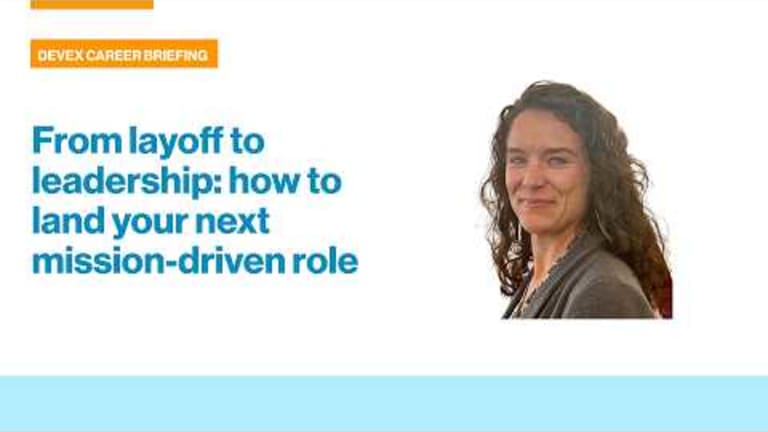
    How to land your next mission-driven role, from someone who's done it
    How to land your next mission-driven role, from someone who's done it
    Devex Career Hub: How and where to develop AI skills
    Devex Career Hub: How and where to develop AI skills
    They lost their jobs in 2025. Here’s how they pivoted
    They lost their jobs in 2025. Here’s how they pivoted

    Siobhan Green had been a senior digital development adviser with the U.S. Agency for International Development for two years before being laid off in the agency-wide cuts of 2025. Prior to that, she ran her own small consultancy firm for 15 years, providing technology services to the likes of the United Nations, the federal government, and USAID — an experience that has proven invaluable in her return to building a business. “I'm back to being an entrepreneur, not because I decided I wanted to be an entrepreneur, but because it's actually a lot easier to create a job than to get a job in this market,” she said.

    Being laid off from her dream job in February 2025 has been difficult to process. To Green, the psychological toll of what she and many others have gone through shouldn’t be underestimated, including the sense of losing one’s identity. “We’ve not only seen the entire industry crumble and see everyone we know lose their jobs, [but] it’s also the moral injury that we see to topics that we deeply care about.”

    Luckily, she could rely on her network of former colleagues from USAID’s office of digital technology, who kept in touch about the difficulties of job seeking and what was happening in the sector. Faced with a highly competitive job market, and recognizing there was still domestic and international demand for the digital services and deep technical expertise they’d built, a group of them started exploring the idea of launching something on their own. Not to mention that “setting up your own company reflects better on your CV than just having been unemployed for a year,” she said.

    This article is exclusively for Career Account members.

    Unlock this article now with a 15-day free trial of a Devex Career Account. With a Career Account subscription you will get:

    • Full access to our jobs board, including over 1,000 exclusive jobs
    • Your Devex profile highlighted in recruiter search results
    • Connections to recruiters and industry experts through online and live Devex events
    Start my 15-day free trial
    Already a user? Sign in

    More reading:

    ► How a former USAID staffer created a network of security experts

    ► 6 avenues open to someone who lost their job due to the USAID crisis

    ► How the talent landscape may shift post-USAID

    • Careers & Education
    • Innovation & ICT
    • Private Sector
    • United States Agency for International Development (USAID)
    Printing articles to share with others is a breach of our terms and conditions and copyright policy. Please use the sharing options on the left side of the article. Devex Pro members may share up to 10 articles per month using the Pro share tool ( ).

    About the author

    • Natalie Donback

      Natalie Donback

      Natalie Donback is a freelance journalist and editor based in Barcelona, where she covers climate change, global health, and the impact of technology on communities. Previously, she was an editor and reporter at Devex, covering aid and the humanitarian sector. She holds a bachelor’s degree in development studies from Lund University and a master’s in journalism from the University of Barcelona and Columbia Journalism School.

    Search for articles

    Related Stories

    CareerRelated Stories - How a former USAID staffer created a network of security experts

    How a former USAID staffer created a network of security experts

    Devex Career EventsRelated Stories - How to land your next mission-driven role, from someone who's done it

    How to land your next mission-driven role, from someone who's done it

    Devex Career HubRelated Stories - Devex Career Hub: How and where to develop AI skills

    Devex Career Hub: How and where to develop AI skills

    CareerRelated Stories - They lost their jobs in 2025. Here’s how they pivoted

    They lost their jobs in 2025. Here’s how they pivoted

    Most Read

    • 1
      Ending HIV globally requires action in Eastern Europe and Central Asia
    • 2
      How the global south can finance AI infrastructure on its own terms
    • 3
      Inside the USAID closeout mess
    • 4
      Exclusive: US seeks to scrap UN efforts to expand women's rights
    • 5
      One year on: Is Africa’s surgical equity push delivering real change?
    • News
    • Jobs
    • Funding
    • Talent
    • Events

    Devex is the media platform for the global development community.

    A social enterprise, we connect and inform over 1.3 million development, health, humanitarian, and sustainability professionals through news, business intelligence, and funding & career opportunities so you can do more good for more people.

    • About us
    • Membership
    • Newsletters
    • Advertising partnerships
    • Devex Talent Solutions
    • Post a job
    • Careers at Devex
    • Contact us
    © Copyright 2000 - 2026 Devex|User Agreement|Privacy Statement